631~675 item / All 685 items
Displayed results
Filter by category

Added to bookmarks
Bookmarks listBookmark has been removed
Bookmarks listYou can't add any more bookmarks
By registering as a member, you can increase the number of bookmarks you can save and organize them with labels.
Free membership registration
Contact this company
Contact Us Online631~675 item / All 685 items
Filter by category

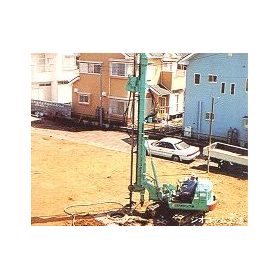
This is a soil-cement column method (deep mixing method) that uses a stepped steel pipe as the core material, which has obtained the architectural technology performance certification (GBRC Performance Certification No. 06-12 Revision 4) from the Japan Architectural Comprehensive Testing Institute, a general incorporated foundation. It is a high-performance hybrid method that combines the stable material strength of steel pipe pile methods with the large friction force of column methods, compensating for the disadvantages of each method, such as the variability in the strength characteristics of the columns and the small friction force of small-diameter steel pipe piles, thereby ensuring reliable high load-bearing capacity. Due to the core material effect, it prevents stress concentration at the head and supports the load along the entire length, significantly improving resistance to bending and shear forces during earthquakes, and minimizing the impact even if localized solidification issues occur.
Added to bookmarks
Bookmarks listBookmark has been removed
Bookmarks listYou can't add any more bookmarks
By registering as a member, you can increase the number of bookmarks you can save and organize them with labels.
Free membership registration
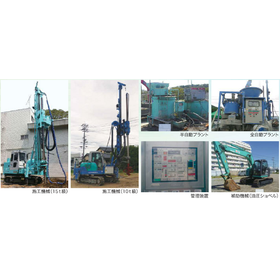
This is a ground improvement method that involves mechanically mixing cement milk and the soil of the original ground to a specified depth, creating a strong columnar improvement body underground. Due to the large diameter of the improvement body, it is expected to provide excellent lateral friction, ensuring effective settlement prevention even in very soft underlying ground with an equivalent N value of around 4. It can be widely adapted to thick soft layers, reliably transmitting the building's load to stable ground and supporting it from below. During construction, a construction machine equipped with multiple measuring devices is used, offering high-quality construction accuracy based on reliable engineering evidence and high reliability through strict quality control.
Added to bookmarks
Bookmarks listBookmark has been removed
Bookmarks listYou can't add any more bookmarks
By registering as a member, you can increase the number of bookmarks you can save and organize them with labels.
Free membership registration
This is a slurry-based mechanical mixing deep mixing treatment method that has obtained the Architectural Technical Performance Certification from the Japan Architecture Comprehensive Testing Institute (GBRC Performance Certification No. 12-17 Revision 1). It achieves extremely stable mixing performance with minimal variation, unaffected by soil type, thanks to a patented, uniquely developed mixing and stirring device. Numerous performance verification tests conducted on sandy soil, clay, and loam have demonstrated a reliable high quality with a coefficient of variation of 25% or less, providing highly reliable construction based on technical guidelines. Additionally, due to the small markup factor for quality control, excessive material usage can be suppressed, and strict quality inspections can be conducted at minimal cost by adopting "Inspection Method A" as a principle.
Added to bookmarks
Bookmarks listBookmark has been removed
Bookmarks listYou can't add any more bookmarks
By registering as a member, you can increase the number of bookmarks you can save and organize them with labels.
Free membership registration
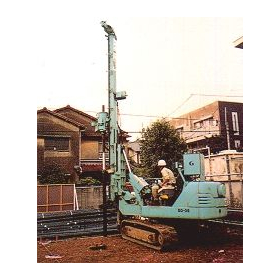
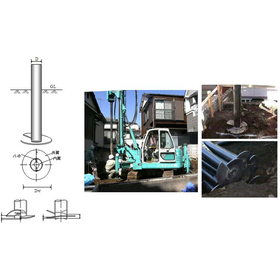
This is a highly reliable pile foundation reinforcement method for small-scale buildings, including residential structures. It features a new spiral-shaped tip wing integrated with four excavation blades at the tip, allowing it to penetrate the ground while rotating. The rotary insertion construction minimizes vibration and noise, and it establishes an environmentally friendly design that generates no excavated soil (residual soil) during construction. Furthermore, by adopting an improved tapered tip wing, it allows for the selection of several types of steel pipes for a single tip structure, successfully achieving dramatic cost reductions and economical design while maintaining high construction performance and safety.
Added to bookmarks
Bookmarks listBookmark has been removed
Bookmarks listYou can't add any more bookmarks
By registering as a member, you can increase the number of bookmarks you can save and organize them with labels.
Free membership registration
The "SMD (Super Mini Drill) Pile Method," which has received certification from the Ministry of Land, Infrastructure, Transport and Tourism, utilizes steel pipe piles equipped with outer wings that are 2 to 3 times the diameter of the pile at the tip, along with unique inner wings and bites. During the rotary penetration, the tip is open, allowing soil to enter the steel pipe, which helps suppress misalignment during construction. Upon completion of penetration, the inner wings compact the soil inside firmly, achieving a high bearing capacity equivalent to complete closure, with a tip bearing capacity coefficient of α = 250. This method is a high-quality and eco-friendly foundation technique that generates no construction waste above ground, thereby eliminating industrial waste and reducing environmental impact and the risk of secondary pollution.
Added to bookmarks
Bookmarks listBookmark has been removed
Bookmarks listYou can't add any more bookmarks
By registering as a member, you can increase the number of bookmarks you can save and organize them with labels.
Free membership registration
This is a type of piled raft foundation method that has obtained the architectural technical performance certification (Performance Evaluation No. 04-02) from the Japan Architectural Comprehensive Testing Institute. It involves driving pipes (thin steel pipes) into weak ground, enhancing the bearing capacity through the combined action of the ground and the pipes, and preventing building settlement. Although this method arranges the pipes in a pile-like manner, it is categorized as a planar ground reinforcement method similar to "surface improvement methods" due to the close placement of the pipes rather than being a pile reinforcement. The design, construction, and supervision are centralized under the "Single-Family Housing Foundation Ground Reinforcement Research Association," and a reliable quality management system is provided under the guidance of Soil Design Office Co., Ltd.
Added to bookmarks
Bookmarks listBookmark has been removed
Bookmarks listYou can't add any more bookmarks
By registering as a member, you can increase the number of bookmarks you can save and organize them with labels.
Free membership registration
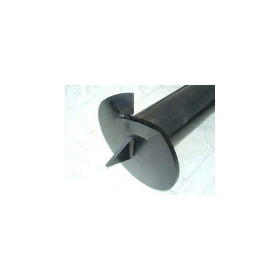
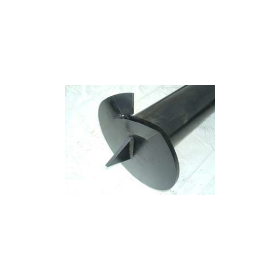
The ETP method is a type of rotary driven steel pipe pile construction that features a tip with a disc-shaped wing and a triangular excavation auxiliary bit. It has received certification from the Minister of Land, Infrastructure, Transport and Tourism (for sandy soil: TACP-0665, for clayey soil: TACP-0666) and a performance certification from the General Incorporated Foundation Japan Building Disaster Prevention Association (GBRC Performance Certification No. 12-20 Rev. 4), ensuring high bearing capacity and smooth construction. By avoiding the use of cement, it mitigates the risk of soil and groundwater contamination, and the no-excavation construction eliminates the need for soil disposal costs. Additionally, it allows for the removal of piles through reverse rotation and employs compact machinery, enabling low-noise and low-vibration construction, thus achieving an economical design and construction that considers the surrounding environment.
Added to bookmarks
Bookmarks listBookmark has been removed
Bookmarks listYou can't add any more bookmarks
By registering as a member, you can increase the number of bookmarks you can save and organize them with labels.
Free membership registration
This is an environmentally friendly ground reinforcement method using advanced winged steel pipes, which has obtained the architectural technical performance certification from the Japan Architectural Comprehensive Testing Institute (GBRC Performance Certification No. 09-19 Revision 5). It employs steel pipe piles equipped with disc-shaped wings at the ends, enhancing penetration by providing 30mm notches above and below the wings, and effectively suppressing deviation during construction with the aid of a drilling assist bit at the tip. Ground surveys are typically conducted using the Screw Weight Penetration Test (SWS Test), and in cases where the supporting layer is deep or the ground is difficult to penetrate, a large dynamic cone penetration test (SRS Test) can be accurately employed. This method offers a clean, environmentally friendly solution with low vibration, low noise, and no generation of residual soil.
Added to bookmarks
Bookmarks listBookmark has been removed
Bookmarks listYou can't add any more bookmarks
By registering as a member, you can increase the number of bookmarks you can save and organize them with labels.
Free membership registration
This is a pile-type ground reinforcement method using small-diameter steel pipes that has received the architectural technology performance certification (GBRC Performance Certification No. 10-01) from the Japan Architectural Institute Foundation. A cast iron spiral wing (tip wing) is attached to the tip of the small-diameter steel pipe, and it is rotated and driven into the ground using a non-discharging construction method with rotation torque. Since the tip wing and steel pipe are bolted together, the welding strength does not limit the bearing capacity. The construction is low-noise and low-vibration, taking into consideration the surrounding environment, and since it does not use cement milk, there are no costs for residual soil disposal. The entire process from component manufacturing to transportation and construction has been thoroughly reviewed, achieving both high performance and excellent economic efficiency.
Added to bookmarks
Bookmarks listBookmark has been removed
Bookmarks listYou can't add any more bookmarks
By registering as a member, you can increase the number of bookmarks you can save and organize them with labels.
Free membership registration
We provide evidence-based ground reinforcement construction that meets the needs of professionals involved in design and construction. Our company covers a diverse range of methods, including cement-based columns, steel pipe piles, and high-performance hybrid methods that combine these techniques, all of which have obtained building technology performance certifications and ministerial approvals. The biggest feature is the "optimal selection of methods" tailored to soil quality, surrounding environment, and structural loads. For example, we compare and examine the technical advantages of methods such as the Pure Pile method, which prevents soil mixing; the Tiger Pile method, which addresses humus soil; and the DM/ETP method, which minimizes environmental impact and excess soil costs without soil discharge, to derive the most economical and reliable design. By proposing a rational plan that thoroughly eliminates risks from an engineer's perspective, without biasing towards a single method, we strongly support your company's smooth project progress and ensure reliable quality management without setbacks.
Added to bookmarks
Bookmarks listBookmark has been removed
Bookmarks listYou can't add any more bookmarks
By registering as a member, you can increase the number of bookmarks you can save and organize them with labels.
Free membership registration
Are you having trouble disposing of the excess soil generated from construction work (such as construction-generated soil and root excavation soil)? Geotech provides reliable soil analysis that complies with the standards and regulations of receiving sites. As a designated investigation agency under the Soil Contamination Countermeasures Act, we propose optimal sampling and analysis methods tailored to the regulations of the receiving sites. With accurate analysis, we help avoid troubles, ensure a smooth handover of safe land, and support the smooth progress of construction with appropriate cost estimation.
Added to bookmarks
Bookmarks listBookmark has been removed
Bookmarks listYou can't add any more bookmarks
By registering as a member, you can increase the number of bookmarks you can save and organize them with labels.
Free membership registration
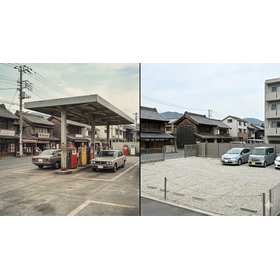
At gas stations, harmful substances related to oils and fats, such as benzene, which is a component of gasoline, boron derived from engine oil and coolant, and lead resulting from past use of leaded gasoline, have been handled. These substances pose a risk of leakage from fuel dispensers and underground tanks, making them important items in soil contamination investigations. In our survey, we thoroughly investigate the operational history and actual usage on the site to accurately assess the invisible underground risks.
Added to bookmarks
Bookmarks listBookmark has been removed
Bookmarks listYou can't add any more bookmarks
By registering as a member, you can increase the number of bookmarks you can save and organize them with labels.
Free membership registration
In the printing and binding industry, there is a possibility that chemical substances such as solvents have been used in past business activities, leading to concerns about soil contamination. Particularly when considering the sale or purchase of land or the establishment of new business locations, it is important to understand the presence or absence of soil contamination in advance to reduce future risks. Historical investigations involve researching how the land being considered for purchase was used in the past through old maps and registries, thereby evaluating the potential for soil contamination. 【Usage Scenarios】 - Risk assessment before land purchase - Investigation of former factory sites or old business locations - Compliance with environmental regulations - Confirmation of soil contamination during business succession 【Benefits of Implementation】 - Early detection of soil contamination risks and planning of countermeasures - Avoidance of unnecessary troubles and costs - Smooth facilitation of land transactions - Assurance of business continuity
Added to bookmarks
Bookmarks listBookmark has been removed
Bookmarks listYou can't add any more bookmarks
By registering as a member, you can increase the number of bookmarks you can save and organize them with labels.
Free membership registrationIn the electronic components manufacturing industry, there may be concerns about the emission of fluorocarbons during the manufacturing process and the risk of soil contamination due to past land use. These contaminations become significant issues in responding to environmental regulations and future land use planning. Conducting appropriate soil contamination investigations and understanding the risks is essential for compliance and business continuity. GeoTech's soil investigation services provide tailored investigation plans and risk assessments based on customer needs, and in the event that contamination is discovered, we offer consistent consulting up to remediation measures as a designated investigation agency. 【Usage Scenarios】 - Soil contamination risk assessment for factory sites and planned new construction sites - Regular soil monitoring for compliance with environmental regulations - Investigation of land with a history of fluorocarbon use 【Benefits of Implementation】 - Early detection of environmental risks and implementation of appropriate measures - Ensuring business continuity through compliance with legal regulations - Contributing to the maintenance and enhancement of land asset value
Added to bookmarks
Bookmarks listBookmark has been removed
Bookmarks listYou can't add any more bookmarks
By registering as a member, you can increase the number of bookmarks you can save and organize them with labels.
Free membership registrationIn the printing industry, there are many opportunities to use chemical substances such as solvents in business activities, raising concerns about the risk of soil contamination. In the event that soil contamination occurs, there will be impacts on business continuity and a need for environmental consideration. GeoTech's soil contamination surveys are planned according to customer requests and survey objectives, ranging from historical investigations to detailed surveys, and appropriate risk assessments are conducted. As a designated survey organization, we provide consistent consulting services, including assistance with remediation measures if soil contamination is identified. 【Usage Scenarios】 - Historical investigations within factory premises - Regular checks of environmental risks - Understanding soil conditions during relocation or sale - Confirming the absence of impacts on neighboring areas 【Benefits of Implementation】 - Early detection of potential soil contamination risks - Compliance with laws and regulations and response to environmental conservation - Support for the development of business continuity plans (BCP) - Maintaining trust from the local community
Added to bookmarks
Bookmarks listBookmark has been removed
Bookmarks listYou can't add any more bookmarks
By registering as a member, you can increase the number of bookmarks you can save and organize them with labels.
Free membership registrationIn the metal refining industry, managing the risks of soil contamination due to heavy metals associated with business activities is of great importance. It is particularly necessary to accurately assess whether there is any impact on the soil in operational areas and based on historical records, and to implement appropriate measures. Early confirmation of the presence or absence of soil contamination and reducing future environmental risks are essential for the sustainability of companies and coexistence with local communities. Geotech's soil contamination surveys respond to the needs of the metal refining industry by providing accurate risk assessments and consulting. 【Usage Scenarios】 - Understanding the heavy metal contamination status within business premises - Preliminary surveys for new business site locations - Contamination risk assessments based on past operational history - Investigations for compliance with environmental regulations 【Benefits of Implementation】 - Early detection and reduction of soil contamination risks - Support for planning appropriate remediation measures - Strengthening environmental compliance - Maintenance and enhancement of corporate value
Added to bookmarks
Bookmarks listBookmark has been removed
Bookmarks listYou can't add any more bookmarks
By registering as a member, you can increase the number of bookmarks you can save and organize them with labels.
Free membership registrationIn the chemical industry, risk assessment of soil contamination associated with operations is crucial. It is necessary to understand the impact of past business activities and the surrounding environment, and to manage future environmental risks appropriately. Accurately assessing the presence and extent of soil contamination is essential not only for legal compliance but also for building trust with the local community. Geotech's soil investigation services provide appropriate risk assessments based on specialized knowledge to support the continuity of your business. 【Usage Scenarios】 - Risk assessment of soil contamination within factory premises - Environmental impact assessment before the construction of new business sites - Verification of soil contamination based on past operational history - Regular soil investigations for legal compliance 【Benefits of Implementation】 - Early detection of potential soil contamination risks - Support for the development of appropriate risk management plans - Strengthening of environmental compliance - Contribution to the formulation of business continuity plans (BCP)
Added to bookmarks
Bookmarks listBookmark has been removed
Bookmarks listYou can't add any more bookmarks
By registering as a member, you can increase the number of bookmarks you can save and organize them with labels.
Free membership registration
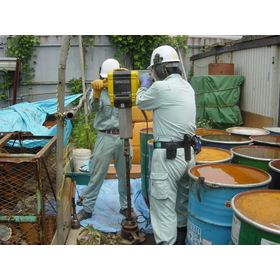
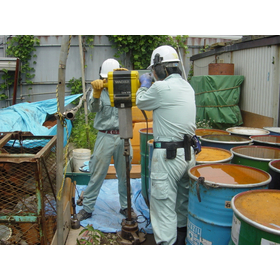
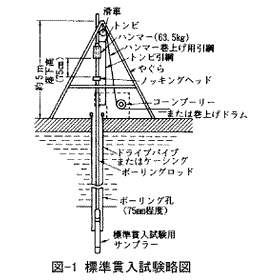
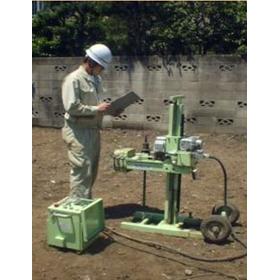
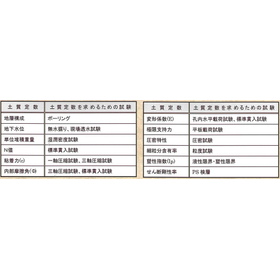
This is the most commonly conducted ground investigation during the design and construction of building works. By excavating the investigation site and directly observing the soil, the stratification is clarified. To understand the hardness and compaction of the soil in its natural state, a standard penetration test is conducted to measure the N value. Additionally, it accommodates in-situ tests such as in-hole horizontal loading tests using boreholes, as well as sampling of undisturbed soil samples.
Added to bookmarks
Bookmarks listBookmark has been removed
Bookmarks listYou can't add any more bookmarks
By registering as a member, you can increase the number of bookmarks you can save and organize them with labels.
Free membership registration
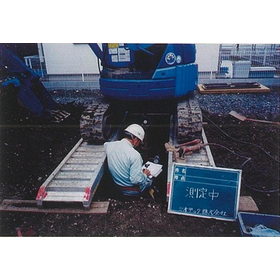
This is a ground survey targeting small-scale buildings, combining hand auger boring with the Swedish Weight Sounding (SWS) test. In addition to measurements from the SWS, the soil conditions directly beneath the foundation base are actually verified. By combining soil information such as clay, sandy soil, humus soil, and loam with SWS data, the accuracy of predicting ground subsidence is significantly improved, enabling the determination of appropriate foundation specifications and the reliable design of ground reinforcement works in soft ground.
Added to bookmarks
Bookmarks listBookmark has been removed
Bookmarks listYou can't add any more bookmarks
By registering as a member, you can increase the number of bookmarks you can save and organize them with labels.
Free membership registration
This is an indoor testing service conducted using collected samples for the purpose of various examinations and the setting of soil parameters required during the design phase of construction work. A sampler is lowered from the bottom of the borehole, and by applying a penetration load, "undisturbed samples" are obtained for indoor soil tests, including mechanical tests. By accurately measuring and analyzing reliable soil data, we provide high-quality soil parameters that serve as a basis for advanced structural design, such as liquefaction assessment and consolidation settlement calculations.
Added to bookmarks
Bookmarks listBookmark has been removed
Bookmarks listYou can't add any more bookmarks
By registering as a member, you can increase the number of bookmarks you can save and organize them with labels.
Free membership registration
This is a ground investigation service that applies a load through a rigid loading plate on the original ground and precisely examines the relationship between the magnitude of the load and the amount of settlement of the loading plate to investigate the bearing capacity characteristics such as ground deformation and strength. A significant advantage is that it directly measures the foundation ground of structures, making the obtained results easy to understand. By providing reliable in-situ data, it strongly supports safe and reliable decision-making in design and construction for construction projects.
Added to bookmarks
Bookmarks listBookmark has been removed
Bookmarks listYou can't add any more bookmarks
By registering as a member, you can increase the number of bookmarks you can save and organize them with labels.
Free membership registration
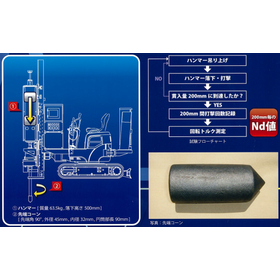
The Automatic Ram Sounding test has a high correlation with the N value and allows for high-precision investigations as a complementary survey to standard penetration tests and SWS tests. The Automatic Ram Sounding test is one of the dynamic cone penetration tests, with a relatively simple investigation method and a penetration capacity of around N value 50, enabling continuous data collection (Nd values) every 200 mm. Additionally, a high correlation has been observed between Nd values and the N values from standard penetration tests.
Added to bookmarks
Bookmarks listBookmark has been removed
Bookmarks listYou can't add any more bookmarks
By registering as a member, you can increase the number of bookmarks you can save and organize them with labels.
Free membership registration
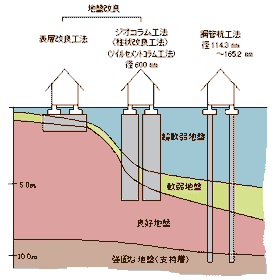
Geo-column method Surface improvement method Small diameter steel pipe pile method ETP method SMD steel pipe pile method ETP-G method RES-P method Tiger pile Σ-i method DM method Pure pile method Cross-wing column method
Added to bookmarks
Bookmarks listBookmark has been removed
Bookmarks listYou can't add any more bookmarks
By registering as a member, you can increase the number of bookmarks you can save and organize them with labels.
Free membership registration
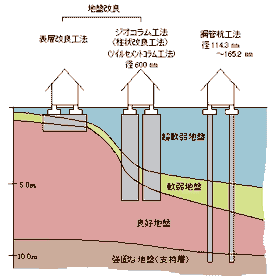
A method of injecting and mixing cement milk (a mixture of cement-based solidifying material and water) into soft ground to create columnar improved piles underground. This method is applicable when the soft layer extends from GL-2.0m to approximately GL-8.0m. However, it is not applicable in cases where most of the soft layer consists of humus soil, where industrial or household waste is accumulated, where there is groundwater, or where buildings are constructed immediately after earthworks on former marshland. Good ground for determining the improvement depth is defined as a continuous layer of cohesive soil with an N value greater than 3, or granular soil with an N value greater than 4.
Added to bookmarks
Bookmarks listBookmark has been removed
Bookmarks listYou can't add any more bookmarks
By registering as a member, you can increase the number of bookmarks you can save and organize them with labels.
Free membership registration
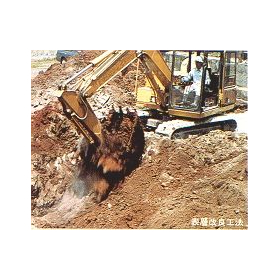
A method that involves spreading cement-based solidifying materials on soft ground, mixing, stirring, and compacting them with the original soil to create a slab-like solidified body. This method is applicable when the soft layer is distributed at a depth of GL-2.0m or shallower. However, it is not applicable if there is a water level within the improvement depth that makes mixing and stirring difficult, or if the improvement area extends to neighboring properties or roads, raising concerns about impacts on boundary blocks, neighboring houses, roads, etc. Good ground for determining the improvement depth is generally defined as a continuous layer of cohesive soil with an N value greater than 3 for cohesive soil and greater than 4 for granular soil.
Added to bookmarks
Bookmarks listBookmark has been removed
Bookmarks listYou can't add any more bookmarks
By registering as a member, you can increase the number of bookmarks you can save and organize them with labels.
Free membership registration
A support pile method using general structural carbon steel pipes STK-400 to support small-scale houses when the column improvement method cannot be applied, and when the building's load is supported only by the tip of the pile. This method is applicable when soft layers continue to a depth of GL-8.0m or more. In the case of steel pipe pile methods, there is a relationship between the building and the surrounding ground, and if adopted in areas where extreme ground subsidence occurs, it may lead to the phenomenon of the building lifting up (such as when embankment is done on extremely soft ground or ground with thick deposits of humus). The supporting ground for determining the length of the steel pipe pile is defined as having an N value of ≧15. The thickness of the supporting ground layer should, in principle, be continuous for more than 2.0m.
Added to bookmarks
Bookmarks listBookmark has been removed
Bookmarks listYou can't add any more bookmarks
By registering as a member, you can increase the number of bookmarks you can save and organize them with labels.
Free membership registration
When planning a basement for structures that exceed the design ground bearing capacity of 30 kN/m² → When it is necessary to embed the foundation to the angle of repose (30° line) For structures that are difficult to approve with ground improvement and would be over-spec with PC piles → Steel-framed buildings of 3 to 4 stories / retaining walls with a design ground bearing capacity of less than 100 kN/m², etc.
Added to bookmarks
Bookmarks listBookmark has been removed
Bookmarks listYou can't add any more bookmarks
By registering as a member, you can increase the number of bookmarks you can save and organize them with labels.
Free membership registration
Leading Edge Wing Easy to penetrate with a simple shape. Design possible with simple testing Design possible with SWS testing and ram sounding testing. Low noise, low vibration, and no spoil, environmentally friendly Extremely low vibration and noise, considerate of the surrounding environment, with no generation of residual soil, making it an environmentally friendly clean construction method.
Added to bookmarks
Bookmarks listBookmark has been removed
Bookmarks listYou can't add any more bookmarks
By registering as a member, you can increase the number of bookmarks you can save and organize them with labels.
Free membership registration
The RES-P method is a type of piled raft foundation method. It involves driving pipes (thin steel tubes) into weak ground, strengthening the ground through the combined effect of the ground and the pipes to prevent settlement, and is a foundation reinforcement method for residential buildings.
Added to bookmarks
Bookmarks listBookmark has been removed
Bookmarks listYou can't add any more bookmarks
By registering as a member, you can increase the number of bookmarks you can save and organize them with labels.
Free membership registration
The Tiger Pile method combines the stable material strength of steel pipe pile methods with the large frictional force of soil cement column methods, compensating for the variability in column strength that is a disadvantage of the soil column cement method with the steel pipe, while the soil cement column method compensates for the small frictional force that is a disadvantage of the steel pipe pile method, effectively canceling out the shortcomings of both methods and demonstrating high bearing capacity.
Added to bookmarks
Bookmarks listBookmark has been removed
Bookmarks listYou can't add any more bookmarks
By registering as a member, you can increase the number of bookmarks you can save and organize them with labels.
Free membership registration
Compatible with all types of ground The Σ-i method is a highly versatile ground reinforcement technique that is compatible with all types of ground, including sandy, gravelly, and clayey soils. Design using the converted N values from SWS tests (screw weight penetration tests) and ram sounding tests is possible.
Added to bookmarks
Bookmarks listBookmark has been removed
Bookmarks listYou can't add any more bookmarks
By registering as a member, you can increase the number of bookmarks you can save and organize them with labels.
Free membership registration
High-performance steel pipes are equipped with tip wings that are 3.0 times and 3.5 times the diameter of the steel pipe at the tip, suitable for clayey and sandy ground with equivalent N values of 5 to 15. Design using the equivalent N values from the SWS test (screw weight penetration test) is possible.
Added to bookmarks
Bookmarks listBookmark has been removed
Bookmarks listYou can't add any more bookmarks
By registering as a member, you can increase the number of bookmarks you can save and organize them with labels.
Free membership registration
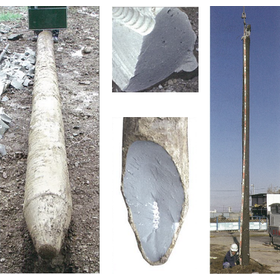
The Pure Pile Method (PP Method) uses a drilling rod equipped with a conical-shaped excavation head to excavate while pushing the ground laterally, constructing a pile-like column by replacing it with cement milk up to the support depth.
Added to bookmarks
Bookmarks listBookmark has been removed
Bookmarks listYou can't add any more bookmarks
By registering as a member, you can increase the number of bookmarks you can save and organize them with labels.
Free membership registration
High quality It is a reliable quality backed by numerous experimental results. Performance confirmation tests conducted on sandy soil, clayey soil, and loam have confirmed that the coefficient of variation is below 25%. Since the variability setting values have been obtained through performance confirmation tests, quality inspection is primarily conducted using "Inspection Method A." We will carry out highly reliable construction based on the technical guidelines of this method.
Added to bookmarks
Bookmarks listBookmark has been removed
Bookmarks listYou can't add any more bookmarks
By registering as a member, you can increase the number of bookmarks you can save and organize them with labels.
Free membership registration
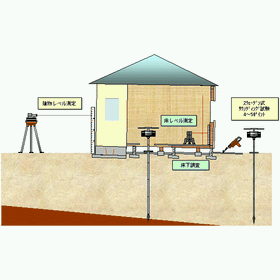
Survey Details Building Level Measurement (Perimeter) SWS Test (Screw Weight Penetration Test) (4-7 Points)
Added to bookmarks
Bookmarks listBookmark has been removed
Bookmarks listYou can't add any more bookmarks
By registering as a member, you can increase the number of bookmarks you can save and organize them with labels.
Free membership registration
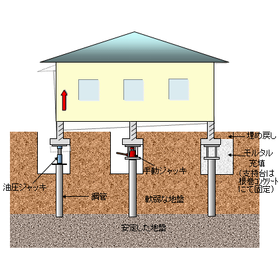
The steel pipe pile driving method is a technique that uses jacks to press steel pipe piles into the supporting ground, allowing the building's load to be supported and adjusted.
Added to bookmarks
Bookmarks listBookmark has been removed
Bookmarks listYou can't add any more bookmarks
By registering as a member, you can increase the number of bookmarks you can save and organize them with labels.
Free membership registration
The tilting and sinking of buildings occur due to insufficient ground support caused by topographical and human factors, and there has been a tendency for this to increase in recent years. i-LIFT method (i-LIFT construction method) patent application: 2003-430063
Added to bookmarks
Bookmarks listBookmark has been removed
Bookmarks listYou can't add any more bookmarks
By registering as a member, you can increase the number of bookmarks you can save and organize them with labels.
Free membership registration
The decision on the method for settlement correction and its implementation will be made based on a site survey, taking into consideration the following points: - Site conditions (slope situation, condition of existing structures, foundation and exterior conditions, ground data, buried objects, etc.) - Whether the settlement is ongoing or has stabilized. - Whether to carry out a full correction under the foundation (for the purpose of preventing re-settlement) or a partial correction.
Added to bookmarks
Bookmarks listBookmark has been removed
Bookmarks listYou can't add any more bookmarks
By registering as a member, you can increase the number of bookmarks you can save and organize them with labels.
Free membership registration
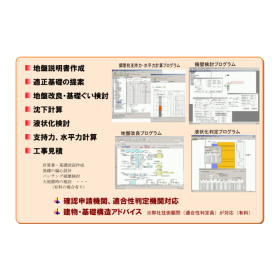
This is a service where specialized engineers in foundation ground support the design. We comply with legal regulations, various standards, guidelines, and other specialized requirements.
Added to bookmarks
Bookmarks listBookmark has been removed
Bookmarks listYou can't add any more bookmarks
By registering as a member, you can increase the number of bookmarks you can save and organize them with labels.
Free membership registration
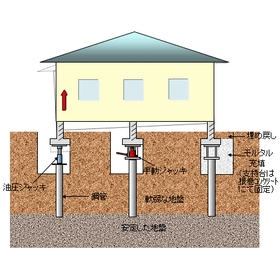
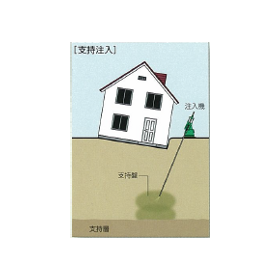
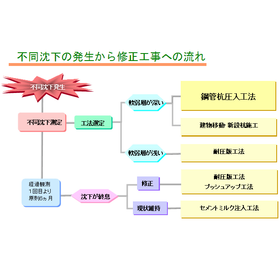
We provide settlement correction work to restore tilted houses that have experienced differential settlement. In the most commonly used steel pipe pile driving method, the building's load is used as a reaction force to drive steel pipe piles into the supporting ground using jacks, thereby supporting and correcting the entire building. This method not only corrects the settlement of the building but also prevents further settlement. Additionally, we select and implement the most suitable method from options such as pressure slab method, building relocation and new pile construction, and cement milk injection method, according to the ground conditions and the state of settlement.
Added to bookmarks
Bookmarks listBookmark has been removed
Bookmarks listYou can't add any more bookmarks
By registering as a member, you can increase the number of bookmarks you can save and organize them with labels.
Free membership registration
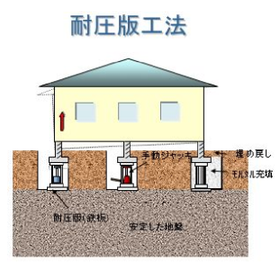
This is a subsidence correction work for buildings that have experienced differential settlement, aimed at restoring tilted houses. In the pressure plate method, a pressure plate (steel plate) is installed on stable ground, and the tilt of the building is precisely corrected using adjustment jacks and other tools. After the correction through jack-up, strong measures such as fixing with adjustment wheels, backfilling, and mortar filling are carried out to properly support the building's load and restore a safe living environment.
Added to bookmarks
Bookmarks listBookmark has been removed
Bookmarks listYou can't add any more bookmarks
By registering as a member, you can increase the number of bookmarks you can save and organize them with labels.
Free membership registration
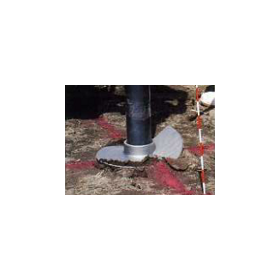
The ETP method is a type of rotary penetration steel pipe pile with a tip wing, which is driven into the ground by rotating a steel pipe that has a triangular excavation auxiliary blade with a circular enlarged base welded to its tip.
Added to bookmarks
Bookmarks listBookmark has been removed
Bookmarks listYou can't add any more bookmarks
By registering as a member, you can increase the number of bookmarks you can save and organize them with labels.
Free membership registration
At Geotech, we plan investigations tailored to your needs, ranging from historical and simple soil surveys to detailed investigations, and provide appropriate risk assessments. In the unlikely event that soil contamination is discovered, we offer assistance with remediation measures, providing consistent consulting as a designated investigation agency. For more details, please contact us.
Added to bookmarks
Bookmarks listBookmark has been removed
Bookmarks listYou can't add any more bookmarks
By registering as a member, you can increase the number of bookmarks you can save and organize them with labels.
Free membership registration
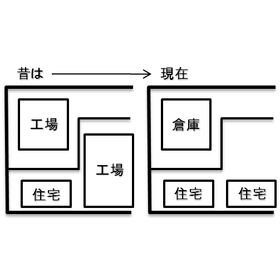
There is an increasing number of cases where historical investigations are conducted to dispel concerns about soil contamination during land transactions. A historical investigation is a service that examines how the land being considered for purchase was used in the past, using old maps and land registries, in order to assess the potential for soil contamination.
Added to bookmarks
Bookmarks listBookmark has been removed
Bookmarks listYou can't add any more bookmarks
By registering as a member, you can increase the number of bookmarks you can save and organize them with labels.
Free membership registration
"Settlement correction work" introduces the flow from the occurrence of differential settlement to the correction work. A commonly used method is the steel pipe pile driving method, which supports the building's load by driving steel pipe piles into the supporting ground using jacks, thereby supporting and correcting the entire structure. [Contents] ■ Building level measurement (current situation assessment) ■ Flow from the occurrence of differential settlement to correction work ■ Steel pipe pile driving method ■ Overview of each method *For more details, please refer to the PDF document or feel free to contact us.
Added to bookmarks
Bookmarks listBookmark has been removed
Bookmarks listYou can't add any more bookmarks
By registering as a member, you can increase the number of bookmarks you can save and organize them with labels.
Free membership registration