
Ministerial certification and performance proof acquisition for advanced winged rotary driven steel pipe piles ETP method.
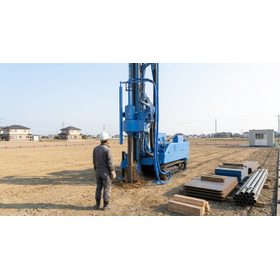
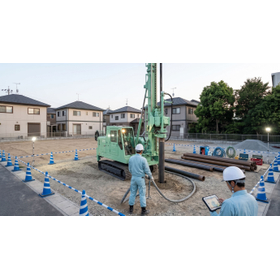
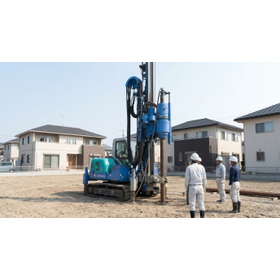
The ETP method is a type of rotary driven steel pipe pile construction that features a tip with a disc-shaped wing and a triangular excavation auxiliary bit. It has received certification from the Minister of Land, Infrastructure, Transport and Tourism (for sandy soil: TACP-0665, for clayey soil: TACP-0666) and a performance certification from the General Incorporated Foundation Japan Building Disaster Prevention Association (GBRC Performance Certification No. 12-20 Rev. 4), ensuring high bearing capacity and smooth construction. By avoiding the use of cement, it mitigates the risk of soil and groundwater contamination, and the no-excavation construction eliminates the need for soil disposal costs. Additionally, it allows for the removal of piles through reverse rotation and employs compact machinery, enabling low-noise and low-vibration construction, thus achieving an economical design and construction that considers the surrounding environment.

Inquire About This Product
basic information
The pile diameters range from φ89.1 to φ609.6 in 16 sizes. The wing diameters have numerous specifications set for each pile diameter, accommodating various design conditions. 590N grade steel pipes (SEAH590, HU590) are available for use. Construction without soil displacement eliminates the need for soil disposal costs. By using compact and powerful construction machinery, low noise and low vibration construction is possible, achieving construction that considers the surrounding environment. The pile diameters are available in 16 sizes from φ89.1 to φ609.6, and the wing diameters also have a variety of specifications to meet various design conditions. The axial steel pipes can utilize standard strengths of $F=235N/mm2 (such as STK400) and $F=325N/mm2 (such as STK490), as well as 590N grade steel pipes. The long-term allowable compressive bearing capacity is calculated based on the tip bearing capacity coefficient α=140$, and the surface friction coefficients (sand β=2.0, clay ɤ=0.3). Furthermore, it accommodates a pull-out bearing capacity with a bearing capacity coefficient $K=65$, with a maximum construction depth of 63.60m. During construction, real-time monitoring is conducted through a management device, ensuring reliable termination based on unique standards through torque management and depth management.
Price range
Delivery Time
Applications/Examples of results
It can be widely applied to sandy ground (including hard ground) and clayey ground as advanced ground. It is suitable for buildings with a total floor area of 500,000 m² or less, and can be introduced into designs of various scales, from mid-rise buildings and large facilities to small structures. As a proven example, by utilizing compact and powerful dedicated construction machinery, it can flexibly accommodate construction in narrow spaces and on sites with overhead restrictions using specially designed machines. It has a strong track record as a foundation method for urban proximity construction, where low noise and low vibration are required to consider the surrounding environment, as well as for ecological regeneration projects where piles can be easily removed and recovered by reversing rotation during future building demolition.
catalog(3)
Download All Catalogs
![Ground reinforcement work [suitable for small sites and during operation] using the ministerial certified disc-shaped tip with winged rotary driven steel pipe pile method | Geotech](https://image.www.ipros.com/public/catalog/image/321794/IPROS9772800321117112852.jpeg?w=120&h=170)
Company information

-

![[Cart Customization Support] Blind spot confirmation that can be installed on any bridge inspection cart.](https://image.www.ipros.com/public/product/image/2101191/IPROS10664339049652487136.png?w=280&h=280)