Analytical Equipment Product List and Ranking from 65 Manufacturers, Suppliers and Companies | IPROS

Last Updated: Aggregation Period:Feb 18, 2026~Mar 17, 2026
This ranking is based on the number of page views on our site.

Analytical Equipment Manufacturer, Suppliers and Company Rankings

Last Updated: Aggregation Period:Feb 18, 2026~Mar 17, 2026
This ranking is based on the number of page views on our site.

  1. インボディ・ジャパン 東京本社 Tokyo//Medical and Welfare
  2. ビーエルテック Tokyo//others
  3. ネッチ・ジャパン Kanagawa//Building materials, supplies and fixtures manufacturers
  4. 4 null/null
  5. 5 null/null

Analytical Equipment Product ranking

Last Updated: Aggregation Period:Feb 18, 2026~Mar 17, 2026
This ranking is based on the number of page views on our site.

  1. InBody Comprehensive Catalog インボディ・ジャパン 東京本社
  2. Portable Body Composition Analyzer "ACCUNIQ BC300"
  3. TMA 4000 SE / Thermomechanical Analysis Device ネッチ・ジャパン
  4. Acoustic analyzer "XL3" suitable for large-scale event monitoring.
  5. 5 Fluorescent X-ray analysis device 'DPO-2000' [Rental] ソーキ

Analytical Equipment Product List

31~60 item / All 211 items

Displayed results

"Analysis Work Efficiency Improvement WEB Online Seminar" *Free Participation*

We propose work efficiency improvements using Continuous Flow Analysis (CFA) and Near Infrared Analysis (NIR) devices. We will also introduce some examples.

Our company, engaged in the development, manufacturing, and sales of analytical instruments, will hold a "Web Online Seminar on Streamlining Analytical Work." We will introduce the "Continuous Flow Analyzer (CFA)," which has become the standard method for environmental analysis, the "Acid Decomposition Pretreatment Device" capable of heating up to 300°C, and the "Near Infrared Analyzer" that can analyze caloric content, protein, fat, carbohydrates, and salt equivalent in about 30 seconds. The seminar consists of three parts, and you can participate in any one of them. Participation is free (pre-registration required). We will also propose ways to improve efficiency using real examples. 【Seminar Overview】 Date: July 3, 2020 (Friday) Part 1 at 13:00, Part 2 at 14:00, Part 3 at 15:00 Cost: Free (pre-registration required) How to apply: Please register at http://www.bl-tec.co.jp/ (Registration will start on June 19) *You can view detailed materials for this seminar via PDF download. Please feel free to contact us with any inquiries.

  • Measurement and Analysis Equipment
  • Other analytical equipment
  • Analytical Equipment

Added to bookmarks

Bookmarks list

Bookmark has been removed

Bookmarks list

You can't add any more bookmarks

By registering as a member, you can increase the number of bookmarks you can save and organize them with labels.

Free membership registration

Establishment of a Nutritional Component Analysis Method in Food Using Near-Infrared Analysis Equipment

Measurement was conducted using a nutrition analyzer, and a comparison of the results with conventional method values.

This document introduces the establishment of a nutritional component analysis method for food items such as bento, side dishes, and bread using the NIR Nutrition Analyzer (near-infrared analysis device). It includes an overview of near-infrared analysis methods, the equipment used, the examination methods, and an example of measurement. Actual samples were blended into a paste and measured using the Nutrition Analyzer with installed calibration data, comparing the results with those obtained by conventional methods. [Contents] ■ Overview ■ What is near-infrared analysis? ■ Keywords ■ Equipment used ■ Examination methods ■ Example of measurement *For more details, please refer to the PDF document or feel free to contact us.

  • Other analytical equipment
  • Analytical Equipment

Added to bookmarks

Bookmarks list

Bookmark has been removed

Bookmarks list

You can't add any more bookmarks

By registering as a member, you can increase the number of bookmarks you can save and organize them with labels.

Free membership registration

Establishment of a Component Analysis Method for Olive Pomace

Conducting a study on rapid and simple analytical methods for the components in olive pomace!

This document introduces the establishment of a component analysis method for olive pomace using the "NIR Olive Checker." The component analysis of olive pomace has become possible through non-destructive analysis methods. Using NIR (Near Infrared Analysis Device), we have established a method to quickly and easily measure the components of "moisture" and "fat" in olive pomace. [Contents] ■ Overview ■ What is Near Infrared Analysis? ■ Keywords ■ Equipment Used ■ Examination Method *For more details, please refer to the PDF document or feel free to contact us.

  • Other analytical equipment
  • Non-destructive testing
  • Measurement and Analysis Equipment
  • Analytical Equipment

Added to bookmarks

Bookmarks list

Bookmark has been removed

Bookmarks list

You can't add any more bookmarks

By registering as a member, you can increase the number of bookmarks you can save and organize them with labels.

Free membership registration

Technical Data: Establishment of Component Analysis Method for Olive Oil

Using the NIR Olive Checker! It can measure a total of 21 types, including acidity and oleic acid.

This document introduces the establishment of a component analysis method for olive oil using the "NIR Olive Checker." Component analysis of olive oil has become possible through non-destructive analysis methods. Using NIR (Near Infrared Analysis Device), we have established a method to rapidly and easily measure 21 components in olive oil, including "acidity," "oleic acid," "linoleic acid," and "polyphenols." [Contents] ■ Overview ■ What is Near Infrared Analysis? ■ Keywords ■ Equipment Used ■ Examination Methods *For more details, please refer to the PDF document or feel free to contact us.

  • Other analytical equipment
  • Non-destructive testing
  • Measurement and Analysis Equipment
  • Analytical Equipment

Added to bookmarks

Bookmarks list

Bookmark has been removed

Bookmarks list

You can't add any more bookmarks

By registering as a member, you can increase the number of bookmarks you can save and organize them with labels.

Free membership registration

Technical Document: Establishment of a Component Analysis Method for Potato Chips Using a Snack Checker

Using NIR (Near Infrared Analysis Device)! Established a method to quickly and easily measure "moisture" and "oil content."

This document introduces a method for analyzing the components of snacks (potato chips) using NIR (Near Infrared Analysis Device). To ensure quality assurance in potato chips, the items "moisture" and "fat" are measured. The measurement of components requires the use of hazardous reagents and involves time-consuming processes and skilled techniques. Therefore, a calibration curve that can be measured using near infrared has been created for the component analysis of potato chips. As a result, it has become possible to simultaneously measure "fat" and "moisture." Consequently, we have established an automated measurement method for analyzing the components of potato chips using the NIR (Near Infrared Analysis Device). [Contents] ■ Overview ■ What is Near Infrared Analysis? ■ Keywords ■ Equipment Used ■ Method of Examination *For more details, please refer to the PDF document or feel free to contact us.

  • Other analytical equipment
  • Non-destructive testing
  • Measurement and Analysis Equipment
  • Analytical Equipment

Added to bookmarks

Bookmarks list

Bookmark has been removed

Bookmarks list

You can't add any more bookmarks

By registering as a member, you can increase the number of bookmarks you can save and organize them with labels.

Free membership registration

Establishment of a component analysis method for coffee beans using a technical data coffee bean checker.

Using the NIR coffee bean checker! A method has been established for anyone to quickly and easily measure nutritional components.

This document introduces the establishment of an automatic measurement method for component analysis of coffee beans using the NIR coffee bean checker. A method has been established to rapidly and easily measure the components in coffee beans, including "sucrose," "trigonelline," "caffeine," "moisture," "lipids," "phosphoric acid," "citric acid," "malic acid," "quinic acid," "glycolic acid," and "formic acid." For coffee beans, measurement has become simple and quick by using our calibration curve. [Contents] ■ Overview ■ What is Near Infrared Analysis? ■ Keywords ■ Equipment Used ■ Examination Method *For more details, please refer to the PDF document or feel free to contact us.

  • Other analytical equipment
  • Non-destructive testing
  • Measurement and Analysis Equipment
  • Analytical Equipment

Added to bookmarks

Bookmarks list

Bookmark has been removed

Bookmarks list

You can't add any more bookmarks

By registering as a member, you can increase the number of bookmarks you can save and organize them with labels.

Free membership registration

Establishment of a fertilizer component analysis method using a feed checker.

Using the NIR feed checker! Established a method for rapid and simple measurement of components in feed.

This document introduces the establishment of an automated measurement method for component analysis in feed using an NIR feed checker. Component analysis of feed is primarily conducted on "moisture," "protein," "lipids," "fiber," "ash," "calcium," "phosphorus," and "salt." In the component analysis of feed, a calibration curve that can be measured in the near-infrared range is created. Therefore, we have established an automated measurement method for determining the components of feed using an NIR (near-infrared analysis device). [Contents] ■ Overview ■ What is Near-Infrared Analysis? ■ Keywords ■ Equipment Used ■ Examination Method *For more details, please refer to the PDF document or feel free to contact us.

  • Other analytical equipment
  • Non-destructive testing
  • Measurement and Analysis Equipment
  • Analytical Equipment

Added to bookmarks

Bookmarks list

Bookmark has been removed

Bookmarks list

You can't add any more bookmarks

By registering as a member, you can increase the number of bookmarks you can save and organize them with labels.

Free membership registration

Establishment of a Cookie Ingredient Analysis Method Using a Confectionery Checker

We conducted an examination of the measurement of the components of cookies: "moisture," "fat," and "sugar."

This document introduces the establishment of an automatic measurement method for component analysis in cookies using a snack checker. To ensure quality assurance in cookies, the items measured include "moisture," "lipids," and "carbohydrates." Since the measurement of components requires the use of hazardous reagents and involves labor-intensive and skilled techniques, a calibration curve that can be measured using near-infrared (NIR) was created for the component analysis of cookies. The items can be measured simultaneously, and thus, we established an automated measurement method for the analysis of cookie components using NIR. 【Contents】 ■ Overview ■ What is Near-Infrared Analysis? ■ Keywords ■ Equipment Used ■ Examination Method *For more details, please refer to the PDF document or feel free to contact us.

  • Other analytical equipment
  • Non-destructive testing
  • Measurement and Analysis Equipment
  • Analytical Equipment

Added to bookmarks

Bookmarks list

Bookmark has been removed

Bookmarks list

You can't add any more bookmarks

By registering as a member, you can increase the number of bookmarks you can save and organize them with labels.

Free membership registration

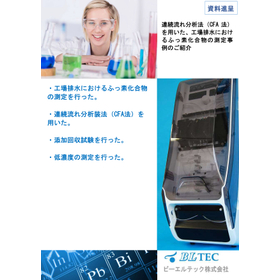
Case study of measuring fluorinated compounds in factory wastewater using Continuous Flow Analysis (CFA) method.

Introduction of a case study on the measurement of fluorinated compounds in factory wastewater using Continuous Flow Analysis (CFA) method.

This document introduces a case study on the measurement of fluoride in factory wastewater using the continuous flow analysis method (CFA method) as per JIS K 0102 34.4. Contents ■ Overview of the analysis ■ Introduction of the equipment ■ Actual measurement case ■ Results of recovery rate *For more details, please refer to the PDF document or feel free to contact us.

  • Other measuring instruments
  • Water treatment technology and systems
  • Water quality/pH measuring device
  • Analytical Equipment

Added to bookmarks

Bookmarks list

Bookmark has been removed

Bookmarks list

You can't add any more bookmarks

By registering as a member, you can increase the number of bookmarks you can save and organize them with labels.

Free membership registration

Automation of pretreatment for inorganic analysis such as environmental analysis and soil analysis AATM/Atom

[Technical Data Presentation] Collaboration on Metal Analysis in Environmental and Wastewater Samples! ~Automation Equipment for Sample Preparation and ICP/MS Measurement in Environmental Analysis (AATM)~

The pretreatment methods for factory wastewater, environmental water, groundwater, etc., use substances such as nitric acid, as specified in factory wastewater testing methods and standards set by the Ministry of the Environment. However, the analytical procedures are complicated and require significant effort for decomposition, and care must be taken to avoid splashes of nitric acid reagents on the skin and eyes, as well as exposure to acidic gas emissions. Therefore, to ensure the safety of analysts, improve work efficiency, and eliminate human error, our company introduces quantifiable devices that can automate the pretreatment to measurement processes in environmental analysis, wastewater analysis, and soil analysis in a seamless manner. <Some introduction examples> ■ Inorganic analysis of wastewater using ICP/MS ■ Inorganic analysis of environmental water (river water, seawater) using ICP/MS ■ Inorganic analysis of soil (content/leaching) using ICP/MS ■ Inorganic analysis of groundwater and drinking water using ICP/MS *For detailed specifications, please download the PDF. Feel free to contact us.

  • others
  • Analytical Equipment

Added to bookmarks

Bookmarks list

Bookmark has been removed

Bookmarks list

You can't add any more bookmarks

By registering as a member, you can increase the number of bookmarks you can save and organize them with labels.

Free membership registration

[Book] Analysis of Components and Additives in Polymers (No. 2079BOD)

Technical Reference Book - How to Choose Analysis Methods, from Preprocessing Techniques to Data Interpretation -

★ Pyrolysis GC, MALDI-MS, NMR, IR/Raman spectroscopy, GPC, Selection of methods suitable for the purpose and materials, along with specific analysis examples for setting measurement conditions! ★ Packed with qualitative and quantitative analysis know-how that can be utilized in the field of separation and extraction from unknown samples, material development, and quality control! ーーーーーーーーーーーーーーーーーーーーーーーーーーーーーーーーーーーーーーーーーーーーーーーーーーーーーーーー ■ Key Points of This Book ◆ Differentiation of Analytical Instruments and Sample Preparation - Characteristics of each analytical method, optimal combinations - Sample preparation - Know-how for conducting high-precision, rapid, and simple analyses - Addressing data variability ◆ How to Obtain Clean Spectral Peaks and Accurate Interpretation - Removal of unwanted peaks such as noise - How to interpret ghost peaks, peak splitting, and overlapping - Analysis and identification methods for similar substances - Detection methods for peaks that are difficult to analyze with general-purpose libraries ◆ Numerous Analysis Examples Included - Characteristics of various additives and their analytical techniques - Analysis of bleed-out additives - Resins, rubber, inks, adhesives, electrolytes, etc. - Molecular weight distribution, branching, and composition analysis of polymers - Identification of unknown components and measurement examples of trace components

  • others
  • Analytical Equipment

Added to bookmarks

Bookmarks list

Bookmark has been removed

Bookmarks list

You can't add any more bookmarks

By registering as a member, you can increase the number of bookmarks you can save and organize them with labels.

Free membership registration

Shape analysis experimental device 'HAVER CPA2-1'

Demo tests and rentals available! New software and innovative interface! Efficient for use in laboratories.

The "HAVER CPA2-1" is an experimental device for particle size and shape analysis with a measurement range of 20μm-30μm. It features easy setup with the new CpaServ software and user-friendly menu navigation. Equipped with the new HAVER CPA software, it operates under the current Windows operating system. Additionally, its consistent modular structure allows this product to be combined with various HAVER peripherals. 【Features】 ■ Latest HAVER CpaServ software, user-friendly operation, and diverse analysis options ■ Compact structure and lightweight for easy portability ■ Very good reproducibility with short measurement times ■ Automatic feeder cleaning ■ LED light source, durable, and energy-efficient *For more details, please refer to the PDF materials or feel free to contact us.

  • Measurement and Analysis Equipment
  • Analytical Equipment

Added to bookmarks

Bookmarks list

Bookmark has been removed

Bookmarks list

You can't add any more bookmarks

By registering as a member, you can increase the number of bookmarks you can save and organize them with labels.

Free membership registration

Aites Device List

This is a list of devices used for analysis, evaluation, and testing services of AITES.

Aites is a solution-oriented company that sincerely addresses customer challenges in cutting-edge industrial fields. We utilize various owned devices to provide optimal solutions. ■ Product Analysis / Defect Analysis / Failure Analysis Morphological observation, electrical characteristic measurement, defect analysis, failure analysis, sample processing ■ Reliability Evaluation Testing Reliability evaluation testing, ESD/latch-up testing, strength testing, optical characteristics ■ Physical Analysis / Chemical Analysis Physical analysis, surface analysis, chemical analysis

  • Analysis and prediction system
  • Analytical Equipment

Added to bookmarks

Bookmarks list

Bookmark has been removed

Bookmarks list

You can't add any more bookmarks

By registering as a member, you can increase the number of bookmarks you can save and organize them with labels.

Free membership registration

[Information] Liquid Crystal Materials and Their Analytical Techniques

A clear explanation of Aites' technological capabilities analyzed from molecular structures, accompanied by diagrams and tables!

This document introduces an example of an analytical method for molecular structure analysis. It includes structural analysis using IR and Raman for liquid crystal polymers (LCP), TIC data from GC-MS analysis of low molecular weight liquid crystals (for LCD), as well as detected substances, presented with figures and tables. For analysis at the quantum level, please consult the technical group "Aites," known for their extensive expertise. 【Contents (excerpt)】 ■ Liquid Crystal Polymers (LCP) ■ Structural analysis of LCP (fully aromatic polyamide) ■ Structural analysis using IR ■ Structural analysis using Raman ■ Structural analysis using XPS (ESCA) *For more details, please refer to the PDF document or feel free to contact us.

  • others
  • Analytical Equipment

Added to bookmarks

Bookmarks list

Bookmark has been removed

Bookmarks list

You can't add any more bookmarks

By registering as a member, you can increase the number of bookmarks you can save and organize them with labels.

Free membership registration

DSC (Differential Scanning Calorimetry)

Observe the degree of endothermic/exothermic reaction of the sample! The temperature range can go from -90°C to 550°C.

DSC (Differential Scanning Calorimetry) is an analytical method that determines the heat difference based on the temperature difference between the sample and a reference material caused by temperature changes in the sample, allowing for the observation of the degree of endothermic/exothermic reactions of the sample. The temperature range is -90°C to 550°C, the required sample amount is 5 to 10 mg, and the sample shapes that can be measured include film, powder, and bulk. 【Features】 ■ Differential Scanning Calorimetry ■ Observation of the degree of endothermic/exothermic reactions of the sample ■ Temperature range: -90°C to 550°C ■ Required sample amount: 5 to 10 mg ■ Sample shapes: film, powder, bulk *For more details, please refer to the PDF document or feel free to contact us.

  • Surveying
  • Structural Survey
  • Measurement and Inspection
  • Analytical Equipment

Added to bookmarks

Bookmarks list

Bookmark has been removed

Bookmarks list

You can't add any more bookmarks

By registering as a member, you can increase the number of bookmarks you can save and organize them with labels.

Free membership registration

Evaluation of membrane quality using EELS analysis method

EELS analysis for element identification allows for the comparison of the bonding states of substances!

Our company provides analysis and reliability evaluation services. EELS analysis and EDS analysis are analytical methods that identify elements by irradiating accelerated electrons onto TEM samples. In the case of "different carbon films," we conducted film quality evaluation in the nano region using the EELS analysis method, which is characterized by state analysis. In the EDS analysis, we detected trace amounts of N and O only in the Bottom film through spectral comparison. In the EELS analysis, the difference in shoulder shapes of the two spectra allows for a comparison of the bonding states of N, O, and C present in the organic film. *For more details, please refer to the PDF document or feel free to contact us.

  • Other analytical equipment
  • Analytical Equipment

Added to bookmarks

Bookmarks list

Bookmark has been removed

Bookmarks list

You can't add any more bookmarks

By registering as a member, you can increase the number of bookmarks you can save and organize them with labels.

Free membership registration

[Data] Research Institute of Chemical Reaction Mechanisms - Case Study on the Causes of Material Discoloration

Clear presentation of analysis results using polyamide imide materials and IR devices, along with data analysis!

This document presents a case study that elucidates the causes of discoloration in super engineering plastic polyamide-imide (PAI) films used in coatings, composite film materials, and various molded products through instrumental analysis and reaction mechanisms. It includes analysis results from infrared (IR) devices, data analysis, and reaction mechanisms, starting with the material polyamide-imide. While the storage stability of raw materials is essential in product manufacturing, environmental conditions during the processing can sometimes induce defects. We encourage you to read on. [Contents] ■ About the material polyamide-imide ■ Analysis results from IR devices ■ Data analysis and reaction mechanisms *For more details, please refer to the PDF document or feel free to contact us.

  • others
  • Analytical Equipment

Added to bookmarks

Bookmarks list

Bookmark has been removed

Bookmarks list

You can't add any more bookmarks

By registering as a member, you can increase the number of bookmarks you can save and organize them with labels.

Free membership registration

Detection of trace elements by EPMA.

Detection sensitivity is excellent! It is particularly outstanding for quantitative analysis of trace components and map analysis.

EPMA analysis has good energy resolution and detection sensitivity, and is particularly excellent for quantitative analysis of trace components and map analysis. In a case where a defect occurred in the Au-1st bonding within the package, EDX analysis and EPMA analysis were conducted to identify the corrosive substances and confirm their distribution. Since EPMA has superior resolution, detection limits, and P/B (peak to background) ratios compared to EDX, the distribution of trace Cl could be clearly understood. 【Equipment Specifications】 ■ Manufacturer: JEOL Ltd. Jeol-8200 ■ Analysis Method: Wavelength Dispersive X-ray Analysis (WDX) ■ Analyzable Elements: B to U ■ Energy Resolution: 20 eV (EDX is approximately 130 eV) ■ Detection Limit: 0.01% and above ■ Maximum Sample Size: 100×100 mm *For more details, please refer to the PDF document or feel free to contact us.

  • others
  • Analytical Equipment

Added to bookmarks

Bookmarks list

Bookmark has been removed

Bookmarks list

You can't add any more bookmarks

By registering as a member, you can increase the number of bookmarks you can save and organize them with labels.

Free membership registration

Analysis of Organic Multilayer Films by Imaging FT-IR: Aluminum

Introducing a method for analyzing the vicinity of the surface through total internal reflection of infrared light by closely adhering micro ATR crystals!

Based on imaging obtained from FT-IR spectra using the ATR method, cross-sectional analysis of organic multilayer films such as aluminum laminate film can be performed. The ATR method (Attenuated Total Reflection) is a technique that involves closely attaching a micro ATR crystal to the sample, allowing for analysis near the surface through total internal reflection of infrared light. Due to the influence of the refractive index of the crystal applied to the sample, the apparent spatial resolution is enhanced, enabling the analysis of smaller foreign substances. 【Features of the ATR Method】 ■ A technique that analyzes near the surface through total internal reflection of infrared light ■ The apparent spatial resolution is enhanced due to the influence of the refractive index of the crystal applied to the sample ■ Enables the analysis of smaller foreign substances *For more details, please refer to the PDF materials or feel free to contact us.

  • others
  • Analytical Equipment

Added to bookmarks

Bookmarks list

Bookmark has been removed

Bookmarks list

You can't add any more bookmarks

By registering as a member, you can increase the number of bookmarks you can save and organize them with labels.

Free membership registration

Analysis of Organic Multilayer Films Using Imaging FT-IR Multilayer Films

It is possible to investigate the layer composition of organic films! Introducing imaging FT-IR analysis of high-performance multilayer film cross-sections.

It is possible to investigate the layer composition of organic films using FT-IR imaging through transmission of organic multilayer membranes that have been sectioned with a microtome. The document introduces imaging FT-IR analysis of high-performance multilayer film cross-sections using photographs and graphs. 【Imaging FT-IR Analysis of High-Performance Multilayer Film Cross-Sections】 ■Sample: High-performance multilayer film ■Measurement Area: Transmission/Reflection method 175μm, ATR method 35μm ■Spatial Resolution (Pixel Size): Transmission/Reflection method 5.5μm, ATR method 1.1μm *For more details, please refer to the PDF document or feel free to contact us.

  • others
  • Analytical Equipment

Added to bookmarks

Bookmarks list

Bookmark has been removed

Bookmarks list

You can't add any more bookmarks

By registering as a member, you can increase the number of bookmarks you can save and organize them with labels.

Free membership registration

Would you like to confirm the degradation of resin through FT-IR analysis?

Detect and analyze the absorption wavelengths of organic molecular groups (functional groups)!

At Aites Co., Ltd., we conduct "FT-IR analysis" to confirm the degradation of resins. The degradation of resins can manifest as visible discoloration or invisible changes. Discoloration can be detected through changes in appearance, but invisible changes can lead to a decrease in strength and become the source of various issues. Analysis using IR allows us to understand the changes in molecular structure caused by these alterations. *For more details, please refer to the PDF document or feel free to contact us.*

  • Other services and technologies
  • Non-destructive testing
  • Analytical Equipment

Added to bookmarks

Bookmarks list

Bookmark has been removed

Bookmarks list

You can't add any more bookmarks

By registering as a member, you can increase the number of bookmarks you can save and organize them with labels.

Free membership registration

Changes due to differences in acceleration voltage during EDX analysis.

Confirm changes due to differences in acceleration voltage! Analyze under appropriate conditions based on accumulated know-how!

When conducting EDX analysis, many people may use high acceleration voltages to increase the detection sensitivity of elements. However, depending on the purpose, analysis at high acceleration voltages is not always the best option. White LEDs generate white light by combining blue LEDs with yellow phosphors (powder), and in this study, we examined how changing the acceleration voltage affects the surface analysis of these phosphors. Please take a moment to read this. [Contents] - Test sample (LED phosphor) - Surface analysis images at different acceleration voltages - Considerations from Monte Carlo simulations of electron beam scattering regions *For more details, please refer to the PDF document or feel free to contact us.

  • others
  • Analytical Equipment

Added to bookmarks

Bookmarks list

Bookmark has been removed

Bookmarks list

You can't add any more bookmarks

By registering as a member, you can increase the number of bookmarks you can save and organize them with labels.

Free membership registration

[Data] Example of EPMA Analysis

By using LIF and LIFH spectroscopic crystals, peak separation of 22Ti and 56Ba becomes possible!

EPMA has superior detection resolution compared to EDX. Even in cases where the detection positions of elements are close in EDX, making peak separation difficult, it may be possible to achieve peak separation with EPMA. This document introduces the peak separation of 22Ti and 56Ba, including analysis examples of multilayer ceramic capacitors and X-ray spectra of barium titanate (BaTiO3). [Contents] - Peak separation of 22Ti and 56Ba - Analysis example: multilayer ceramic capacitors - X-ray spectrum of barium titanate (BaTiO3) *For more details, please refer to the PDF document or feel free to contact us.

  • Analysis and prediction system
  • Analytical Equipment

Added to bookmarks

Bookmarks list

Bookmark has been removed

Bookmarks list

You can't add any more bookmarks

By registering as a member, you can increase the number of bookmarks you can save and organize them with labels.

Free membership registration

[Data] Analysis of SEG-LCD Panel Display Malfunction

We introduce case studies of comparative analysis conducted through chemical analysis, such as GC-MS analysis and ICP-AES analysis!

In the event of a display failure on a liquid crystal panel, it is necessary to clarify the cause in order to prevent recurrence. This document presents a case study comparing panel A, which exhibited display unevenness due to temperature stress, and panel B, which showed no display issues, through chemical analysis. Aites can investigate the cause through chemical analysis of the liquid crystal interior when initial analyses, such as observations, do not reveal any issues. We can also propose analytical methods tailored to the samples and objectives beyond the techniques mentioned here. [Contents] ■ Reliability testing (80°C / dry conditions / 1000 hours) ■ Liquid crystal GC-MS analysis ■ Metal element ICP-AES analysis within the liquid crystal ■ Summary *For more details, please refer to the PDF document or feel free to contact us.

  • Analysis and prediction system
  • Analytical Equipment

Added to bookmarks

Bookmarks list

Bookmark has been removed

Bookmarks list

You can't add any more bookmarks

By registering as a member, you can increase the number of bookmarks you can save and organize them with labels.

Free membership registration

[Document] Mass Spectrometry Guide

Analyze using various analytical methods to obtain information such as functional groups and skeletal structures! Introducing the mass spectrometry guide.

This document introduces a mass spectrometry guide. In the analysis of organic compounds, information is obtained and analyzed using various analytical methods based on the functional groups, skeletal structures, and masses of the compounds. There are various methods for analyzing the mass of compounds, each with its own strengths in terms of the type of analysis and targets. Additionally, these methods can be selectively used according to the application or combined with other analytical techniques to obtain the necessary information. [Contents] ■ Methods mainly used in mass spectrometry - GC-MS - LC-MS - MALDI-TOFMS - GPC *For more details, please refer to the PDF document or feel free to contact us.

  • Analysis and prediction system
  • Other analytical equipment
  • Measurement and Analysis Equipment
  • Analytical Equipment

Added to bookmarks

Bookmarks list

Bookmark has been removed

Bookmarks list

You can't add any more bookmarks

By registering as a member, you can increase the number of bookmarks you can save and organize them with labels.

Free membership registration

[Case of EBSD] Comparison of two brass materials

Visualizing the differences between two samples based on differences in crystal structure! Introducing a case study of EBSD analysis.

Here is a case study comparing two types of brass with similar elemental compositions. When spectral analysis was conducted using SEM-EDX, it was found that brass primarily consists of Cu (copper) and Zn (zinc), and the elemental compositions of both samples appeared to be relatively similar. Additionally, an EBSD analysis was performed to check the phase map, revealing that a portion of sample 1 exhibited a β phase with a different crystal structure. 【Case Overview】 <Comparison of Two Brass Materials through Elemental Analysis> ■ Analysis Method: SEM-EDX Analysis ■ Results - Spectral analysis indicated that brass primarily consists of Cu (copper) and Zn (zinc), and the elemental compositions of both samples appeared to be relatively similar. - Surface analysis was conducted for elements Cu and Zn, and no bias in the in-plane distribution was observed. *For more details, please refer to the PDF document or feel free to contact us.

  • Measurement and Inspection
  • Analytical Equipment

Added to bookmarks

Bookmarks list

Bookmark has been removed

Bookmarks list

You can't add any more bookmarks

By registering as a member, you can increase the number of bookmarks you can save and organize them with labels.

Free membership registration

[Information] GC-MS Analysis Device Guide

Introducing the sample introduction device and the types of analytical samples and analysis that each device specializes in!

GC-MS analysis is a method commonly used for the analysis of organic components and organic structure analysis. With auxiliary devices, it can accommodate a wide range of analyses, from low molecular substances like solvents to high molecular substances like plastics. This document introduces the sample introduction devices owned by Aites, as well as the types of analysis samples and analysis content that each device specializes in. Please take a moment to read it. 【Contents】 ■ Overview ■ Conditions ■ Samples ■ Data Obtained ■ Analysis Examples *For more details, please refer to the PDF document or feel free to contact us.

  • Other analytical equipment
  • Analytical Equipment

Added to bookmarks

Bookmarks list

Bookmark has been removed

Bookmarks list

You can't add any more bookmarks

By registering as a member, you can increase the number of bookmarks you can save and organize them with labels.

Free membership registration

Analysis of foreign substances and component analysis: Comparison of micro-Raman and FTIR.

Spectroscopic analysis is suitable for component analysis of foreign substances and qualitative analysis.

We will introduce a comparison between Raman spectroscopy analysis by Aites Co., Ltd. and FTIR. Spectroscopic analysis is suitable for component analysis of foreign substances and qualitative analysis. Both Raman and FT-IR can obtain spectra based on the structure of the analysis target. However, since each has its strengths and weaknesses, it is necessary to use both according to the analysis target. 【Features】 ■ Measurement in the order of a few micrometers, which is difficult with IR analysis, is possible. ■ No sampling is required. *For more details, please refer to the PDF document or feel free to contact us.

  • Measurement and Analysis Equipment
  • Analytical Equipment

Added to bookmarks

Bookmarks list

Bookmark has been removed

Bookmarks list

You can't add any more bookmarks

By registering as a member, you can increase the number of bookmarks you can save and organize them with labels.

Free membership registration

Example of analysis of compounds at the interface between SAC solder and Ni pads.

It is also possible to display various maps of each phase! Analysis is based on the information of the crystal structure possessed by the sample.

We will introduce an example of the analysis of compounds formed at the interface between Sn-Ag-Cu solder and NiP pads. At the interface between NiP pads and Sn-Ag-Cu solder, compounds such as (Ni,Cu)3Sn4 and (Cu,Ni)6Sn5 grow, and surface analysis using EDX shows the distribution of Ni, Cu, and Sn within these compounds. The EBSD method is an analytical technique based on the crystallographic information of the sample. By combining it with elemental analysis using EDX, it is possible to estimate the composition, and in some cases, analysis can be performed using the crystallographic data of Ni3Sn4 and Cu6Sn5 as substitutes. 【Overview】 <Elemental Analysis by EDX> ■ Surface analysis shows the distribution of Ni, Cu, and Sn within the compounds. <Crystallographic Orientation Analysis by EBSD> ■ By combining it with elemental analysis using EDX, it is possible to estimate the composition. ■ In some cases, analysis can be performed using the crystallographic data of Ni3Sn4 and Cu6Sn5 as substitutes. *For more details, please download the PDF or feel free to contact us.

  • Analysis and prediction system
  • Analytical Equipment

Added to bookmarks

Bookmarks list

Bookmark has been removed

Bookmarks list

You can't add any more bookmarks

By registering as a member, you can increase the number of bookmarks you can save and organize them with labels.

Free membership registration