Ground Investigation | Visualization Survey of Bearing Capacity to Optimize Pile Layout for New Building Construction on Soft Ground
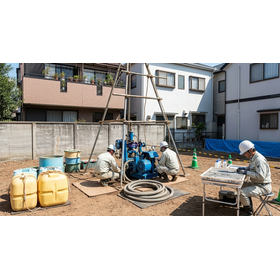
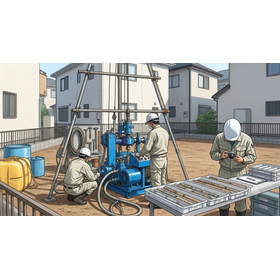
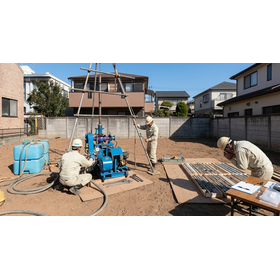
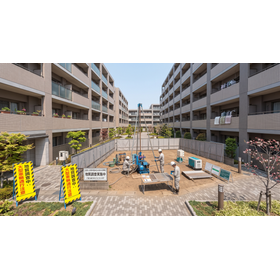
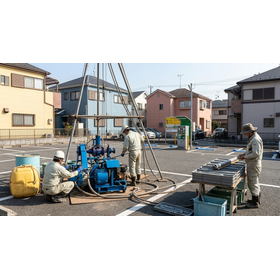
Boring survey

3D visualization of ground bearing capacity in building construction on weak ground! By linking structural calculations, we reduce excessive piling while ensuring both safety and cost-effectiveness.
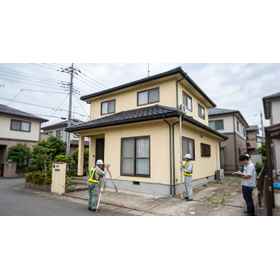
This solution is a ground consulting service that optimizes pile placement by integrating high-precision visualization of bearing capacity and structural calculation models in building construction plans on soft ground. Traditional foundation designs that rely solely on single-point boring surveys tend to overestimate safety factors to accommodate uneven support layer undulations, leading to unnecessary pile driving and excessive specifications for pile diameter and quantity. Geotech integrates precise multi-point sounding surveys and detailed laboratory soil test data within the site to accurately visualize the three-dimensional distribution of ground bearing capacity and the irregularities of support layers. By conducting precise optimal stress analysis that correlates the highly reliable bearing capacity constants obtained with the axial and lateral forces of each column in the superstructure, we derive the minimum necessary number of piles and appropriately optimized pile lengths in millimeter increments while maintaining structural safety. This preemptively resolves unexpected issues such as insufficient pile lengths or excessive pile head cutting processes at the construction site, directly leading to significant reductions in construction costs and material expenses. Furthermore, the clear calculation basis provided in the judgment report facilitates smoother reviews.
Inquire About This Product
basic information
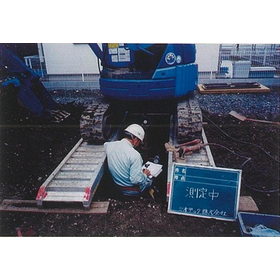
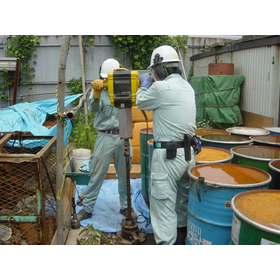
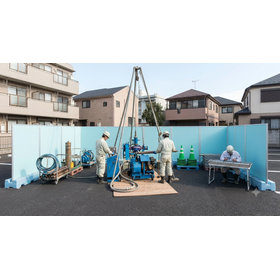
This survey service combines mechanical boring surveys with standard penetration tests and multi-point automatic continuous penetration tests to obtain stratigraphic data up to a maximum exploration depth of 30 meters. The blow resistance values and rotational torque are electronically measured at depths of 200 mm, and corrections for side friction are applied to accurately convert these values to standard N values. Additionally, indoor soil tests (such as unconfined and triaxial compression tests, consolidation tests, etc.) are conducted to calculate cohesion and deformation coefficients, and the allowable vertical bearing capacity and estimated settlement based on building foundation structural design guidelines are output.
Price range
Delivery Time
Applications/Examples of results
It is primarily used for the pile foundation design and pile layout optimization of mid-rise office buildings, reinforced concrete apartments, and steel-framed commercial facilities constructed in soft ground areas. It is ideal for design projects that aim to avoid excessive pile length and diameter in complex sites where the bearing layer is inclined or meandering, or that require high-precision soil bearing capacity parameters directly linked to structural calculation models. Additionally, it is widely adopted as reliable technical evidence to ensure smooth progress in structural conformity assessments by designated inspection agencies and building permit applications.
catalog(3)
Download All Catalogs
Company information

-
![Fence foundation dual-purpose decorative boundary block [Shikīru]](https://image.www.ipros.com/public/product/image/6d4/2000203792/IPROS6592272567679821523.gif?w=280&h=280)