Construction method(frp) - List of Manufacturers, Suppliers, Companies and Products | IPROS

Last Updated: Aggregation Period:Mar 11, 2026~Apr 07, 2026
This ranking is based on the number of page views on our site.

Construction method Product List

91~120 item / All 122 items

Displayed results

Gainah SH sheet board method (tunnel, concrete structure reinforcement)

Existing Tunnel Reinforcement Method Using "CFRP" Bonded Plates - Achieving Effective Tunnel Interior Reinforcement with High-Strength CFRP Using Carbon Fiber Sheets and Separators.

■NETIS Number: KT-230046 Technology Name: Fiber Sheet Adhesive Method for Tunnel and Bridge Repair and Reinforcement "Gaina SH Sheet Board Method" * Reinforcement with a single-layer laminated fiber sheet using high-density carbon fiber (compared to conventional multi-layer). * Compared to our carbon fiber sheet method of overlapping, this method is expected to shorten construction time and reduce costs. * Lighter than our steel plate adhesive method. No anchor work is required due to adhesive application. Fewer processes are needed compared to our continuous fiber sheet method. * High strength allows for strip placement. Unfinished areas between strips can be visualized, enabling visual confirmation of crack progression after reinforcement. * High-performance impregnation agents ensure reliable impregnation, allowing for high-quality construction. * No specialized skills are required for application and impregnation work, making it easy to secure construction personnel. * As a fiber sheet adhesive method, partial construction and partial adhesion are possible. It is flexible, allowing for easy application in corners.

  • SH3.JPG
  • SH.JPG
  • シート貼付.JPG
  • Bridge Materials
  • Construction method

Added to bookmarks

Bookmarks list

Bookmark has been removed

Bookmarks list

You can't add any more bookmarks

By registering as a member, you can increase the number of bookmarks you can save and organize them with labels.

Free membership registration

Cypress bath and wood regeneration glass coating method

A new technology for the regeneration method that maintains the aesthetic appearance of aged and deteriorated wood over the long term, addressing issues such as discoloration, splinters, mold, rot, dirt, and damage!

Glass paint for wood is a top-quality wood coating that possesses discoloration prevention, antibacterial, and antifungal properties. The inorganic glass film prevents the deterioration of wood and exhibits excellent water repellency. It also reinforces wood fibers, preventing splinters and rough edges. This technology is medically safe, allowing for worry-free use in venues such as assembly halls, hot spring facilities, and food factories. 【Features】 ■ Reduces slipping, staining, and UV degradation of wood ■ Suppresses mold and excels in water repellency ■ Prevents wood rot, damage, and termite infestation ■ Can suppress efflorescence in non-combustible and quasi-non-combustible wood ■ Widely adopted in buildings made of CLT, a technology currently in the spotlight

  • Exterior coating materials
  • Interior coating materials
  • Wood processing
  • Construction method

Added to bookmarks

Bookmarks list

Bookmark has been removed

Bookmarks list

You can't add any more bookmarks

By registering as a member, you can increase the number of bookmarks you can save and organize them with labels.

Free membership registration

Underground buried resin double-shell piping with leak detection device [30-year warranty]

Patented technology exclusive to Sunfront with a 30-year warranty.

This is a structure that incorporates sensors into the gap between the inner pipe of the double-shell piping and the outer shell pipe. This technology allows for pinpoint detection of leaks from external water and internal fuel oil, enabling repairs to the faulty areas before any actual damage occurs. Patent: No. 4421711, Utility Model: No. 3183085, Patent Application: 2014-235598, Patent Application: 2015-115624 - Double Piping Structure Utility Model: No. 3195379, Patent Application: 2014-176033, Utility Model Application: 2014-005777 - Piping Structure ■ Single Shell Piping Resin piping is developed for the transportation of fuels such as petroleum products. It is also suitable for organic solvents and achieves high hydrocarbon durability. ■ Double Shell Piping This is a piping structure that places an outer shell pipe over the inner shell pipe (single shell piping). By doubling the piping, the risk of fuel oil leakage (environmental pollution) can be dramatically reduced, making it suitable for suction pipes and oil supply pipes that serve as pathways for fuel oil. *For more details, please contact us or download the PDF materials for review.

  • Piping materials (plastic pipes)
  • Construction method

Added to bookmarks

Bookmarks list

Bookmark has been removed

Bookmarks list

You can't add any more bookmarks

By registering as a member, you can increase the number of bookmarks you can save and organize them with labels.

Free membership registration

Reinforcement of Reinforced Concrete Structures: Underwater Applicable CFRP Grid Reinforcement Method

It is a method for reinforcing concrete structures in water inexpensively without draining.

The underwater applicable CFRP grid reinforcement method is a technique that provides a cost-effective solution for aging deterioration and insufficient seismic strength in reinforced concrete structures such as bridge piers located underwater. The method involves adhering a lattice of carbon fiber bundles (CFRP grid) that has been impregnated with resin to the surface of the structure using a resin layer that cures underwater, thereby reinforcing the structure. Both the CFRP grid and the underwater curing resin have long-term durability. 【Features】 - Reinforces concrete structures underwater - Can be reinforced inexpensively without drainage - Long-term durability with CFRP grid and underwater curing resin - Carbon fiber can reinforce with high strength and minimal thickness - NETIS registration number KT-100101-A For more details, please contact us or download the catalog.

  • Reinforcement and repair materials
  • Construction method

Added to bookmarks

Bookmarks list

Bookmark has been removed

Bookmarks list

You can't add any more bookmarks

By registering as a member, you can increase the number of bookmarks you can save and organize them with labels.

Free membership registration

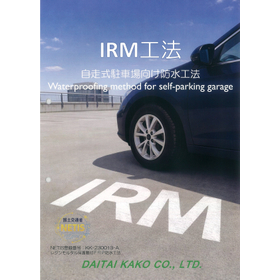
FRP waterproofing IRM method for self-driving parking lots

Impact resistance and wear resistance dramatically improved with FRP + resin mortar!

The "IRM Method" is a waterproofing technique for self-supporting parking lots that combines an FRP waterproof layer with a resin mortar protective layer, offering a lightweight and highly durable solution. By using resin mortar for the protective layer, it achieves excellent water resistance and abrasion resistance with a thickness of just a few millimeters, and it is designed to withstand tire chains and de-icing agents typical in cold regions. There are numerous construction achievements in Hokkaido. This technology is registered with NETIS (Registration Number: KK-230013-A).

  • Coating film waterproofing material/permeable waterproofing material
  • Construction method

Added to bookmarks

Bookmarks list

Bookmark has been removed

Bookmarks list

You can't add any more bookmarks

By registering as a member, you can increase the number of bookmarks you can save and organize them with labels.

Free membership registration

FRP Bridge Vacuum Infusion Method

A bridge that is resistant to salt damage, lightweight, high-strength, and does not decay.

Vacuum Infusion The entire glass fiber mat layered on the mold is covered with a film and sealed, creating a complete vacuum state by removing the air from the glass fiber layer. Next, using the power of the vacuum, polyester resin is injected into the glass fiber layer, ensuring it spreads evenly to create a uniform and strong FRP laminate. This manufacturing method is referred to as "Vacuum Infusion (VI)." This technique is also used in the production of large blades for wind turbines and yacht hulls. Laminates produced using this method are used in the structural components of FRP bridges. The high glass fiber content allows for lightweight and strong laminates, and there is the advantage of being able to produce very large laminate sheets. The shape of the mold can be freely designed, whether flat or curved, enabling the creation of elegantly shaped bridge girders.

  • Bridge Construction
  • Construction method

Added to bookmarks

Bookmarks list

Bookmark has been removed

Bookmarks list

You can't add any more bookmarks

By registering as a member, you can increase the number of bookmarks you can save and organize them with labels.

Free membership registration

FRP concrete reinforcement material Sangrid

New materials for the repair and reinforcement of concrete structures.

"Sungrid" is a "FRP concrete reinforcement material" that integrates high-performance continuous fibers such as carbon fibers, aramid fibers, and glass fibers into a lattice structure while being impregnated with a resin that has excellent chemical resistance.

  • Reinforcement and repair materials
  • Construction method

Added to bookmarks

Bookmarks list

Bookmark has been removed

Bookmarks list

You can't add any more bookmarks

By registering as a member, you can increase the number of bookmarks you can save and organize them with labels.

Free membership registration

Concrete repair and reinforcement method "CFRP Laminate Method"

Streamlining of work is achievable! Repair and reinforcement methods for reinforced concrete structures using CFRP.

The "CFRP Laminate Method" is a reinforcement technique that involves arranging carbon fibers in one direction, impregnating them with epoxy resin, and shaping and curing them into a plate-like form. This CFRP is then adhered to the concrete surface using a paste-like epoxy adhesive (Sika Dur 30), making the process simple. Since the surface preparation is only required for the area to be adhered, it also takes into account the preservation of the working environment and the reduction of waste. 【Features】 - Easy to work with, requiring no large machinery or equipment - Can be performed in areas where pipes intersect beneath the slab or in confined spaces - Reduces safety risks for workers and minimizes protective measures around the work area - There is almost no change in the shape or weight of the reinforced members - Provides reinforcement equivalent to 4 to 8 layers of carbon fiber sheets, allowing for labor-saving in the work process *Available in Tokyo, Saitama, Chiba, and Kanagawa Prefectures *For more details, please refer to the PDF materials or feel free to contact us.

  • Reinforcement and repair materials
  • Construction method

Added to bookmarks

Bookmarks list

Bookmark has been removed

Bookmarks list

You can't add any more bookmarks

By registering as a member, you can increase the number of bookmarks you can save and organize them with labels.

Free membership registration

【Pin Foundation Construction Example】Difficult Locations for Other Foundation Methods

Simple foundation methods for NETIS registration! We will introduce examples of construction in locations where other foundation methods are difficult.

Places where other foundation methods are difficult We will introduce examples of the pin foundation method. Due to weak ground, there are sites where foundation work becomes extensive, sites where draining water from ponds or canals incurs significant costs, or sites where transporting materials is very labor-intensive. In such cases, the lightweight pin foundation method, which can be constructed manually, is optimal. Depending on the case, it is also possible to significantly reduce the cost of foundation work. 【Examples】 ■ National Okinawa Memorial Park Ocean Expo Park (Okinawa Prefecture) ■ Structure: Effective width 2.0m, column pitch 3.0m ■ Materials used - Railing: FRP - Floorboard: FRP - Structural materials: Steel, FRP ■ Foundation type: DP-75, DP-100 *For more details, please refer to the catalog or feel free to contact us.

  • Civil Engineering Method
  • Ground foundation construction method
  • others
  • Construction method

Added to bookmarks

Bookmarks list

Bookmark has been removed

Bookmarks list

You can't add any more bookmarks

By registering as a member, you can increase the number of bookmarks you can save and organize them with labels.

Free membership registration

Coating Type FRP Anti-Corrosion Material NM Method [For Sewage Facilities]

We have developed a non-cross method using vinyl ester resin type!

The "NM method" is a coating-type lining method with a laminated specification that does not require impregnation and de-airing work during the lamination of fiber-reinforced fabric, which is necessary for reinforcement material lamination specifications (non-cross method). Additionally, it has obtained "Patent No. 7066236" as a method for corrosion protection of concrete. Furthermore, it corresponds to the coating-type lining method for concrete corrosion protection of sewer structures with laminated specifications (non-cross method) and is compliant with types A to D of the Japan Sewerage Agency and types C and D of the Tokyo Metropolitan Government Sewerage Bureau.

  • Sewerage facilities
  • Construction method

Added to bookmarks

Bookmarks list

Bookmark has been removed

Bookmarks list

You can't add any more bookmarks

By registering as a member, you can increase the number of bookmarks you can save and organize them with labels.

Free membership registration

Reinforcement of Existing Concrete Structures: Outplate Method

High bending reinforcement effect and high crack control effect! Suitable for the construction of RC and PC hollow slab bridges.

The Outplate method is a reinforcement technique that involves tensioning a prefabricated CFRP plate (Outplate) with anchoring bodies at both ends, fixing and bonding it to an existing concrete structure. Compared to conventional continuous fiber sheet bonding methods, tensioning the Outplate allows for the introduction of prestress into the concrete. This method achieves significant reinforcement effects with a minimal amount of reinforcement material. Since thin CFRP plates are used as tensioning materials, there is almost no change in the appearance or cross-section after reinforcement, making it particularly suitable for the construction of RC and PC hollow slab bridges. 【Features】 ■ High bending reinforcement effect ■ High crack control effect ■ Recovery of deflection ■ Improved durability ■ Minimal maintenance ■ Reinforcement above the supports of continuous girders is possible from the underside *For more details, please refer to the PDF document or feel free to contact us.

  • Renovation and repair methods
  • Construction method

Added to bookmarks

Bookmarks list

Bookmark has been removed

Bookmarks list

You can't add any more bookmarks

By registering as a member, you can increase the number of bookmarks you can save and organize them with labels.

Free membership registration

The Innovative CFRP Repair and Reinforcement Method for Steel Structures - In-situ VaRTM Method

Forming 3D-shaped CFRP stiffeners on-site! (There is an example of steel girder web buckling countermeasures in Tokushima Prefecture)

The "In-situ VaRTM Method" is a innovative resin impregnation technique that utilizes vacuum technology, allowing for the production of high-quality CFRP reinforcement materials on-site, tailored to the shape of steel materials, through a new CF sheet bonding method. <Strengths of the Method> 1. Three-Dimensional Reinforcement Materials ● Three-dimensional reinforcement materials, similar to ribs, can be produced on-site, enabling integration with existing steel structures. This is something that was not possible with conventional CFRP reinforcement methods but can be achieved with the On-Site VaRTM Method. 2. Ultra-Short Construction Period and Cost Reduction ● Reinforcement for one location of steel corrosion can be completed in a standard of 3 to 4 days (a 70-80% reduction in construction time compared to conventional CF sheet bonding methods), allowing for efficient steel reinforcement. ● Due to the shortened construction period and increased efficiency, costs can be reduced by 20-30% compared to conventional CF sheet bonding methods. 3. Measures Against Poor Curing During Resin Curing ● During curing, uncured resin is covered with a film, preventing issues such as amine brushing that can lead to poor resin curing. 4. Others ● The On-Site VaRTM Method is a unique method developed by Toray. ● It received the Minister of Economy Award at the 6th Infrastructure Maintenance Awards.  ● Approved as a new repair and reinforcement method by Japan Ministry of Land, Infrastructure, Transport and Tourism. *For more details, please download the PDF or feel free to contact us.

  • Renovation and repair methods
  • Construction method

Added to bookmarks

Bookmarks list

Bookmark has been removed

Bookmarks list

You can't add any more bookmarks

By registering as a member, you can increase the number of bookmarks you can save and organize them with labels.

Free membership registration

【Pin Foundation Construction Example】A place where valuable flora and fauna inhabit.

Simple basic construction method for NETIS registration! Introducing examples of construction in areas where valuable flora and fauna inhabit.

We will introduce an example of the Pin Foundation Method in a location where valuable flora and fauna reside. Conventional foundation methods, which involve excavating the ground and pouring large concrete blocks, cause significant environmental changes to the flora and fauna living in the area. In our method, only small-diameter steel pins are driven in through fixed blocks, so there is no alteration to the ecosystem of the valuable flora and fauna. [Case Study] ■ Okikubugawa Promenade (Okinawa Prefecture) ■ Structure: Effective width 1.2m, column pitch 2.5m ■ Materials used: - Handrails/Floorboards/Structural materials: FRP ■ Foundation type: DP-100/DP-L/SP For more details, please refer to the catalog or feel free to contact us.

  • Civil Engineering Method
  • Ground foundation construction method
  • others
  • Construction method

Added to bookmarks

Bookmarks list

Bookmark has been removed

Bookmarks list

You can't add any more bookmarks

By registering as a member, you can increase the number of bookmarks you can save and organize them with labels.

Free membership registration

【Pin Foundation Construction Example】Locations in wetlands where conventional foundations are difficult to install.

Simple foundation methods for NETIS registration! We will introduce examples of construction in areas where conventional foundations are difficult to install, such as wetlands.

Examples of the pin foundation method in areas where conventional foundations are difficult to install, such as wetlands. In soft ground areas like wetlands or lake beds, traditional concrete foundations may not be suitable. However, with the pin foundation method, it is possible to drive the pins very deep, making it feasible to work with such weak ground. Additionally, since there is no need for concrete pouring, it can be easily constructed even when there is water on the surface. 【Case Studies】 ■ Hibikinada Biotope (Fukuoka Prefecture) ■ Structure: Effective width 1.5m, column pitch 3.0m ■ Materials Used - Handrail: FRP - Decking: Recycled wood - Structural materials: FRP ■ Foundation Type: DP-75, SP *For more details, please refer to the catalog or feel free to contact us.

  • Civil Engineering Method
  • Ground foundation construction method
  • others
  • Construction method

Added to bookmarks

Bookmarks list

Bookmark has been removed

Bookmarks list

You can't add any more bookmarks

By registering as a member, you can increase the number of bookmarks you can save and organize them with labels.

Free membership registration

Reinforcement method for existing concrete structures: "Outplate Method"

Fixed and bonded to the existing concrete structure! You can achieve a significant reinforcement effect with a small amount of reinforcement material.

The Outplate method is a reinforcement technique that involves tensioning prefabricated CFRP plates (outplates) with anchoring bodies at both ends, fixing and bonding them to existing concrete structures. Compared to conventional continuous fiber sheet bonding methods, tensioning the outplates allows for the introduction of prestress into the concrete, enabling significant reinforcement effects with a smaller amount of reinforcement material. Since thin CFRP plates are used as tensioning materials, there is almost no change in the external appearance or cross-section after reinforcement, making it particularly suitable for the construction of RC and PC hollow slab bridges, and it can also be applied to external cable reinforcement of steel bridges. 【Features】 ■ High bending reinforcement effect and crack control effect ■ Recovery of deflection ■ Improved durability ■ Minimal maintenance ■ Reinforcement over the supports of continuous girders can be done from the underside ■ Excellent aesthetic quality *For more details, please refer to the PDF document or feel free to contact us.

  • Earthquake-resistant construction method
  • Construction method

Added to bookmarks

Bookmarks list

Bookmark has been removed

Bookmarks list

You can't add any more bookmarks

By registering as a member, you can increase the number of bookmarks you can save and organize them with labels.

Free membership registration

Gainamesh method [fall prevention measures]

It has excellent durability, conforms to the curved surfaces of tunnels, and prevents the spalling of concrete fragments.

■NETIS Registered, Registration Number: KK-240048 ■High-strength aramid fibers reliably prevent the spalling of concrete pieces. This construction method aims to prevent the spalling of concrete pieces in concrete structures using GFRP shape retainers and high-strength aramid fiber mesh, ensuring the safety of users of the structures. *This meets the quality standards specified in the NEXCO Tunnel Construction Management Guidelines. 【Features】 The mesh part allows for visual inspection after construction. By using high-strength aramid, there is less alkali deterioration due to groundwater, and since it does not conduct electricity, it can also be applied in railway-related tunnels. Installation is quick and easy, as it only requires driving in strike anchors. Additionally, if any deformation is observed after construction, maintenance such as removing and reattaching the fixing screws can be easily performed. By using a locking K-nut with a friction ring (leaf spring), it provides a function to prevent detachment, enhancing safety. This locking K-nut meets NAS standards, which are specified as verification items during material approval by NEXCO.

  • Renovation and repair methods
  • Construction method

Added to bookmarks

Bookmarks list

Bookmark has been removed

Bookmarks list

You can't add any more bookmarks

By registering as a member, you can increase the number of bookmarks you can save and organize them with labels.

Free membership registration

Anti-fall prevention construction method "NAV-G/NAV-G (UV specification) method"

A method to prevent peeling that addresses visible cracks on the surface of the lining even after repairs!

By applying and impregnating acrylic resin adhesive onto a special fiber sheet, a highly transparent FRP can be formed on the concrete surface, allowing for visual observation of the existing crack progression and the occurrence of new cracks even after construction. This is a new method for preventing spalling. It complies with the "NEXCO Structural Construction Management Guidelines for Spalling Prevention Standards." 【Features】 ■ Transparency that is not present in conventional spalling prevention methods is ensured. ■ Long-lasting visibility is expected. ■ The adhesive has excellent rapid curing and low-temperature curing properties, which can shorten construction time.

  • Renovation and repair methods
  • Construction method

Added to bookmarks

Bookmarks list

Bookmark has been removed

Bookmarks list

You can't add any more bookmarks

By registering as a member, you can increase the number of bookmarks you can save and organize them with labels.

Free membership registration

Long-length cutting edge reinforcement method for grooved steel pipes 'Me fix type R'

Use of small diameter thin-walled steel pipes is possible! High-adhesion type grooved steel pipe long-length cut wing reinforcement method.

The "Me fix type R" is a long steel pipe reinforcement method that aims to improve the adhesion strength, which has been a weakness of previous steel pipe cut-off reinforcements, and ensures reliable ground confinement force. The "type R (RASEN concept)" features a helical grooved steel pipe that possesses adhesion strength equivalent to that of conventional grooved GFRP pipes. When using smooth general steel pipes, the number required may increase due to insufficient adhesion strength, but this method can reduce the number of pipes used, providing economic advantages. 【Features】 ■ Improvement of adhesion strength and assurance of propulsion performance ■ Strengthening of threaded sections and thinning of steel pipes through diameter-reducing connections ■ Recycling of steel materials through separate collection ■ Use of small-diameter thin-walled steel pipes (φ76.3×4.0, 4.2mm) is possible ■ Improved economy and workability due to weight reduction *For more details, please refer to the PDF document or feel free to contact us.

  • Work tools
  • Special Construction Method
  • Construction method

Added to bookmarks

Bookmarks list

Bookmark has been removed

Bookmarks list

You can't add any more bookmarks

By registering as a member, you can increase the number of bookmarks you can save and organize them with labels.

Free membership registration

Anti-fall prevention method "Hybrid Sheet Method"

NEXCO Structural Construction Management Guidelines: Obtaining Proof of Spalling Prevention Performance! Introducing an excellent construction method that also leads to shortened construction periods.

The "Hybrid Sheet Method" is a construction technique that involves adhering a weather-resistant "HB Sheet (Hybrid Sheet)" to the surface of concrete using adhesive. Similar to concrete protective coatings, it possesses the ability to suppress salt damage and carbonation, providing measures against deterioration (salt damage and carbonation). Since it can be reinforced by simply overlapping without removal, the initial construction will not be wasted when reinforcing with steel plates or CFRP in the future. Additionally, compared to conventional methods, the number of traffic regulation days is reduced by about half, leading to a shortened construction period. 【Features】 ■ Excellent peeling prevention performance ■ Contributes to shortening the construction period ■ Measures against deterioration (salt damage and carbonation) are also possible ■ Can be reinforced by overlapping without removal ■ Obtained certification for peeling prevention performance according to NEXCO structure construction management guidelines *For more details, please refer to the PDF document or feel free to contact us.

  • Other civil engineering works
  • Special Construction Method
  • Construction method

Added to bookmarks

Bookmarks list

Bookmark has been removed

Bookmarks list

You can't add any more bookmarks

By registering as a member, you can increase the number of bookmarks you can save and organize them with labels.

Free membership registration

Compatible with various pipe types! Sewer pipe fittings "Seismic Flexible Joint Series"

It is possible to improve the seismic resistance of pipeline connections at low cost. The area occupied by ground work is small, which reduces the impact on traffic and other factors.

This is a joint for sewer pipes that can be installed regardless of whether they are newly constructed or existing, and can flexibly respond to ground movement and displacement (horizontal displacement and bending displacement) caused by seismic activity. It generates minimal waste materials, is low-cost, and minimizes impacts on traffic and other factors, thereby reducing risks in case of emergencies. We propose joints that accommodate various installation conditions such as pipe type, pipe diameter, installation angle, and construction site conditions through a diverse lineup of joints. 【Features】 - There are seismic-resistant flexible joints for manholes and pipelines, as well as between pipelines. - Seismic-resistant flexible joints can be installed for various types of pipes (concrete pipes, PVC pipes, ceramic pipes, FRP pipes, ribbed pipes). - It is designed to withstand Level 2 seismic motion. - The selection of seismic-resistant flexible joints can be tailored based on construction conditions. Please consult us first. For more details, please contact us or download the catalog.

  • Water Supply Facilities
  • Prefab
  • Prefabricated Concrete Products
  • Construction method

Added to bookmarks

Bookmarks list

Bookmark has been removed

Bookmarks list

You can't add any more bookmarks

By registering as a member, you can increase the number of bookmarks you can save and organize them with labels.

Free membership registration

Agricultural Waterway Rehabilitation Method "AG Mortar Lining Method"

Introducing a mortar lining method for agricultural waterway rehabilitation that boasts excellent abrasion resistance and high durability!

The "AG Mortar Lining Method" involves applying a high-durability polymer cement mortar to the surface of structures that have been worn or eroded in agricultural water channels, aiming to restore and enhance functions such as smoothness (roughness coefficient) and water tightness. It can be applied to various wear and cross-sectional defects that occur in agricultural concrete channels, improving the roughness coefficient. By using "AG Primer," it can accommodate wet surface construction and ensure long-term integration with weakened existing channel structures. Additionally, the adhesive strength does not decrease even when exposed to water environments for extended periods. 【Features】 ■ Applicable to various wear and cross-sectional defects in agricultural concrete channels ■ Ensures long-term integration with weakened existing channel structures (using AG Primer) ■ AG Mortar can be used simply by mixing with the appropriate amount of water, requiring no special skills ■ Excellent wear resistance and high durability ■ Reinforcement of cross-sections is possible with the use of CFRP grid reinforcement *For more details, please refer to the PDF document or feel free to contact us.

  • Erosion control works
  • Other civil engineering works
  • Construction method

Added to bookmarks

Bookmarks list

Bookmark has been removed

Bookmarks list

You can't add any more bookmarks

By registering as a member, you can increase the number of bookmarks you can save and organize them with labels.

Free membership registration

Agricultural Water Conservancy Facility Preservation and Repair Method "Water Stop Band Method"

Repair and seismic reinforcement of pipeline joints! Repair methods to prevent the decline of water stop performance.

The "Water Stop Band Method" is a repair technique that uses water-expandable sponge within the water-tight rubber of the water stop section to prevent the decline in water stop performance caused by the compression permanent deformation of the water-tight rubber. The water-expandable sponge attached to the water stop section of the water-tight rubber enhances the water stop effect due to the lateral restraint force at both ends of the attachment groove. Additionally, by making the bolt fixing part after the expansion of the fixed ring in a wedge shape, it creates a structure that prevents loosening. 【Features】 ■ Repair and seismic reinforcement method for pipeline joints ■ Prevents decline in water stop performance ■ Uses water-expandable sponge ■ Loosening prevention structure ■ Design registration No. 1400834 *For more details, please refer to the PDF document or feel free to contact us.

  • Renovation and repair methods
  • Reinforcement and repair materials
  • Construction method

Added to bookmarks

Bookmarks list

Bookmark has been removed

Bookmarks list

You can't add any more bookmarks

By registering as a member, you can increase the number of bookmarks you can save and organize them with labels.

Free membership registration

Agricultural Water Conservancy Facility Maintenance and Repair Method "Test Band Method"

Cost reduction and shortened construction time! Waterproof testing of pipelines can be conducted without using water!

The "Test Band Method" is an air-based water tightness inspection method for pipeline joints that does not use water. By using air as the pressurized fluid, the testing equipment is simplified and lightweight, improving work efficiency, reducing costs, and shortening construction time, while also allowing testing in inclined pipelines. All necessary materials can be brought in and out through a manhole with a diameter of 600mm, and assembly and disassembly within the pipe can be easily performed. 【Features】 ■ Uses air as the pressurized fluid ■ Simplified and lightweight testing equipment ■ Easy assembly and disassembly within the pipe ■ Testing possible with flexible and rigid pipes ■ Patent No. 4978905 *For more details, please refer to the PDF materials or feel free to contact us.

  • Hydrological survey
  • Construction method

Added to bookmarks

Bookmarks list

Bookmark has been removed

Bookmarks list

You can't add any more bookmarks

By registering as a member, you can increase the number of bookmarks you can save and organize them with labels.

Free membership registration

Underground buried tank leak detection device with inner FRP double-shell structure.

Eliminate abnormal pressure fluctuations in the small space between the outer shell of the SF double-shell tank made of FRP and the inner shell made of steel at low cost! No need for repairs at each location every time an anomaly is detected!

Underground tanks at facilities handling hazardous materials such as SS have been equipped with SF double-walled tanks since around 1994, and as of March 31, 2011, a total of 41,572 SF double-walled tanks have been installed. In this situation, during leakage inspections of underground tanks, abnormal pressure fluctuations have been confirmed in the small space between the outer FRP shell and the inner steel shell of the SF double-walled tanks. Even if the cause is identified and the leakage point is repaired, there are cases where new abnormalities appear elsewhere, or abnormalities in different locations are confirmed several years after the first repair, making it impossible to guarantee that past repair work will be completed in one go. However, the fire department is also struggling with the reality that they cannot provide strong guidance due to economic issues. Our company's "Underground Storage Tank Leakage Detection Device with Inner FRP Double-Wall Structure" offers a low-cost solution to these problems. 【Benefits】 - There is no need to repair each location every time an abnormality is detected. - The number of facilities that cannot be repaired due to economic reasons decreases, reducing the risk of accidents. - Even facilities that cannot be inspected frequently can be safely monitored from a remote location. *For more details, please download the PDF or contact us.

  • Special Construction Method
  • Construction method

Added to bookmarks

Bookmarks list

Bookmark has been removed

Bookmarks list

You can't add any more bookmarks

By registering as a member, you can increase the number of bookmarks you can save and organize them with labels.

Free membership registration

Gain CF sheet method [Structural reinforcement and peeling prevention measures]

High-strength carbon fiber "Gaina CF Sheet" demonstrates significant reinforcement and repair effects on concrete structures without applying any load.

The Gain CF Sheet Method is a technique that involves applying carbon fiber sheets treated with high adhesive penetration to concrete structures for the repair and reinforcement of tunnels. It has passed tests for "flammability, self-extinguishing properties, and the safety of emitted gases," making it suitable for use within tunnels. Additionally, the sheets are treated for high penetration and, when combined with a specialized adhesive, exhibit excellent adhesive performance. This helps to prevent the sheets from peeling during construction, ensuring safe installation. There are two types of sheets with different weaves: the "CR" type, primarily used for fall prevention, which incorporates carbon fibers woven in both vertical and horizontal directions, and the "UD" type, designed for reinforcement, which aligns carbon fibers in one direction. With the addition of the UD300, which has a weight of 300g/m², alongside the existing UD200 and CR200 (both with a weight of 200g/m²), the application range of the Gain CF Sheet Method has expanded.

  • CR.jpg
  • う.jpg
  • Renovation and repair methods
  • Construction method

Added to bookmarks

Bookmarks list

Bookmark has been removed

Bookmarks list

You can't add any more bookmarks

By registering as a member, you can increase the number of bookmarks you can save and organize them with labels.

Free membership registration

Lining Method for Sewer Facilities "Plascoat L"

Corrosion-resistant materials use vinyl ester resin! Lining methods adaptable to various construction techniques.

We would like to introduce our lining method for sewer facilities, "Plascoat L." It is compatible with the B-type standards of the Sewerage Business Corporation and can be applied to methods such as the "LV B method," which uses glass flakes and is coated three times with vinyl ester resin with a design thickness of 0.35mm or more. Additionally, it is also applicable to the "L-UV method," which complies with the D-type standards of the Sewerage Business Corporation and uses light-curing FRP sheet specifications. 【Applicable Products (Partial)】 ■ LV B Method ■ LV C Method ■ LV (NP) C Method ■ LV D Method ■ LV (NP) D Method ■ L-UV Method *For more details, please refer to the PDF materials or feel free to contact us.

  • 2022-07-08_15h36_50.png
  • 2022-07-08_15h36_53.png
  • 2022-07-08_15h36_58.png
  • 2022-07-08_15h40_56.png
  • 2022-07-08_15h41_02.png
  • 2022-07-08_15h41_07.png
  • 2022-07-08_15h41_16.png
  • 2022-07-08_15h42_07.png
  • 2022-07-08_15h42_11.png
  • Special Construction Method
  • Construction method

Added to bookmarks

Bookmarks list

Bookmark has been removed

Bookmarks list

You can't add any more bookmarks

By registering as a member, you can increase the number of bookmarks you can save and organize them with labels.

Free membership registration

[Construction Information] Streamlining the process of "removing" artificial turf and waterproof layers, etc.

We can perform construction tailored to the site, such as whether or not there is vibration. Leave the "peeling" work to us!

The "HBS-2000" is a ride-on scraper capable of removing waterproofing materials without damaging the base material. Thanks to its high power, it can remove residual asphalt (less than 10mm) as well. The scraper unit can be repositioned to one of three locations: left, center, or right of the machine, and the blade tips are available in 300mm and 150mm sizes (300mm is standard equipment). 【Features】 ■ Ideal for removing waterproof layers from bridges and elevated structures, cushioning materials from stadiums, and FRP flooring from parking lots. ■ Capable of removing waterproofing materials without damaging the base material. ■ High power allows for the removal of residual asphalt (less than 10mm). ■ Achieves labor savings and shortens construction periods. ■ Equipped with an environmentally friendly water-cooled diesel engine. *For more details, please refer to the PDF document or feel free to contact us.

  • Special Construction Method
  • Construction method

Added to bookmarks

Bookmarks list

Bookmark has been removed

Bookmarks list

You can't add any more bookmarks

By registering as a member, you can increase the number of bookmarks you can save and organize them with labels.

Free membership registration