Ground investigation for narrow steel frame buildings|Verification of support layers in response to delivery restrictions
Geotechnical survey

The restriction on moving in has been resolved! We accurately identify deep support layers with automatic ram sounding.
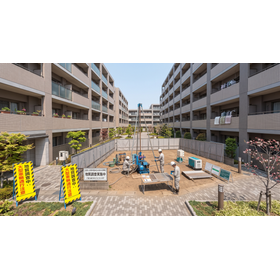
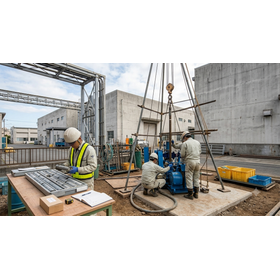
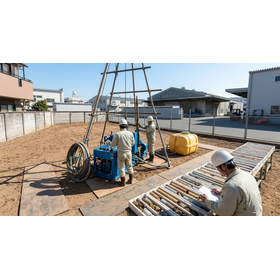
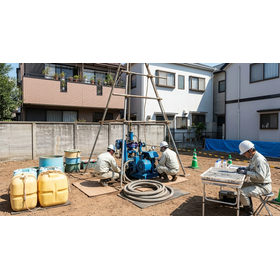
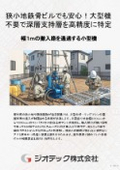
In the construction of steel frame buildings in urban areas with limited space, traditional boring methods often face challenges such as space shortages, high costs, and long-term temporary setups. GeoTech's "Automatic Ram Sounding Test" employs an ultra-compact self-propelled crawler machine with a width of 830 mm, allowing for easy access and setup even in restricted transport routes. It features a fully automatic striking mechanism with a hammer weighing 63.5 kg, capable of penetrating hard layers with an N value exceeding 30, which are difficult to reach with SWS tests, and can advance to depths of around 30 meters. By simultaneously measuring the number of strikes and rotational torque to correct for surface friction, it provides high-precision ground strength data with correlation equivalent to that of boring. The dry construction method, which does not require scaffold assembly and does not use water, eliminates the hassle of temporary setups and removals, allowing for verification of support layers with a short construction period and low costs. This effectively mitigates project delays and budget overruns.

Inquire About This Product
basic information
The testing system consists of a fully automatic self-propelled automatic ram sounding survey machine (YBM model CRS-12). Its dimensions are 830 mm in width (1,000 mm during operation), 2,350 mm in length, and 2,570 mm in height, with a body weight of approximately 1,630 kg, making it compact and easily transportable to the site using a 2-ton truck. A hammer weighing 63.5 kg is dropped freely from a height of 500 mm (22 times per minute) to conduct dynamic cone penetration tests. The number of impacts (Ndm) and the rotational torque (Mv) are automatically recorded for every 200 mm of penetration, and the converted N value is derived using torque correction. It is capable of measurements up to a maximum depth of about 30 m.
Price information
Please contact us.
Delivery Time
Applications/Examples of results
It is ideal for new foundation surveys of steel frame buildings, commercial stores, and apartment complexes in urban areas with narrow spaces and high density where large boring machines cannot enter. It is utilized when you want to accurately set the specifications and lengths of foundation piles based on reliable ground data while keeping expensive boring survey costs and long temporary periods in check. Additionally, it is widely used for efficiently understanding subsurface conditions through point measurements at multiple locations and for quickly securing data equivalent to boring for building reviews and submissions to third-party organizations.
catalog(3)
Download All Catalogs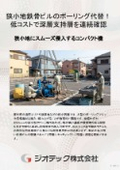

Company information

-