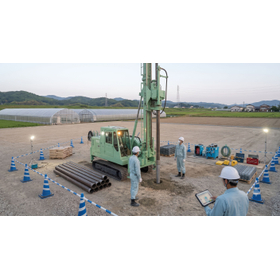
Ground reinforcement work | Visualizing construction quality through casting torque management with the ETP-G method.
Ground reinforcement work

Proving reliable support layer establishment with automatic monitoring of total installation torque! The ETP-G method boasts advanced quality control and traceability.
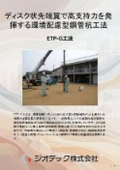
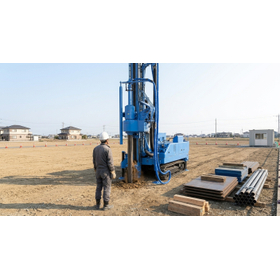
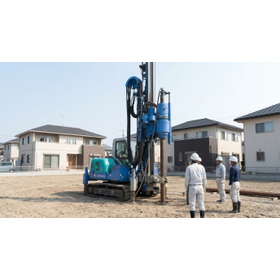
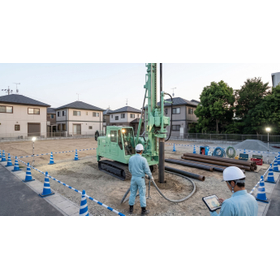
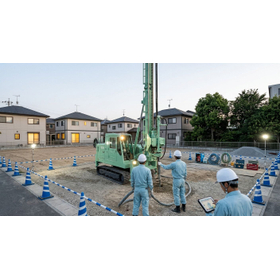
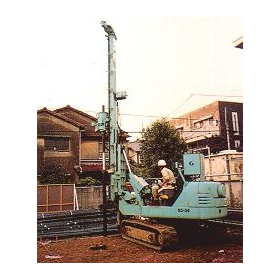
In ground reinforcement work, it is essential to prevent differential settlement risks in advance and to demonstrate the safety of structures through the visualization of construction data and reliable quality management. GeoTech's ETP-G method is a steel pipe pile method equipped with a disc-shaped enlarged wing and a triangular excavation auxiliary bit at the tip. Its structure prevents axial deviation during rotary insertion, allowing for smooth drilling and exhibiting high load-bearing capacity. The strength of this method lies in its real-time monitoring system through construction management devices. It automatically measures and saves the penetration torque, rotation speed, and depth values during installation, scientifically confirming the reach to the bearing layer. By employing a no-excavation method that does not use cement milk, it eliminates the risks of generating excavation residual soil and contaminating soil and groundwater. It can be applied to buildings with three stories or fewer and a total floor area of less than 1,500 square meters, allowing for optimal design from seven types of pile diameters and 45 types of wing diameter variations. Our company delivers assured safety and high quality to clients through strict traceability management in compliance with ISO 9001 quality management standards.
Inquire About This Product
basic information
The ETP-G method features main components with an outer diameter of the shaft steel pipe ranging from φ89.1mm to φ216.3mm (a total of 7 types), wall thickness from 3.2mm to 12.7mm, and materials STK400 and STK490. A total of 45 types of tip widening wings are available, with diameters ranging from 223mm to 620mm (thickness from 12mm to 22mm, material SM490A, etc.), allowing for precise selection based on building loads and support conditions. The maximum construction depth is 130 times the pile diameter and no more than 19.2m from the ground surface of the reinforced material. It is suitable for sandy soil (including gravelly soil) and clayey soil, and the allowable vertical bearing capacity can be accurately calculated from SWS test and SRS test data.
Price information
Delivery Time
Applications/Examples of results
This construction method is ideal for single-family homes, apartments, stores, and offices with three stories or fewer (up to 13 meters in height and a total floor area of 1,500 square meters or less), as well as for ground reinforcement of retaining walls and various structures up to 3.5 meters in height. It is particularly effective in construction projects where strict requirements for post-construction quality inspections and objective evidence of construction data are demanded. Because it allows for real-time monitoring and data management of the pouring situation, it is widely used in sites where clear quality evidence needs to be disclosed to clients and supervisors, as well as in ground reinforcement work by major house manufacturers and construction companies that emphasize traceability management.
catalog(3)
Download All Catalogs
Company information

-
![[Cart Customization Support] Blind spot confirmation that can be installed on any bridge inspection cart.](https://image.www.ipros.com/public/product/image/2101191/IPROS10664339049652487136.png?w=280&h=280)