
Subsidance correction work | Floor tilt restoration and low-noise ground reinforcement for used housing sales assessment
Subsidance correction work

Fundamental solutions for floor slope issues and dizziness problems pointed out in inspections! Enhancing the asset value and livability of existing homes with low-noise hydraulic jack methods.
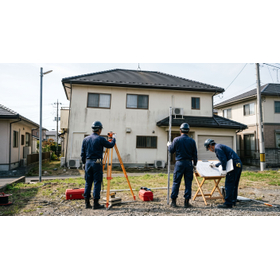
This document is a technical material that clearly explains the sinking correction work to rectify floor tilts, which can be a bottleneck in used housing transactions and renovation proposals, thereby resolving dizziness issues for residents and enhancing the asset value of the building. Millimeter-level floor tilts caused by uneven ground subsidence can create illusions in the human vestibular system and semicircular canals, leading to chronic dizziness, headaches, and other health problems. At Geotech, we conduct building perimeter level measurements using high-precision levels and SWS tests to objectively visualize the degree of subsidence and ground conditions as digital data. For tilt correction, we apply a low-noise hydraulic jack method that utilizes the building's own weight as a counterforce, allowing for precise leveling without placing excessive burden on the superstructure. Even in narrow sites where large machinery cannot enter, we can safely carry out the work in a short period while residents remain in the building. After restoration, we prevent re-subsidence through the insertion of steel pipe piles and the injection of bubble mortar, and we also accommodate the reattachment of ground guarantees. This strongly supports the reliability of real estate transactions and renovation work.
Inquire About This Product
basic information
This technical specification describes a system that objectively identifies the causes of tilt using a high-precision building perimeter level measuring device and SWS ground investigation equipment, and corrects the level to a millimeter precision using a low-noise hydraulic jack unit. The building's own weight is utilized for the lifting reaction force, and a carbon steel pipe (STK400 standard) with an outer diameter of 114.3 mm or greater, or a steel pressure-resistant plate (12 mm or thicker), is used for the foundation support on the bearing layer. After jacking up, a lightweight bubble mortar with excellent fluidity is pumped into the void under the floor to equalize the ground pressure, and high-adhesion epoxy resin injection treatment is performed on foundation cracks to fully restore the durability and toughness of the foundation itself.
Price range
Delivery Time
Applications/Examples of results
It is ideal for correcting building inclinations in the purchase and resale of used homes and renovation projects, as well as for addressing subsidence issues identified in inspection surveys. It can be utilized to prevent health problems such as dizziness and headaches for existing residents, restoring a comfortable living environment. It is effective in various situations, including narrow sites where large excavators cannot enter, homes close to property boundaries, renovation sites where residents wish to continue living without moving, localized subsidence and crack repairs in mat foundations, addressing warranty responsibilities, and asset evaluation measures before buying and selling, all while scientifically ensuring the structural safety of buildings.
catalog(4)
Download All Catalogs



Company information

-