Construction method Product List and Ranking from 1592 Manufacturers, Suppliers and Companies

Last Updated: Aggregation Period:Dec 10, 2025~Jan 06, 2026
This ranking is based on the number of page views on our site.

Construction method Manufacturer, Suppliers and Company Rankings

Last Updated: Aggregation Period:Dec 10, 2025~Jan 06, 2026
This ranking is based on the number of page views on our site.

  1. Taiyo Kisokogyo Co.,Ltd. Aichi//General contractors and subcontractors
  2. ナカムラ Hyogo//Other construction industries
  3. 水研 Shiga//Building materials, supplies and fixtures manufacturers
  4. 4 シーカ・ジャパン Tokyo//Building materials, supplies and fixtures manufacturers
  5. 5 HOKOKU ENGINEERING CO.,LTD. Osaka//Other construction industries

Construction method Product ranking

Last Updated: Aggregation Period:Dec 10, 2025~Jan 06, 2026
This ranking is based on the number of page views on our site.

  1. Construction method for achieving large wooden structures: "NK Method" ナカムラ
  2. Install the valve without stopping the water! 'EM Continuous Water Valve Method' 水研
  3. Foundation Omega Method HOKOKU ENGINEERING CO.,LTD.
  4. 4 側溝修繕工法『ネプラス工法』<施工前後の写真付き資料進呈> ネプラス工法全国会 本部
  5. 5 [Disaster Measures] A must-see for those who want to reduce the amount of leftover soil! Liter Method 吉光組

Construction method Product List

4186~4200 item / All 4277 items

Displayed results

Mesh Formwork Panel Method "Eco Well Mesh"

A new concept of non-demolition concrete formwork! It can be used as the foundation of the building even after pouring the concrete!

"Eco Well Mesh" is a concrete formwork developed based on a completely different concept from traditional formwork methods such as conventional frames and conventional lath formwork, by processing iron wire frames and combining them with specialized wire mesh. Since it can be used as the foundation of the building after pouring concrete, there is no need for dismantling, and no waste is generated. ◎ We are currently seeking sales agents! 【Features】 ■ Custom-made production eliminates the need for on-site processing ■ Easy assembly allows for shortened construction time ■ Zero waste means no cleanup is necessary on-site ■ Can be used at the bottom of beams and is easy to install *For more details, please request materials or view the PDF data from the download.

  • Formwork material
  • Dismantling and moving

Added to bookmarks

Bookmarks list

Bookmark has been removed

Bookmarks list

You can't add any more bookmarks

By registering as a member, you can increase the number of bookmarks you can save and organize them with labels.

Free membership registration

Ceramax Method

Proposals for preventive maintenance and longevity of aging steel and concrete structures.

We would like to introduce our "Ceramax Method." It has ultraviolet durability that is several times greater than that of conventional paints, and it is effective for concrete corrosion prevention due to its salt resistance, prevention of neutralization, and waterproofing properties. It penetrates and hardens in fine pores of around 1μm due to its low molecular weight, providing high rust prevention capability. Additionally, the paint used in this method, Ceramax, has passed Type I and Type II tests for civil engineering anti-fouling materials. 【Features】 ■ Rust prevention capability ■ Weather resistance ■ Concrete corrosion prevention ■ VOC reduction ■ Shortened construction period ■ Non-combustibility *For more details, please download the PDF or feel free to contact us.

  • Renovation and repair methods

Added to bookmarks

Bookmarks list

Bookmark has been removed

Bookmarks list

You can't add any more bookmarks

By registering as a member, you can increase the number of bookmarks you can save and organize them with labels.

Free membership registration

Steel Slit Wall Construction Material Prices and Estimation Data

Please use this as construction material for steel slit walls.

This document contains construction prices and estimation materials for "Steel Slit Walls." [Contents] ■ Construction Prices ■ Estimation Materials *For more details, please refer to the catalog or feel free to contact us.

  • Retaining wall
  • Civil Engineering Method

Added to bookmarks

Bookmarks list

Bookmark has been removed

Bookmarks list

You can't add any more bookmarks

By registering as a member, you can increase the number of bookmarks you can save and organize them with labels.

Free membership registration

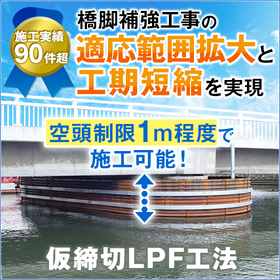
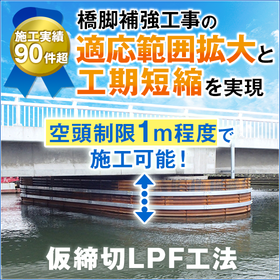
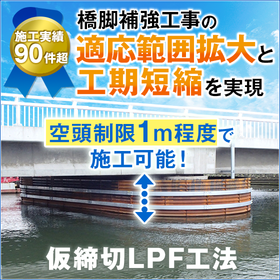
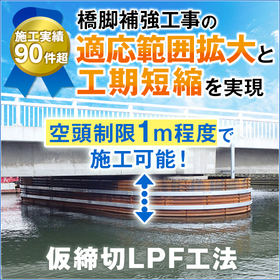
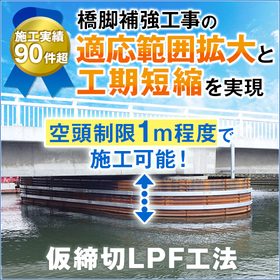
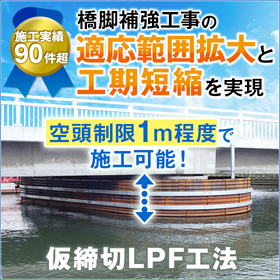
LPF method for temporary closure supporting pier reinforcement with abundant achievements.

Over 90 construction achievements and more than 110 target bridge piers. Supporting bridge pier reinforcement work nationwide safely and efficiently with proven know-how.

The "Temporary Closure LPF Method" is a well-established technique for constructing temporary closures using liner plates in underwater structures such as rivers, seas, and dams. By minimizing custom components for each pier and allowing for shape selection based on site conditions, it contributes to shortening the construction process and ensuring stable construction quality. It is also compatible with manual construction, having numerous successful projects even in sites with strict headroom restrictions (approximately 1.0m). *Please take a look at the collection of case studies summarizing our construction achievements. 【Features】 ■ Composition of liner plates + H-beam reinforcement rings + support structures ■ Assembled above water and then installed underwater ■ Compatible with narrow and vibration-free construction ■ Usable even under low headroom conditions

  • Renovation and repair methods

Added to bookmarks

Bookmarks list

Bookmark has been removed

Bookmarks list

You can't add any more bookmarks

By registering as a member, you can increase the number of bookmarks you can save and organize them with labels.

Free membership registration

A temporary closure LPF method capable of adapting to various site conditions.

Wide-ranging support for rivers, seas, and dams. Temporary closure methods suitable for bridge pier reinforcement that are easy to adopt even under low headroom and narrow conditions.

The "Temporary Closure LPF Method" is a temporary closure method that has been adopted in various underwater environments such as rivers, seas, and dams. Since it allows for the selection of the optimal shape according to site conditions, it enables flexible construction plans even in sites with spatial constraints that are difficult to address with conventional methods. It is also compatible with manual construction, making it easy to implement even in bridge pier reinforcement work where headroom restrictions are strict. *For details, please refer to the construction case collection and method comparison materials. 【Features】 ■ Temporary closure structure using liner plates ■ Above-water assembly and underwater installation method ■ Suitable for low headroom and narrow areas ■ Construction that suppresses vibrations is possible

  • Renovation and repair methods

Added to bookmarks

Bookmarks list

Bookmark has been removed

Bookmarks list

You can't add any more bookmarks

By registering as a member, you can increase the number of bookmarks you can save and organize them with labels.

Free membership registration

Temporary closure LPF method suitable for bridge pier reinforcement work

Considering the actual conditions of repair and reinforcement work. A temporary closure method that achieves stable construction even under narrow and low headroom conditions.

In bridge repair and reinforcement work, what is important is the reliable temporary closure construction in a limited working space. The temporary closure LPF method adopts a structure that can be assembled and installed even in narrow areas and low headroom conditions. Due to vibration-free construction, it is possible to ensure both safety and workability while minimizing the impact on existing structures. *Please refer to the case study collection that includes examples of its use in reinforcement work. 【Features】 ■ Temporary closure structure using liner plates ■ Above-water assembly and underwater installation method ■ Compatible with low headroom and narrow areas ■ Vibration-reduced construction is possible

  • Renovation and repair methods

Added to bookmarks

Bookmarks list

Bookmark has been removed

Bookmarks list

You can't add any more bookmarks

By registering as a member, you can increase the number of bookmarks you can save and organize them with labels.

Free membership registration

Temporary closure LPF method supporting offshore pier construction

Corresponds to the reinforcement of bridge piers in marine and port areas. A temporary closure method with vibration-free construction to minimize the impact on surrounding facilities.

In reinforcement work for harbor areas and offshore bridge piers, consideration for surrounding facilities and navigation environments is essential. The temporary cutoff LPF method adopts a structure that allows for vibration-free construction, achieving temporary cutoff work that takes into account the marine environment. It also accommodates manual construction, making it an easy-to-implement method even in harbor areas with limited working space. *Please check the construction examples of harbor and offshore work. 【Features】 ■ Temporary cutoff structure using liner plates ■ Above-water assembly and underwater installation method ■ Suitable for low headroom and narrow areas ■ Construction that minimizes vibrations is possible

  • Renovation and repair methods

Added to bookmarks

Bookmarks list

Bookmark has been removed

Bookmarks list

You can't add any more bookmarks

By registering as a member, you can increase the number of bookmarks you can save and organize them with labels.

Free membership registration

Temporary closure LPF method supporting seismic reinforcement of bridges

Corresponds to reinforcement and renewal work for existing bridges. A temporary closure method that is easy to consider even in seismic reinforcement projects with many constraints.

In the seismic reinforcement and longevity enhancement project for existing bridges, a construction plan that utilizes existing structures is required. The temporary closure LPF method can be implemented even in narrow conditions and low headroom environments, making it a chosen temporary closure method for seismic reinforcement work. By minimizing custom components, it also contributes to the overall project schedule management. *Examples of its application in seismic reinforcement work are included. 【Features】 ■ Temporary closure structure using liner plates ■ Above-water assembly and underwater installation method ■ Suitable for low headroom and narrow areas ■ Construction that minimizes vibrations is possible

  • Renovation and repair methods

Added to bookmarks

Bookmarks list

Bookmark has been removed

Bookmarks list

You can't add any more bookmarks

By registering as a member, you can increase the number of bookmarks you can save and organize them with labels.

Free membership registration

Temporary closure LPF method that can be constructed even under heavy machinery restrictions.

A temporary closure method that is easy to implement even for bridge pier reinforcement work where heavy machinery cannot be used, accommodating manual construction.

In bridge pier reinforcement work, the use of heavy machinery may be restricted due to site conditions and surrounding environments. The temporary cutoff LPF method accommodates manual construction, allowing assembly and installation even in low headroom and narrow spaces. It is utilized as a practical temporary cutoff method even at sites with construction constraints. *Please refer to the materials that include examples of manual construction. 【Features】 ■ Temporary cutoff structure using liner plates ■ Above-water assembly and underwater installation method ■ Suitable for low headroom and narrow areas ■ Construction that minimizes vibrations is possible

  • Renovation and repair methods

Added to bookmarks

Bookmarks list

Bookmark has been removed

Bookmarks list

You can't add any more bookmarks

By registering as a member, you can increase the number of bookmarks you can save and organize them with labels.

Free membership registration

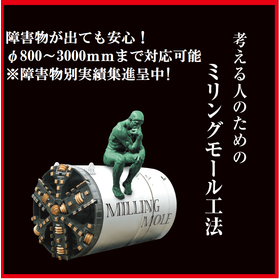
When it comes to construction work, it's the "Milling Mall Method"! *Currently offering a collection of achievements by obstacle type.

[NETIS Registered] No worries even if obstacles arise! A construction method that is starting to be chosen nationwide! Compatible with diameters from φ800 to 3000 mm.

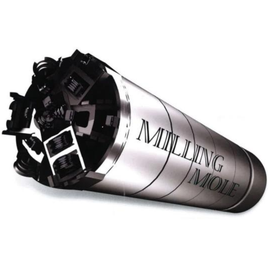
The "Milling Mole Method," a ground obstacle response type mud-based propulsion method equipped with four special functions: exploration, improvement, cutting, and guidance, consists of three devices: a tunneling machine, a special telescopic pipe, and a special injection pipe, allowing for the fine cutting and discharge of underground obstacles. Using electromagnetic waves, it explores metal obstacles ahead while propelling and can also improve the ground from within the tunneling machine before and after the detected obstacles. In the event that an obstacle is detected, a special telescopic device can be used to cut through the underground obstacle at ultra-low speed, allowing for continued propulsion. Additionally, a system is equipped to guide the tunneling machine to a designated position within the arrival shaft by installing a receiving coil at that location, making it the ultimate propulsion method that can lead to high precision even when obstacles are encountered. 【Performance by Obstacle Type】 ■CASE-6: Cutting of steel sheet piles 3W ■CASE-7: Cutting of steel sheet piles 3 and H steel ■CASE-8: Cutting of wooden piles and steel sheet piles ■CASE-9: Cutting of H steel and existing manhole walls ■CASE-10: Cutting of underground continuous walls and metal objects *For more details, please refer to the PDF document or feel free to contact us.

  • Site and ground investigation
  • Civil Engineering Method
  • Special Construction Method

Added to bookmarks

Bookmarks list

Bookmark has been removed

Bookmarks list

You can't add any more bookmarks

By registering as a member, you can increase the number of bookmarks you can save and organize them with labels.

Free membership registration

*Exhibition of Sewers '18 Kitakyushu*

We have showcased the "Underground Obstacle Response Type Mud Density Propulsion Method" that no longer fears obstacles!

**Exhibition Overview** Exhibition Name: Sewer Exhibition '18 Kitakyushu Date: July 24 (Tuesday) - 27 (Friday), 2018, for 4 days Time: 10:00 AM - 5:00 PM Location: West Japan General Exhibition Center Booth: C-822 **Exhibited Products** ■ Subsurface Obstacle-Compatible Slurry Shield Method The milling mole method is used in urban development and is a slurry shield method that safely performs construction by cutting through obstacles left underground. It can detect obstacles ahead of the excavation and discharge them as cutting powder of about 1 cm in size. If necessary, it allows for the injection of chemicals from within the machine and guidance of the tunneling machine using GPS. ■ Jet Method The jet method uses a CCD camera sensor to instantly measure the position of the tunneling machine on sharp curves. It enables long-distance and sharp curve construction in small-diameter tunneling. By using a dedicated pump cylinder and lubricant injection pipe for the jet method, it reduces the load on the pipe, allowing for long-distance tunneling even with small diameters. It is the most excellent all-around tunneling method that does not limit construction locations due to in-pipe measurement.

  • Site and ground investigation
  • Civil Engineering Method
  • Special Construction Method

Added to bookmarks

Bookmarks list

Bookmark has been removed

Bookmarks list

You can't add any more bookmarks

By registering as a member, you can increase the number of bookmarks you can save and organize them with labels.

Free membership registration

A must-see for consultants! Sewer construction for the Olympics and rainwater management.

[Performance Collection Available] No worries even if obstacles appear underground! We detect and capture obstacles about 2 meters ahead of the tunneling machine and cut through them!

The demand for sewer construction is increasing due to the hosting of the Olympics in 2020 and sudden heavy rain, as well as measures for rainwater management. When the demand for construction rises and there is pressure to respond quickly, encountering obstacles buried underground can lead to a loss of time. Therefore, we recommend the milling mole method, which is safe even when encountering underground obstacles! The underground obstacle response type mud-based thrusting method, "milling mole method," is equipped with four special functions: "exploration, improvement, cutting, and guidance." It consists of three devices: a tunneling machine, special bits, and a special telescopic pipe, allowing for the precise cutting and removal of underground obstacles. Using electromagnetic waves, it explores and pushes forward while tunneling through metal obstacles, and it is also possible to improve the ground from within the tunneling machine before and after the detected obstacles. If an obstacle is detected, a special telescopic device can be used to cut through the underground obstacle at ultra-low speed, allowing for continued thrusting. Furthermore, a receiving coil is installed at a designated position within the access shaft, and a system is also equipped to guide the tunneling machine to that position, making it a thrusting method that can accurately reach the destination even when obstacles are present.

  • Site and ground investigation
  • Civil Engineering Method
  • Special Construction Method

Added to bookmarks

Bookmarks list

Bookmark has been removed

Bookmarks list

You can't add any more bookmarks

By registering as a member, you can increase the number of bookmarks you can save and organize them with labels.

Free membership registration

Solving issues with construction methods! "Case Studies for Problem Solving Available"

The advancement construction method often faces many challenges during the excavation process. Here are examples of how those problems were solved!

Have you ever faced any of these issues when performing construction using thrusting methods? ▶ Construction was halted due to encountering obstacles like wooden stakes or H-beams... ▶ The time and cost of construction increased, leading to delays or interruptions... ▶ Construction over difficult distances could not be managed with standard equipment and methods... The "Milling Mole Method" solves these problems associated with thrusting methods! 【Example of a resolved case】 ✔ Sewer construction in Osaka City Planned to push 127 meters in one span using a standard mud slurry method with a diameter of φ80mm. Immediately after starting, the machine encountered wooden stakes, making it impossible to proceed, and the excavation was halted. By changing the plan to adopt the Milling Mole Method, the presence of obstacles was confirmed by discharging wood chips, and the thrusting was completed. ✔ Sewer construction in Osaka Prefecture Planned to push 119 meters in one span using a standard mud slurry method with a diameter of φ1800mm. While excavating about 10 meters, the machine encountered support piles of a bridge pier, making it impossible to proceed, and both the excavation machine and thrusting pipe were left underground. By changing the plan to adopt the Milling Mole Method, re-excavation was carried out from the same launch shaft. The reinforced concrete pipe that became an obstacle was cut, and the discharge of metal fragments, thrusting pipe collars, and rebar was confirmed, allowing safe passage through the obstacle section, and the thrusting was completed. *We are currently providing materials such as "Case Studies of Problem Solving" and "Comparison of Methods for Dealing with Obstacles in Thrusting Methods" from the PDF!

  • Special Construction Method
  • Sewerage facilities

Added to bookmarks

Bookmarks list

Bookmark has been removed

Bookmarks list

You can't add any more bookmarks

By registering as a member, you can increase the number of bookmarks you can save and organize them with labels.

Free membership registration

Soil cutting and reinforcement method "RBP Wall Method" [*NETIS registered method*]

Prevent collapse by stabilizing cut slopes and embankment earth! *For a limited time, we are offering technical materials that include examples of application and construction sequence for free!

The "RBP Wall Method" is a slope construction technique that involves excavating the ground from the top of the slope while securing the slope with reverse bolt panels as it is lowered. By combining reverse bolt paneling with rebar insertion, it prevents collapse through the stabilization of cut slopes and the surrounding ground. This method is applicable for road widening, land development, steep slope countermeasures, fall prevention measures, and slope stabilization in areas with small ground stress, limited space, or adjacent to structures. [NETIS Number: QS-160035-A] **Features** - Can be extended in either vertical direction - Always ensures slope stability - Allows excavation on steep slopes even in areas with low ground strength - Has significant resistance to ground behavior during earthquakes and other events *For detailed features, application examples, and construction procedures, please download the PDF of the "RBP Wall Method" technical documentation.*

  • Civil Engineering Method
  • Earthquake-resistant construction method

Added to bookmarks

Bookmarks list

Bookmark has been removed

Bookmarks list

You can't add any more bookmarks

By registering as a member, you can increase the number of bookmarks you can save and organize them with labels.

Free membership registration

Mini wall construction method

A ground continuous wall method that can accommodate narrow sites and allows for construction at a maximum depth of 20 meters with small machinery. It can also be adapted for permanent retaining walls through the installation of concrete sheet piles!

The "Mini Wall Method" is a construction technique that creates a soil-cement underground continuous wall with high water-stopping ability and uniform vertical strength by mixing and agitating cement slurry discharged from the base ground and the bottom end of the posts using a chainsaw-type cutter mounted on a cutter post in a vertical direction. Since uniform thickness walls can be created, it is possible to install core materials at arbitrary intervals, allowing for high design flexibility and economical soil retention and water-stopping continuous walls. 【Features of the Mini Wall Method】 - Due to the uniform thickness of the wall, the installation interval of the stress core materials can be set arbitrarily. - Wall thickness can be adjusted by changing the cutter bits. - Construction is possible close to structures and at property boundaries. - The use of a suspended leader allows for step construction (5-6 meters). *Please refer to the PDF data for the catalog and construction examples of the "Mini Wall Method" available for download.

  • Ground foundation construction method
  • Other earthworks, foundation works, and exterior floors

Added to bookmarks

Bookmarks list

Bookmark has been removed

Bookmarks list

You can't add any more bookmarks

By registering as a member, you can increase the number of bookmarks you can save and organize them with labels.

Free membership registration