Ground reinforcement work | Cost reduction by omitting mix tests with uniform strength CWC method.
Ground reinforcement work

The Cross Wing Column Method that brings about a quality revolution in ground reinforcement work. It achieves the omission of mixing tests and ensures uniform strength with patented technology that has a coefficient of variation of 25% or less.
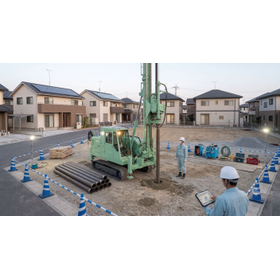
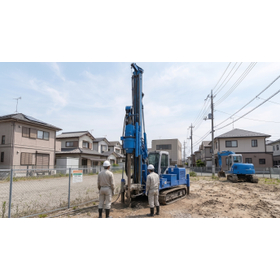
The variation in strength of improved bodies in ground reinforcement work is a direct cause of differential settlement accidents in buildings. The Cross-Wing Column Method (CWC Method) developed by Geotech Co., Ltd. thoroughly mixes the on-site soil and cement slurry using patented intersecting six-blade mixing wings, creating uniform and high-quality columnar bodies through deep mixing treatment. It has achieved a coefficient of variation of 25% or less in performance verification tests for sandy soil, clayey soil, and loam layers, allowing for a smaller markup factor in quality control, which effectively reduces excessive cement addition. Furthermore, due to this exceptional quality stability, the omission of preliminary indoor mixing tests for small-scale buildings is officially recognized. Quality inspections can also apply "Inspection Method A" using on-site produced cores (molded cores), enabling significant cost reductions for preliminary tests and substantial shortening of construction periods. We provide rational reinforcement proposals with reliable technology that has obtained the GBRC performance certification (No. 12-17 Rev. 1) from the General Incorporated Foundation Japan Building Comprehensive Testing Institute.
Inquire About This Product
basic information
The specifications of the CWC method, which excels in uniformity of strength, are applicable to sandy soil, clayey soil, and loam layers. The improved column diameter ranges from φ400mm to φ1200mm, with a design standard strength of 400 to 1500 kN/m², covering a maximum improvement length of 22m (12m for loam and 12m for small-scale). It maintains a coefficient of variation of 25% or less through six intersecting mixing blades, excluding the patented excavation wing. The number of blade cuts (at least 450 to 550 cuts/m) is strictly adhered to, and it is a reliable technical specification that can also accommodate conditions for omitting mixing tests.
Price information
Delivery Time
Applications/Examples of results
This construction method is ideal for various building projects that absolutely want to avoid risks related to quality dispersion and strength nonconformity in ground improvement. It is effective for small-scale buildings such as single-family homes, apartments, and stores, where sites aim to reduce budgets and shorten construction periods by omitting pre-mixing tests, as well as for contractors and design offices that want to prevent excessive additive use and implement rational ground reinforcement. Furthermore, it can be widely utilized for various applications where uniform strength is emphasized, such as retaining walls, structures, and tower foundations.
catalog(4)
Download All Catalogs
Company information

-