Ground reinforcement work | Achieving cost reduction in construction by suppressing excessive design with the CWC method.
Ground reinforcement work

For those troubled by the rising costs of ground reinforcement work, the CWC method achieves economical foundation reinforcement by suppressing excessive additive use and omitting mix tests.
In ground reinforcement work, it is very important to achieve both the certainty of appropriate construction and the optimization of costs simultaneously. Geotech Co., Ltd.'s Cross-Wing Column Method (CWC Method) uses patented intersecting six-blade mixing wings to suppress the coefficient of variation, which indicates strength dispersion, to below 25%, preventing the excessive use of cement solidifying agents. Due to the extremely low variability in quality, the quality control markup factor can be set low, directly leading to a reduction in material costs. Furthermore, for small-scale buildings, the omission of indoor mixing tests and the selection of "Inspection Method A" using site-made cores (mold cores) are permitted, significantly reducing the burden of pre-test costs and on-site sampling inspections. With high reliability certified by GBRC Performance Certification (No. 12-17, Revision 1), it strongly supports shortening construction periods and reducing budgets. We provide rational ground reinforcement plans. Please feel free to contact us when considering your options.
Inquire About This Product
basic information
The CWC method can be applied with special specifications for small-scale buildings and similar structures. The amount of solidifying agent is set at 150 kg/m3 or more for sandy soil, 200 kg/m3 or more for clayey soil, and 300 kg/m3 or more for loam (using loam-compatible solidifying agents), and when omitting the mixing test, it is set at 300 to 350 kg/m3 or more. The design strength standards are 400 to 1200 kN/m2 for sandy soil, 400 to 1000 kN/m2 for clayey soil, and 400 to 800 kN/m2 for loam under small-scale conditions, covering 400 to 1500 kN/m2 under general conditions. The maximum improvement length is 22 m (12 m for small-scale), providing a rational specification without excessive additives.
Price information
Delivery Time
Applications/Examples of results
This construction method is optimal for single-family homes and various small-scale building projects where there is a strong demand for reducing construction costs and shortening construction periods. It has been widely adopted for ground reinforcement work for apartments, stores, garages, and other projects that want to shorten the preparation period from design to construction by taking advantage of the benefit of omitting mix tests. Furthermore, the flexible settings for the improvement diameter (φ400mm to φ1200mm) allow for adaptation to a wide variety of applications, such as retaining walls, structures, and tower foundations, with a minimal number of piles. It has achieved very high results as a solution to the challenges faced by contractors and general contractors aiming to optimize construction budgets.
catalog(4)
Download All Catalogs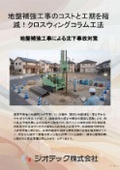
Company information

-