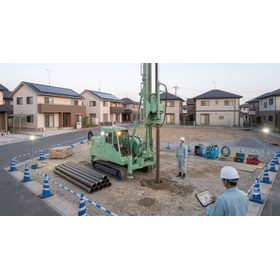
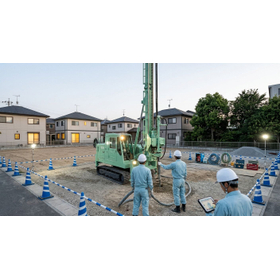
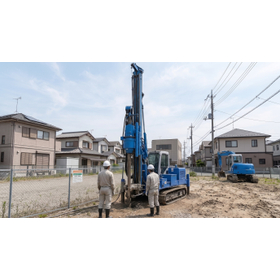
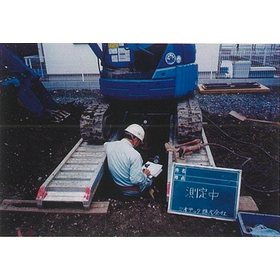
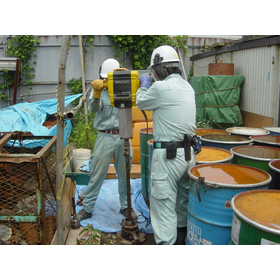
Ground reinforcement work | Providing objective assurance with the CWC method of GBRC performance certification.
Ground reinforcement work

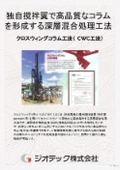
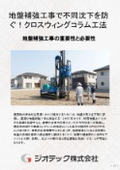
The Cross-Wing Column Method enhances the reliability of ground reinforcement work. It objectively demonstrates structural safety with a reliable technology that has obtained GBRC performance certification.
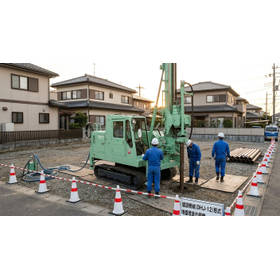
To ensure the safety and durability of architectural structures, ground reinforcement work based on objective technical evidence is essential. The Cross Wing Column Method (CWC Method) developed by Geotech Co., Ltd. is a highly reliable deep mixing treatment method that has obtained the GBRC performance certification (No. 12-17 Rev. 1) from the Japan Building Disaster Prevention Association. The patented intersecting six-blade mixing wings efficiently and forcibly mix the local soil with cement slurry, forming high-quality columns that are not affected by soil quality. It can accommodate sandy soils, clayey soils, and loam layers, adapting to a wide range of design conditions with public evidence, including design strength standards of 400 to 1500 kN/m² and a maximum improvement length of 22 m (12 m for small-scale projects). Additionally, for small-scale buildings, the omission of mixing tests and inspection method A using mold cores are permitted, ensuring quality at a third-party certification level while keeping costs and construction periods down. Geotech provides reliable ground reinforcement under strict QMS management, facilitating smooth building confirmation applications. Please feel free to contact us.
Inquire About This Product
basic information
The specifications for the Cross Swing Column Method (CWC Method) comply with the GBRC performance certification (No. 12-17 Revision 1). The applicable ground types are sandy soil, clayey soil, and loam layers, with column diameters selectable from φ400mm to φ1200mm. The design standard strength ranges from 400 to 1500 kN/m² (for small-scale buildings, it is 400 to 1200 kN/m²). The maximum improvement length is generally specified as 22m (12m for loam), and 12m for small-scale specifications. The number of blade cuts must strictly adhere to a minimum of 450 cuts/m for sandy and clayey soils, and 550 cuts/m for loam layers. The amount of solidifying agent and the water-to-solidifying agent ratio are also clearly defined for reliable design.
Price information
Delivery Time
Applications/Examples of results
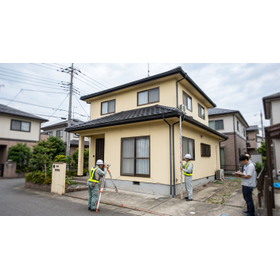
This construction method is ideal for building projects that require technical certification from third-party organizations or the presentation of objective structural safety. It is widely used for residential purposes such as single-family homes, apartments, and mid-rise condominiums, as well as for ground reinforcement of retaining walls, structures, and tower foundations where smooth progress of confirmation applications and conformity assessments is desired. In particular, it is chosen as a ground improvement technology that can publicly demonstrate safety in sites where clear evidence is needed for clients and warranty organizations, as well as in public and private construction projects that emphasize the traceability of quality data.
catalog(4)
Download All Catalogs
Company information

-