Ground reinforcement work | Constructing high-strength piles with the Pure Pile method that are unaffected by soil conditions.
Ground reinforcement work

We propose the Pure Pile method, which forms pile-like reinforcement using high-strength cement milk without mixing with local soil, preventing any influence from soil conditions and avoiding differential settlement.
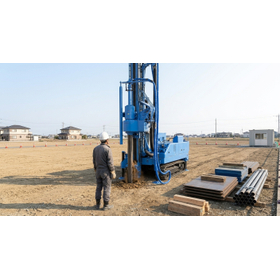
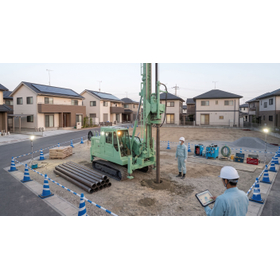
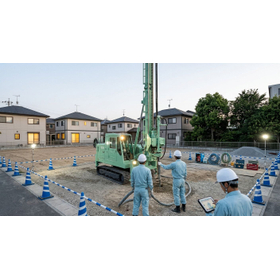
To ensure the structural safety of buildings over a long period, it is essential to accurately analyze the characteristics of the local ground and to carry out appropriate ground reinforcement work to prevent uneven settlement. The Pure Pile method proposed by Geotech Co., Ltd. is an innovative ground reinforcement technology that constructs pile-like reinforcement bodies by directly replacing the ground with high-strength cement milk while expanding the ground laterally using a conical excavation head. Because it uses a 100% cement milk structure without mixing with local soil, it is unaffected by soil quality in diverse ground conditions, including humus layers, and can consistently demonstrate the planned high strength and quality. By evenly distributing a large number of reinforcement bodies with a design pile diameter of 20 cm, it supports the building load in a balanced manner across the surface, achieving high vertical bearing capacity and effectively eliminating the risk of settlement accidents in structures. Additionally, due to the construction structure that generates almost no residual soil, it reduces the costs of transporting and disposing of leftover soil from the site. At Geotech, under an ISO-certified quality management system, specialized construction technicians thoroughly manage real-time data to provide reliable and trustworthy foundation reinforcement.
Inquire About This Product
basic information
The design pile diameter of this construction method is a uniform specification of 20 cm, and the maximum construction depth can accommodate up to 10 m from the construction ground surface. The applicable ground types are sandy soil, clayey soil, and humus soil. The applicable buildings are small-scale structures such as single-family homes with three stories or fewer, a height of 13 m or less, an eave height of 9 m or less, and a total floor area of 1500 square meters or less, as well as ground slabs. This technology has obtained the Building Technology Performance Certification from the General Incorporated Foundation Japan Building Comprehensive Testing Institute (GBRC Performance Certification No. 11-28). With a replacement pile structure made of 100% cement milk that does not mix with the local soil, it boasts high quality stability and suppresses the discharge of on-site generated residual soil through the use of straight rods.
Price information
Delivery Time
Applications/Examples of results
It is mainly used for ground subsidence measures and foundation reinforcement in buildings such as wooden, steel frame, and reinforced concrete single-family homes, multi-family residences, and small-scale stores. It is particularly suitable for ground measures in soft ground with a distribution of humus layers and in special soil conditions where poor solidification is likely to occur due to mixing with local soil. Furthermore, it is widely adopted in sites that require measures to prevent subsidence of factory and warehouse floor slabs, as well as in projects aiming to significantly reduce the amount of construction waste generated. It contributes to practical applications as a safe and reliable ground reinforcement solution in the foundation design of small-scale buildings, where a certain vertical bearing capacity and high quality stability are required.
catalog(4)
Download All Catalogs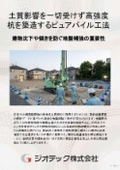

Company information

-