Site Investigation | Optimization of Foundation Costs for Custom Homes to Prevent Excessive Improvement on Weak Ground
Ground investigation

An optimization method that prevents excessive improvement through soil quality assessment and soil strength evaluation using the SDS test, significantly reducing foundation costs while maintaining the safety of custom-built homes.
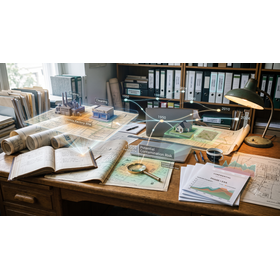
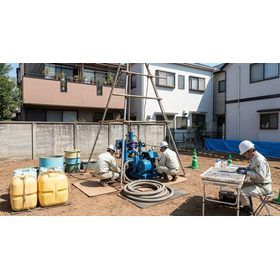
This technical proposal is a ground investigation and analysis solution that prevents excessive ground improvement work in soft ground and optimizes the foundation costs of custom homes. By digitally measuring soil conditions that were difficult to distinguish with conventional simple sounding tests using the SDS test, we objectively identify sandy soils, clayey soils, loam, and humus based on rotational torque and penetration resistance. Furthermore, by combining depth-specific stress propagation analysis of building loads with our unique judgment criteria based on an annual track record of 100,000 cases, we accurately evaluate the inherent bearing capacity of the ground (allowable bearing capacity). This approach avoids uniform deep improvement and excessive pile work, maximizing the potential for direct foundations such as slab foundations and strip foundations. Additionally, clear reports that visualize subsurface cross-sections and settlement predictions facilitate technical explanations to clients and streamline consensus building. Through appropriate design based on evidence-based technical data, we contribute to significant reductions in construction costs and improvements in builders' gross profit margins, while also smoothly addressing the review of ground warranty systems, strongly supporting the creation of safe and secure homes.
Inquire About This Product
basic information
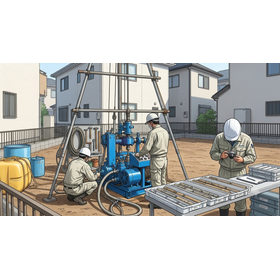
The applicable targets are small wooden houses and S-structure and RC-structure detached houses. The survey methods available include SDS testing, SWS testing, hand auger boring, and plate load testing. The main measurement items are impact and penetration resistance values, rotational torque, penetration speed, and ground pressure by depth. In data analysis, we will conduct long-term allowable stress calculations and load diffusion settlement analysis, in addition to our unique evaluation criteria of three items and eight elements (strength, shrinkage, deformation). As a deliverable, we will issue a detailed ground investigation report that includes subsurface cross-sectional diagrams and future settlement prediction graphs.
Price information
Please contact us.
Delivery Time
※Please contact us.
Applications/Examples of results
It is widely used for ground assessment during the planning of custom-built and single-family homes for new construction and rebuilding. It is optimal for preventing excessive construction costs due to ground improvement, reviewing foundation specifications through ground second opinions, and determining the feasibility of adopting direct foundations (slab foundations and strip foundations). It can provide clear technical explanations and justifications for clients regarding foundation specification decisions, and can be used as evidence for applications to major ground warranty systems. Furthermore, it can effectively be utilized to improve gross profit margins for contractors and builders, control total construction costs, and differentiate proposals for construction quality during sales.
catalog(2)
Download All Catalogs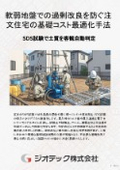

Company information

-

![[For Construction Companies] Ground Survey | Optimization of Housing Foundation Costs for Weak Soils](https://image.www.ipros.com/public/product/image/321794/IPROS16099699817276184985.png?w=280&h=280)

![[Not Public] Soil Contamination | Category B](https://image.www.ipros.com/public/product/image/321794/IPROS4400175568595756491.jpg?w=280&h=280)