Ground Investigation | Analysis of Subsurface Remnants and Uneven Ground at the Site of a Demolished Wooden Apartment
Boring survey

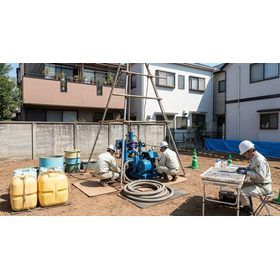
Visualize the risks of residual materials and uneven ground subsidence lurking in the site of a dismantled structure through multi-point penetration tests, fundamentally preventing differential settlement accidents in wooden apartments.
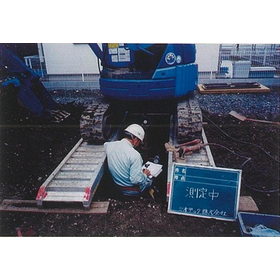
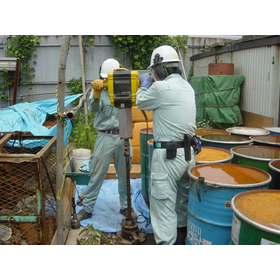
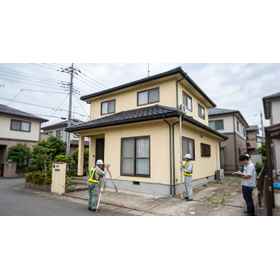
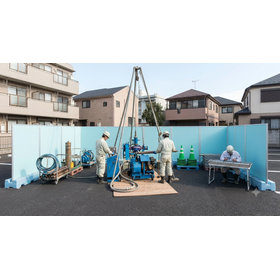
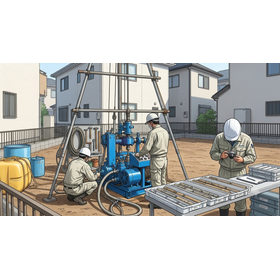
This technology is a ground investigation method that precisely identifies and evaluates the risk of settlement caused by old foundations, demolition debris, and uneven backfill layers remaining on the site of a demolished wooden apartment building. In post-demolition land, the presence of underground remnants and insufficient compaction can easily lead to significant variations in strength within the site, which can cause differential settlement and distortion of structures after new construction. Our service employs multi-point screw weight penetration tests (SWS tests) to finely measure penetration resistance values at various depths, accurately analyzing the stratigraphic profile while appropriately eliminating the influence of obstacles. Furthermore, we conduct comparisons of resistance values between measurement points and simulate estimated deformation angles to quantitatively calculate the differential settlement behavior that affects buildings. Based on the analysis data, we propose rational ground reinforcement plans that best fit the characteristics of uneven ground, such as surface improvement, columnar improvement, and small-diameter steel pipe pile methods. We aim to prevent troubles unique to demolition sites in advance and ensure the structural safety and high-quality evidence of wooden apartments.
Inquire About This Product
basic information
This survey method is based on the Screw Weight Sounding (SWS) test, and hand augers and boring surveys are used as necessary. The applicable depth can reach up to 10 meters below the foundation, and the penetration load and half rotation count are recorded precisely. In data analysis, the Inada method for converting N values is applied, and allowable bearing capacity calculations are performed according to the soil characteristics of cohesive soils and sandy soils. Furthermore, a multi-faceted assessment is conducted based on a unique three-item, eight-element standard (strength, shrinkage, deformation, etc.), and a detailed ground investigation report, including elevation survey data, is prepared and issued.
Price range
Delivery Time
Applications/Examples of results
It is mainly used for new construction and rebuilding projects on the sites of demolished wooden apartments and houses, as well as on uneven ground after the removal of old structures. It is ideal for accurately assessing localized softening and settlement risks caused by leftover demolition debris and uneven backfill soil on the site. It serves as a basis for determining the suitability of direct foundations such as slab foundations and strip foundations, and is used in the design of ground reinforcement works such as surface improvement, columnar improvement, and small-diameter steel pipe piles when necessary. It is also widely used as supplementary material for building confirmation applications and as quality certification evidence for ground warranty organizations.
catalog(3)
Download All Catalogs
Company information

-


![Fence foundation dual-purpose decorative boundary block [Shikīru]](https://image.www.ipros.com/public/product/image/6d4/2000203792/IPROS6592272567679821523.gif?w=280&h=280)