Ground Investigation | Deep Support Capacity Assessment for Data Centers Supporting Ultra High Loads
Boring survey

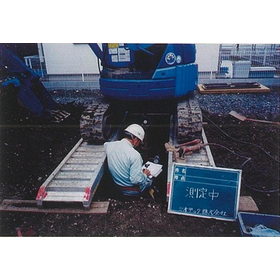
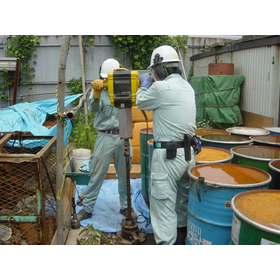
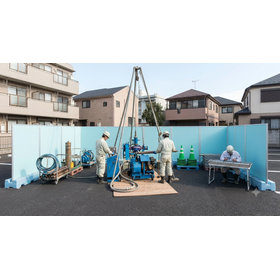
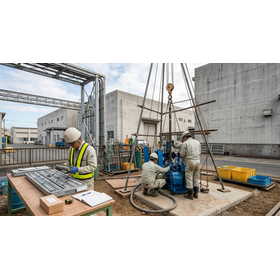
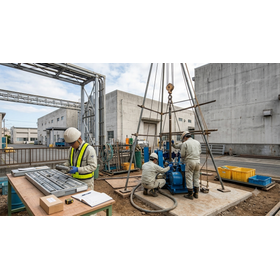
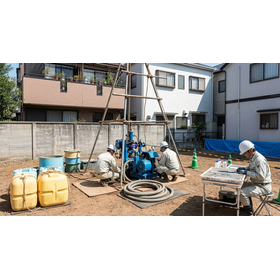
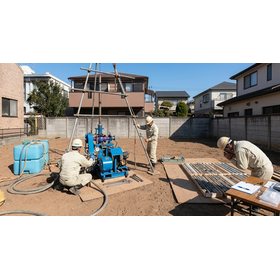
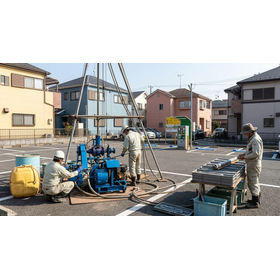
To prevent differential settlement accidents occurring under ultra-high loads in data centers, a precise evaluation of long-term allowable bearing capacity is conducted through deep boring and viscous soil consolidation tests.
In the architecture of data centers that support a highly information-oriented society, a vast number of heavy server racks and uninterruptible power supplies are concentrated, resulting in ground pressures that far exceed those of typical buildings. If there are uneven layers of viscous soil or weak layers in the deep ground, minor yet serious differential settlement may occur after the facility begins operation, posing risks of equipment malfunction and structural damage. Geotechnical ground investigations clarify the properties of deep supporting layers through deep drilling and standard penetration tests. Furthermore, by conducting laboratory consolidation tests using undisturbed samples to identify consolidation yield stress and compression index, we can highly simulate future settlement amounts and convergence behavior. Additionally, by calculating deformation coefficients through in-situ horizontal loading tests and combining them with comparisons of surrounding ground using the database "GEODAS," we present a clearly substantiated long-term allowable bearing capacity. This helps prevent facility accidents and ensures robust structural safety.
Inquire About This Product
basic information
The basic specifications include deep drilling using a boring machine and standard penetration tests, with the acquisition of N values and soil samples at various depths. For cohesive soil layers, undisturbed sample collection (such as thin-walled sampling) will be conducted, and the consolidation yield stress Pc and compression index Cc will be calculated using staged loading consolidation tests based on JIS A 1217. In-situ lateral loading tests (LLT) will directly measure the lateral deformation coefficient E value of the ground from the applied water pressure and the displacement of the borehole wall. These measurement data will be integrated with the company's ground information integration system GEODAS and will be calculated and reported as various constants necessary for structural calculations.
Price range
Delivery Time
Applications/Examples of results
It is applied to the verification of deep soil bearing capacity in the design and development of data centers, AI server buildings, and hyperscale data centers where ultra-high loads are anticipated. It is optimal for determining the overconsolidation ratio of cohesive soil layers and for blocking future risks through consolidation settlement analysis, as well as for obtaining the basis for vertical and horizontal bearing capacity calculations of pile foundations. Furthermore, it can be used for structural compatibility assessments, preparation of documents for building confirmation reviews, prevention of differential settlement issues in large facilities, and as a basis for evaluating long-term safe operations.
catalog(3)
Download All Catalogs
Company information

-
![Fence foundation dual-purpose decorative boundary block [Shikīru]](https://image.www.ipros.com/public/product/image/6d4/2000203792/IPROS6592272567679821523.gif?w=280&h=280)