Site Investigation | Prevention of Settlement Defects in Uneven Ground at the Site of a Demolished Wooden Apartment Building
Site investigation

Quantify the risk of uneven ground subsidence lurking in the site of a demolished structure through multi-point penetration tests, in order to prevent accidents and defects after the handover of wooden apartments.
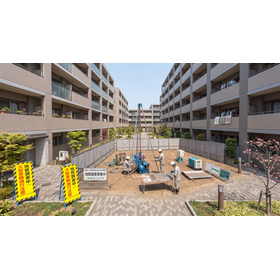
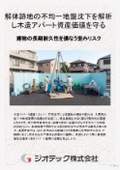
This technology is a ground diagnosis service that precisely identifies the risk of uneven ground subsidence lurking in the demolition site of wooden apartment buildings, preventing uneven subsidence accidents and defect liability issues after handover. In the demolition site of old structures, insufficient compaction of backfill soil and underground obstacles can easily lead to significant strength discrepancies within the site, raising concerns about tilting incidents occurring after the building's completion. This service employs multi-point screw weight penetration tests (SWS tests) to meticulously measure penetration resistance values at various depths, visualizing uneven strata structures and localized weak areas. By calculating and simulating the estimated deformation angles (building tilt) from the resistance differences between measurement points, we quantitatively verify the impact on the structure. By providing objective and highly reliable ground data along with detailed analysis reports, we facilitate the smooth passage of third-party ground guarantee reviews and dramatically reduce after-risk for business owners and builders. We protect the asset value and business reliability of the completed apartments over the long term.
Inquire About This Product
basic information
This survey method adopts the Screw Weight Sounding Test (SWS test) in accordance with JIS A 1221, and precisely measures the penetration resistance values at multiple locations throughout the site. The measurement depth corresponds to a maximum of 10 meters below the foundation, and the incremental load application (25 kg to 100 kg) and half rotations are accurately recorded. In data analysis, the Inada method for converting N values is applied to calculate the allowable bearing capacity according to the characteristics of cohesive and granular soils. Furthermore, a strict assessment based on a unique three-item, eight-element criterion (strength, shrinkage, deformation, etc.) is conducted, and a ground assessment report is issued and bound.
Price information
Please contact us.
Delivery Time
※Please contact us.
Applications/Examples of results
It is used primarily in new construction and rebuilding projects on the sites of demolished wooden apartments to prevent differential settlement accidents and defect compensation troubles after completion. It serves as a technical basis for determining the suitability of direct foundations such as slab foundations and strip foundations on construction sites where the ground hardness has become uneven after demolition work, as well as for assessing the necessity of surface ground improvement and columnar improvement. It is widely used as evidence materials when construction companies and real estate developers apply for third-party ground guarantee systems, as well as a safety certification tool for apartment owners.
catalog(3)
Download All Catalogs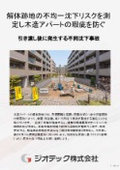

Company information

-