Site Investigation | Investigation to Identify Support Layers in a Small Steel Building Where Large Heavy Machinery Cannot Enter
Boring survey

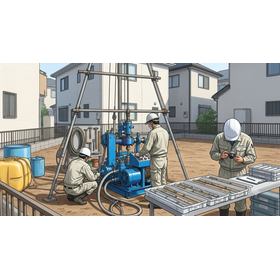
Supports the construction of steel frame buildings in urban areas with limited space where large heavy machinery cannot enter! Automatically measures deep supporting layers with automatic ram sounding tests.
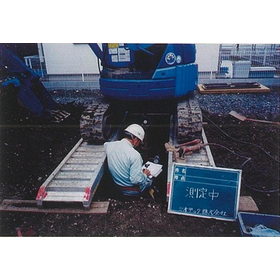
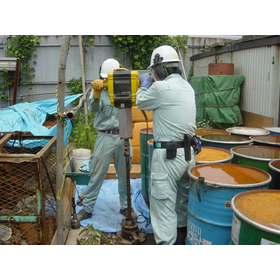
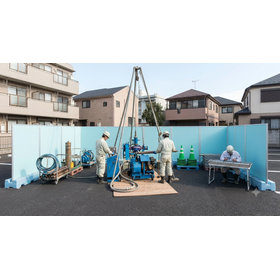
In urban areas, the construction of steel frame buildings on narrow plots often faces challenges due to site width and restrictions on the delivery of large boring survey machinery. The "Automatic Ram Sounding Test" proposed by Geotech utilizes a compact self-propelled survey machine with a width of just 830 mm, enabling smooth surveys even in tight spaces and sites with delivery limitations. Equipped with an automatic continuous penetration mechanism using a 63.5 kg hammer, it can continuously advance and measure through hard layers exceeding an N value of 30, which traditional SWS tests cannot address, as well as deeper layers. Additionally, by automatically acquiring the number of blows (Nd value) and rotational torque every 200 mm of penetration, it corrects for the effects of side friction and calculates highly accurate ground data that correlates well with the N value from standard penetration tests. Since there is no need to assemble scaffolding, installation and removal are easy, allowing for rapid verification of bearing layers while significantly reducing costs. This greatly contributes to the safe design of pile foundations and the efficiency of processes in the construction and renovation of steel frame buildings in urban areas.
Inquire About This Product
basic information
The survey equipment used will be an automatic ram sounding machine (CRS-12, etc.). The dimensions of the machine are a total width of 830 mm (1,000 mm when expanded), a total length of 2,350 mm, a total height of 2,570 mm, and a weight of approximately 1,630 kg, making it a small crawler-type self-propelled machine. The hammer mass is 63.5 kg, with a free fall height of 500 mm, and it performs dynamic cone penetration tests at a rate of 22 strikes per minute. A cone with an outer diameter of 45 mm and a tip angle of 90 degrees is attached to the rod tip, and the number of strikes (Nd) and the rotational torque (Mv) for every 200 mm of penetration are automatically recorded. Side friction correction is performed to calculate the equivalent N value, allowing for deep measurements of up to approximately 30 m.
Price range
Delivery Time
Applications/Examples of results
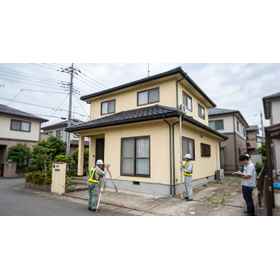
It is ideal for foundation ground surveys of mid- to low-rise steel buildings and heavy structures in narrow sites where large machinery and boring machines have difficulty accessing. It is used to determine the reliable depth of the supporting layer (N value of 50 or more) in ground reinforcement methods such as steel pipe pile methods, and to optimize pile lengths. Furthermore, it functions as a supplementary survey to understand the stratigraphy of deep layers that cannot be reached by conventional SWS tests, and is suitable for urban sites where existing buildings are in close proximity. It is appropriate for preventing excessive design and achieving cost-effective pile foundation design in uneven ground conditions such as sloped ground and demolition sites.
catalog(2)
Download All Catalogs
Company information

-
![[Data] Rain Leak Diagnosis Survey](https://image.www.ipros.com/public/product/image/d9c/2001157424/IPROS80615274029625319079.png?w=280&h=280)

![Fence foundation dual-purpose decorative boundary block [Shikīru]](https://image.www.ipros.com/public/product/image/6d4/2000203792/IPROS6592272567679821523.gif?w=280&h=280)