
Designated Investigation Agency | Practical Application of Article 3 of the Law in Relation to Factory Reconstruction Due to the Abolition of Specific Facilities
Soil contamination investigation

Responding to the Article 3 investigation during the reconstruction of factories involving the abolition of specific facilities for the use of harmful substances. A seamless process from efficient historical research to sampling and administrative reporting.
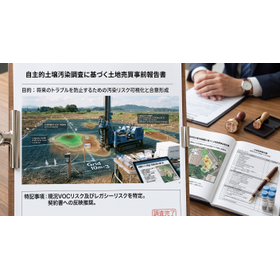
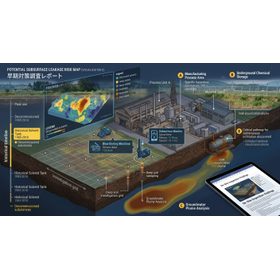
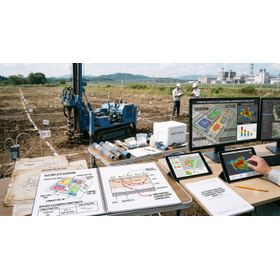
This theme explains the "practical procedures for Article 3 investigations during factory rebuilds and production line updates" associated with the abolition of specified facilities using harmful substances, focusing on preventing delays in the process and ensuring an efficient approach. The soil contamination investigation imposed on landowners, triggered by the notification of the abolition of specified facilities, carries risks that can severely impact the demolition and construction schedule. To facilitate smooth operations, GeoTech's investigation first thoroughly conducts a Phase 1 historical survey, meticulously identifying the underground infiltration risks of specified harmful substances from architectural drawings and public documents, and appropriately classifying the target site by risk categories. In the subsequent soil sampling process, reliable soil gas surveys for first-class substances and soil collection for second and third-class substances are conducted to establish accurate numerical data based on official methods. Furthermore, we provide comprehensive support from the preparation of high-quality administrative reports that eliminate the risk of re-investigation orders to the submission process to the prefectural governor. This ensures the confirmation of legal compliance is completed reliably, allowing for a safe transition to the next step of construction work as planned.
Inquire About This Product
basic information
This practical response service is a special specification for factory reconstruction that fully complies with the statutory investigation based on Article 3, Paragraph 1 of the Soil Contamination Countermeasures Act. In Phase 1, the historical investigation clarifies the underground infiltration risk of specific hazardous substances through verification of public notification documents, past operational records, and construction history, and creates a classification plan view according to the risk categories. In Phase 2, sampling calculates the optimal arrangement (10m or 30m grid) applicable for the exemption provisions of depth-limited investigations based on the maximum depth of physical alteration in the reconstruction area. It includes measurement of leaching and content standards by a registered analytical institution based on the Measurement Act, strict supervision and written audits by a technical manager, and preparation of regulatory format reports for submission to the prefectural governor.
Price information
Price range
P3
Delivery Time
P4
Applications/Examples of results
The main application scenarios involve responding to soil contamination surveys under Article 3 of the law in connection with the renewal, dismantling, and rebuilding plans of chemical plants and plating factories that had established facilities for the use of harmful substances, as well as various manufacturing lines. It is used to ensure and expedite the reporting obligation to the governor associated with the abolition of specified facilities within a limited period before the start of construction, in order to prevent delays in the overall development project. By incorporating legal omission provisions, such as depth limitations, into practice, it aims to optimize investigation costs while blocking future liability for defects and risks of damage claims, thereby facilitating the construction of a safe and reliable new factory through the establishment of evidence.
catalog(2)
Download All Catalogs

Company information

-


![[Case Study] Successful "Monetization" of Waste Plastics through Sensor Utilization! Japan Special Ceramics Co., Ltd.](https://image.www.ipros.com/public/product/image/245/2001484916/IPROS11668876257031716160.jpg?w=280&h=280)
![[Case Study] Utilizing Sensors for Material Inspection! Val Corporation](https://image.www.ipros.com/public/product/image/2113824/IPROS2851298067058129490.jpg?w=280&h=280)
![[Case Study] Utilizing Sensors for the Valorization of Waste Plastics! Fuji Kasei Co., Ltd.](https://image.www.ipros.com/public/product/image/2113824/IPROS8141173142511549749.jpg?w=280&h=280)
![[Case Study] Visualizing the Value of Waste Plastics! LIXIL](https://image.www.ipros.com/public/product/image/2113824/IPROS7223626806004004614.jpg?w=280&h=280)
![[Case Study] Utilized for the identification of waste plastics! Mazda](https://image.www.ipros.com/public/product/image/2113824/IPROS11293733218906178171.jpg?w=280&h=280)