1~45 item / All 125 items
Displayed results
Added to bookmarks
Bookmarks listBookmark has been removed
Bookmarks listYou can't add any more bookmarks
By registering as a member, you can increase the number of bookmarks you can save and organize them with labels.
Free membership registrationContact this company
Contact Us Online1~45 item / All 125 items
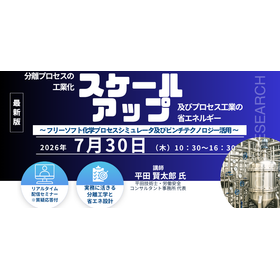
■Title "Industrial Scale-Up of Separation Processes and Energy Saving in Process Industries - Utilizing Free Software Chemical Process Simulators and Pinch Technology -" In the industrialization of chemical processes, it is crucial to balance the design of separation processes such as distillation, extraction, and adsorption with energy efficiency. This seminar will explain methods for scaling up separation processes, transitioning from bench tests to pilot tests, and will discuss points to consider and case studies of failures in industrialization. Additionally, participants will learn about chemical process simulation using the free software "COCO/ChemSep," as well as heat recovery and energy-saving design through pinch technology, and evaluation of carbon recycling. 【Knowledge Gained from the Seminar】 - Industrialization techniques for distillation, extraction, and adsorption processes - Methods for scaling up separation processes - Process simulation using COCO/ChemSep - Energy-saving technologies utilizing pinch analysis 【Target Audience】 Researchers, developers, designers, and production technology personnel in the chemical and process industries, as well as engineers and researchers involved in industrialization and energy saving.
Added to bookmarks
Bookmarks listBookmark has been removed
Bookmarks listYou can't add any more bookmarks
By registering as a member, you can increase the number of bookmarks you can save and organize them with labels.
Free membership registration
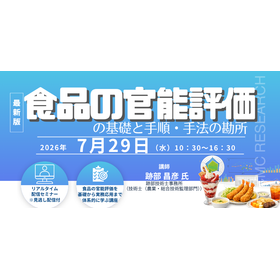
■Title "Fundamentals and Key Points of Sensory Evaluation of Food" Sensory evaluation of food is an essential evaluation technique for product development and quality control. This seminar will systematically explain the basics of analytical sensory evaluation focused on taste and smell, how to develop evaluation plans, selection and training of panels, evaluation methods such as discrimination tests, scaling methods, and characteristic profiling, as well as statistical analysis. Additionally, the latest knowledge and case studies useful in practice, such as odor detection, hedonic sensory evaluation, and validation through instrumental analysis and biometrics, will also be introduced. 【Knowledge Gained from the Seminar】 - Basics and implementation procedures of food sensory evaluation - Various methods of analytical sensory evaluation - Methods for selecting, training, and managing panels - Application methods for product development and quality control 【Target Audience】 Researchers, developers, quality control, and product planning personnel from food manufacturers, as well as engineers and researchers planning to implement or introduce sensory evaluation.
Added to bookmarks
Bookmarks listBookmark has been removed
Bookmarks listYou can't add any more bookmarks
By registering as a member, you can increase the number of bookmarks you can save and organize them with labels.
Free membership registration
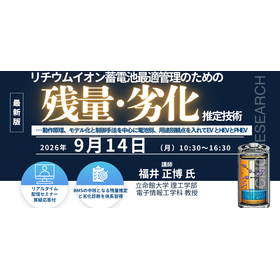
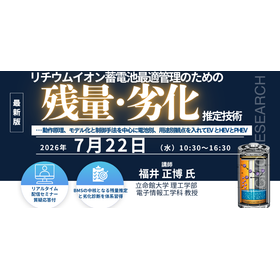
■Title "Explanation of Remaining Capacity and Degradation Estimation Techniques for Optimal Management of Lithium-Ion Batteries: Focusing on Operating Principles, Modeling, and Control Methods from the Perspectives of Different Batteries and Applications in EVs, HEVs, and PHEVs" High performance and long lifespan of lithium-ion batteries require accurate estimation of remaining capacity (SOC) and degradation state (SOH). This seminar will systematically explain the operating principles of lithium-ion batteries, modeling using equivalent circuit models, the basic structure of Battery Management Systems (BMS), remaining capacity estimation using Kalman filters, and degradation diagnosis using Recursive Least Squares (RLS). Additionally, simulation methods using MATLAB, application examples in EVs, HEVs, and PHEVs, and the latest lifespan prediction technologies will also be introduced. 【Knowledge Gained from the Seminar】 - Basic characteristics of lithium-ion batteries - Fundamentals of battery modeling and BMS - SOC and SOH estimation techniques - Degradation diagnosis and lifespan prediction methods 【Target Audience】 Beginners, young engineers, and those involved in research, development, and design related to batteries, EVs, and energy management.
Added to bookmarks
Bookmarks listBookmark has been removed
Bookmarks listYou can't add any more bookmarks
By registering as a member, you can increase the number of bookmarks you can save and organize them with labels.
Free membership registration
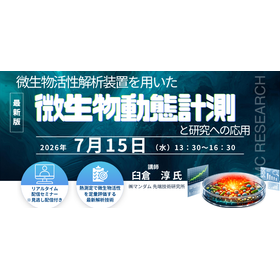
**Title: "Measurement of Microbial Dynamics and Applications in Research Using Microbial Activity Analysis Equipment"** The microbial activity analysis equipment is a technology that measures the heat generated by microorganisms during metabolism with high sensitivity and non-destructively, allowing for real-time quantitative evaluation of microbial growth and activity. This seminar will explain the principles of microbial activity evaluation through heat measurement, the differences from traditional culture methods and turbidity methods, and how to utilize it for growth dynamics analysis and evaluations of antibacterial, static, and sterilizing effects. Additionally, it will cover applications in quality assurance, preservative efficacy evaluation, and fermentation research in the food, cosmetics, and pharmaceuticals sectors, along with case studies on antibacterial action analysis and mechanisms of preservative efficacy reduction in the cosmetics industry. **Knowledge Gained from the Seminar:** - Principles and features of microbial activity analysis equipment - Differences from traditional methods and applicable scenarios - Practical methods for growth dynamics and antibacterial evaluation - Research case studies on applications in the cosmetics industry **Target Audience:** Quality assurance and research and development personnel in the food, cosmetics, and pharmaceuticals sectors, as well as those who wish to acquire skills in microbial evaluation and antibacterial evaluation techniques.
Added to bookmarks
Bookmarks listBookmark has been removed
Bookmarks listYou can't add any more bookmarks
By registering as a member, you can increase the number of bookmarks you can save and organize them with labels.
Free membership registration
Naphtha Shock: Survival of the Chemical Industry in the Era of AI Power Struggles ~ Vulnerabilities of Byproduct Networks and Defense of the Semiconductor Materials Supply Chain ~ [Features of this Book] - Resins will disappear! Cars will stop! Thoroughly predicting the cascading industrial impacts! - The true nature of the 2026 problem! Can your products survive in a world without naphtha? - Plastic supply can be halted! The definitive survival strategy to avoid industrial disruption! - Unraveling the mechanisms of petrochemical complex collapse! A must-have manual for procurement professionals! - An era where "naphtha dependence" becomes a management risk! Revealing technologies and tactics for overcoming it! - Naphtha shortages are not temporary! Rebuilding supply chain resilience is essential! - The OS of the chemical industry is changing! Opportunities in bio, recycling, and electrification are here! - Analyzing voices from the field and market data! Completely covering the depths and future of the naphtha crisis! - Changing decision-making for managers! Guiding procurement and production strategies under supply constraints!
Added to bookmarks
Bookmarks listBookmark has been removed
Bookmarks listYou can't add any more bookmarks
By registering as a member, you can increase the number of bookmarks you can save and organize them with labels.
Free membership registration
Market Analysis of Heat Dissipation Materials (TIM and Fillers) for AI Data Centers ~ Overview of Liquid Cooling Supply Networks (Taiwan ODM) and Material Specification Structures ~ 【Features of This Document】 - The definitive strategy for materials that control "heat" for the NVIDIA Blackwell generation! - A thorough dissection of the Taiwan ODM ecosystem. The behind-the-scenes of designated adoption (Spec-in)! - Compatible with silicon photonics. Nano thermal management technology that solves ultra-localized thermal density! - Coverage of strategies from 50 major global companies. Ratings of winners that investors need to know! - Silicone-free and liquid immersion compatible. A comprehensive explanation of the rapidly changing trends in resin design! - Turning geopolitical risks into profits. An analysis of regional procurement and economics of heat dissipation fillers! - The fusion of implementation processes and materials. Condensed insights on the latest TIMs to maximize performance! - Robotics changing maintenance. A new "quality definition" required in the era of automation! - Anticipating the demands of hyperscalers. Detailed explanation of the evolution of technical requirements from a materials perspective!
Added to bookmarks
Bookmarks listBookmark has been removed
Bookmarks listYou can't add any more bookmarks
By registering as a member, you can increase the number of bookmarks you can save and organize them with labels.
Free membership registration
The Complete Guide to Low Dielectric Materials in the Semiconductor and AI Era ~ Decoding the 2035 Strategy from Implementation, Regulation, and Economic Security ~ 【Features of this Book】 - Technological innovations and market changes in low dielectric materials supporting the era of over 224Gbps! - Restructuring of supply chains and material strategies in the geopolitical era! - Future vision of advanced packaging driven by optoelectronic integration and glass core substrates! - Analyzing the 2035 electronic substrate materials market through a triple amplification model! - A multifaceted analysis of the competitive advantages of major material manufacturers! - Technical requirements for low dielectric materials supporting chiplets and 3D packaging! - Growth potential and investment value of the low dielectric materials market looking towards 2035!
Added to bookmarks
Bookmarks listBookmark has been removed
Bookmarks listYou can't add any more bookmarks
By registering as a member, you can increase the number of bookmarks you can save and organize them with labels.
Free membership registration
AI Infrastructure Major Transformation - The Revolution of Next-Generation AI Infrastructure and Photonic-Electronic Integration Implementation 【Features of this Book】 - Essential analysis for engineers covering thermal design, liquid cooling, and yield! A comprehensive guide to the challenges of CPO implementation! - Market forecasts up to 2035! Investment opportunities and conditions for success revealed through the CPO adoption curve! - GAFA's pursuit of "light supremacy"! Disruptive strategies from emerging disruptors challenging existing powers! - Delving into the core of the IOWN concept! The day when Japan's material intelligence conquers the world! - The intersection of technology and market! A strategic roadmap leading to the redefinition of AI computing! - The true nature of the "AI Infrastructure Major Transformation"! Everything about the next-generation computing foundation led by photonic-electronic integration is here! - No longer supported by "copper"! The shock of infrastructure transformation brought by photonic-electronic integration implementation! - Japan's material strength seizing opportunities! Geopolitical risks and future strategies of the photonic-electronic integration supply chain! - A compass to 2035! Explaining the strategic value of "lightification," which holds the key to AI infrastructure transformation!
Added to bookmarks
Bookmarks listBookmark has been removed
Bookmarks listYou can't add any more bookmarks
By registering as a member, you can increase the number of bookmarks you can save and organize them with labels.
Free membership registration
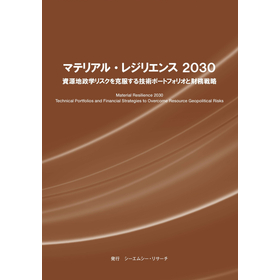
Material Resilience 2030 A Technology Portfolio and Financial Strategy to Overcome Geopolitical Resource Risks The End of "Efficient Management." A thorough explanation of the "Material Resilience" strategy to thrive in the era of geopolitical resources, DPP, and IRA. A next-generation industry report covering AI material development, autonomous labs, circular economy, and financial KPIs. **Features of this Book** - From "Efficiency" to "Resilience" — Decoding the essence of industrial structural transformation! - A comprehensive explanation of new strategies for the era of geopolitics, resource constraints, and environmental regulations! - The forefront of Material Informatics (MI) and autonomous labs! - Decoding the "strategic pressure points" of the semiconductor, battery, and mobility industries! - Covering the forefront of AI material development, autonomous labs, and MI! - A next-generation industry report crossing technology, policy, and finance! - Survival strategies of Japanese companies revealed through analysis of 50 leading companies in the global market! Systematizing the forefront of next-generation material development, including accelerated material exploration through MI and autonomous labs, AI screening of alternative elements, and controlling the instability of recycled materials. Furthermore, a concrete analysis of "resource risk-free technologies" such as Ga2O3 power semiconductors, sodium-ion batteries (SIB), and tungsten-free cutting tools.
Added to bookmarks
Bookmarks listBookmark has been removed
Bookmarks listYou can't add any more bookmarks
By registering as a member, you can increase the number of bookmarks you can save and organize them with labels.
Free membership registration
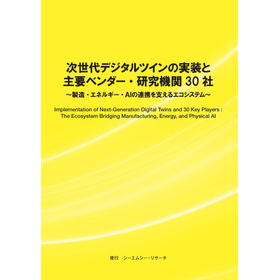
Implementation of Next-Generation Digital Twins and 30 Major Vendors and Research Institutions ~ An Ecosystem Supporting Collaboration in Manufacturing, Energy, and AI ~ 【Features of This Book】 - The definitive guide to physical models × AI! Revealing the secrets of PINNs implementation and all methods for CPS autonomous optimization! - Transforming tacit knowledge into capital! A digital strategy for Japan's materials industry to survive by 2026! - The forefront of batteries, semiconductors, and chemicals! Innovations in manufacturing processes brought by autonomous digital twins! - Breaking down "data silos"! A concrete prescription for achieving vendor interoperability and MI collaboration! - Thorough analysis of 30 major companies and research institutions! A leading digital twin ecosystem in the world! - The proposition of next-generation data centers! Practical improvements in PUE through liquid cooling technology and energy optimization! - A book that connects theory and practice! Practical implementation of Physics-Informed Neural Networks (PINNs)! - The optimal solution for green infrastructure! Presenting a dynamic energy model that connects factories and data centers!
Added to bookmarks
Bookmarks listBookmark has been removed
Bookmarks listYou can't add any more bookmarks
By registering as a member, you can increase the number of bookmarks you can save and organize them with labels.
Free membership registration
The Dominance of the Display Industry Redefined by Physical AI ~ A Shift from Panel Obsolescence to Optics, Materials, and Implementation ~ [Features of this Book] - What comes after panels! The new protagonists of the display industry taken over by Physical AI and the emergence of a new dominance! - The shock of a market that has abandoned "display"! Capital movement towards 2030 interpreted from CES/SPIE! - The trap of gallium and antimony regulations! Material security determines the fate of next-generation devices! - The true nature of "heat" that stops AI! A detailed explanation of the frontline battle for material dominance that competes for design freedom! - Displays will "disappear"! From operation to "sensing," a new market created by Physical AI! - Spatial imaging is a "technology of understanding"! Don't miss the investment opportunities in the $5 trillion market where AI assigns meaning! - Crystal structures and operational evaluation data of post-lithium 3 technologies (Na/Ni-Zn/Fe-Air)! - Who will be the winner in 2030? Drawing the line between the sinking of generic panels and companies that profit from optical implementation technology!
Added to bookmarks
Bookmarks listBookmark has been removed
Bookmarks listYou can't add any more bookmarks
By registering as a member, you can increase the number of bookmarks you can save and organize them with labels.
Free membership registration
Strategies for Energy Storage and Implementation in the Era of Physical AI: Latest Industry Report [Features of this Book] - "Is a battery a component or a structure?" - The true nature of energy storage implementation that influences the performance of Physical AI! - Latest update for the first half of 2026. A correlation diagram of vertical integration deciphered from the implementation strategies of the world's top 10 companies! - OS-friendly material design changes the dynamic impedance control of next-generation humanoids! - Center of gravity optimization and irregular cell arrangement maximize ROI. The shock of the paradigm shift in physical implementation! - "Those who control energy control AI" - The forefront of the 2026 market with advancing vertical integration! - High-value-added markets driven by slow, high-precision processes. Technical discussions for winning in niche and high-end markets! - Drive performance created by PLC-BMS and power line communication. An intelligent energy storage platform! - Redefining the economic value of safety and reliability. Designing next-generation energy storage systems that monetize non-financial information! - "The shape of the battery" that breaks through the structural constraints of humanoids. Profitability and opportunities in the specialized cell market!
Added to bookmarks
Bookmarks listBookmark has been removed
Bookmarks listYou can't add any more bookmarks
By registering as a member, you can increase the number of bookmarks you can save and organize them with labels.
Free membership registration
Coexistence Strategy of AI Data Centers and Power Systems ~ New Infrastructure to Break Through Grid Bottlenecks ~ 【Features of this Book】 - Can AI DC save the power system? All methods for system stabilization and monetization through VPP revealed! - Surviving the explosive electricity demand of 2030. New strategies decoded with IEA and OCCTO data! - A shocking PUE of below 1.1. The paradigm shift in DC design brought about by liquid cooling transition and waste heat resource utilization! - Is "24/7 CFE" achievable? The core of decarbonization through advanced PPA and hydrogen fuel cells! - From direct SMR connection to microgrids. Detailed description of the next-generation power supply model that breaks free from system dependence! - Next-generation UPS sells "inertia." New demand response rewards through battery utilization! - The fusion of watts and bits. Integrated control technology for IT, power, and cooling through digital twins! - Seizing opportunities in power and DC special zones. Public-private partnership projects for system enhancement and investment insights!

Added to bookmarks
Bookmarks listBookmark has been removed
Bookmarks listYou can't add any more bookmarks
By registering as a member, you can increase the number of bookmarks you can save and organize them with labels.
Free membership registration
The Shock of the Inference Economy 2026-2030 ~ The Full Picture of "Physical AI" that Transforms Physical Limits into Profits and Bottleneck Investments ~ [Features of this Book] - Investment criteria are about to change dramatically! The full picture of "unmarketed technologies" that capital should target in 2026! - Semiconductors, thermal management, spatial intelligence! Transforming physical bottlenecks into "the strongest barriers to entry"! - The era of learning is over! Here is the roadmap for the "inference economy" that turns power into profits! - Power, heat, materials! The "physical limits" that bind digital intelligence are the source of immense wealth! - API-ize on-site assets! The new landscape of next-generation industries rewritten by Physical AI! - Where will the next GAFA emerge? Strategies of winners that premiumize "computational resources" under grid constraints! - Turning geopolitical risks into gains! The true nature of cold economics that takes advantage of regulation and standardization!
Added to bookmarks
Bookmarks listBookmark has been removed
Bookmarks listYou can't add any more bookmarks
By registering as a member, you can increase the number of bookmarks you can save and organize them with labels.
Free membership registration
Physical AI: Integrated Technology of Materials, Devices, and Implementation [Features of this Book] - A radical shift in design philosophy. A complete and detailed explanation of the "four-in-one" strategy of materials, components, structures, and signal processing! - The reintegration of matter and intelligence. An essential latest report for developers that delves into the core of next-generation device development! - From self-healing materials to soft robotics. A stunning vision of the future opened up by physical intelligence! - Going beyond GAFA. Analyzing the evolution of implementation technology and devices to interpret the hegemony scenario of 2050! - Comprehensive corporate analysis. Identifying technological challenges and business opportunities, providing guidelines for investment and development! - A condensed overview of the latest trends in MEMS and flexible devices. The societal changes brought about by advanced sensing! - Sustainable manufacturing. A sharp analysis of the challenges of sustainable materials and social implementation! - From autonomous driving to healthcare. A roadmap to 2050, a bible for technological integration!
Added to bookmarks
Bookmarks listBookmark has been removed
Bookmarks listYou can't add any more bookmarks
By registering as a member, you can increase the number of bookmarks you can save and organize them with labels.
Free membership registration
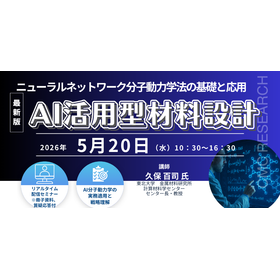
■ Title: "Fundamentals and Applications of Neural Network Molecular Dynamics: AI-Driven Material Design" ―― Solving issues of "computations not going well" and "uncertainty about applicability." This seminar will systematically explain the fundamentals, strengths, limitations, and countermeasures of NNMD, along with specific implementation strategies for material development. ■ Date and Time: May 20, 2026 (Wednesday) 10:30 AM – 4:30 PM ■ Zoom Streaming (with materials) 【Knowledge Gained from the Seminar】 - Successful case studies of NN molecular dynamics simulations - Differences and advantages over conventional MD - Basic theory and computational procedures - Countermeasures for computational issues - Applicable areas and limitations - Directions and strategies for corporate implementation 【Target Audience for the Seminar】 - Those who want to introduce NN molecular dynamics - Those who want to understand the differences and features compared to conventional MD - Those who want to strengthen their ability to handle computational troubles - Those who want to grasp the applicability and limitations - Those who want to consider utilization strategies in their companies *Those interested in related fields are also welcome.
Added to bookmarks
Bookmarks listBookmark has been removed
Bookmarks listYou can't add any more bookmarks
By registering as a member, you can increase the number of bookmarks you can save and organize them with labels.
Free membership registration
■ Title: "Changes in Joint Structures and Packaging Response Due to the Evolution of Semiconductors - Addressing the Increase in the Number of Joint Locations and Narrow Spacing with Resin Sealing Technology -" ――Organizing the core of joint design and sealing technology essential for the WLP and 3D assembly era. Covering the failure mechanisms and countermeasures associated with high integration, providing insights directly related to development, evaluation, and mass production challenges. ■ Date and Time: May 15, 2026 (Friday) 13:00 - 16:30 ■ Zoom Streaming (with materials) 【Knowledge Gained from the Seminar】 - Development history and trends of semiconductor packaging - Changes in semiconductor joint structures and the current state of packaging technology response - Evolution of semiconductor packaging and the development history, challenges, and countermeasures of resin sealing technology 【Target Audience for the Seminar】 - Stakeholders in the semiconductor-related fields (sales, technical positions, etc.) - Individuals interested in semiconductor manufacturing technology (front-end, back-end, etc.) - Those interested in the evolution of semiconductor packaging and the corresponding packaging technology - Individuals interested in semiconductor integration = joint technology (Bumping Technology)
Added to bookmarks
Bookmarks listBookmark has been removed
Bookmarks listYou can't add any more bookmarks
By registering as a member, you can increase the number of bookmarks you can save and organize them with labels.
Free membership registration
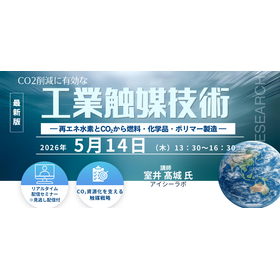
■ Title: "Industrial Catalytic Technologies Effective for CO2 Reduction - Production of Fuels, Chemicals, and Polymers from Renewable Hydrogen and CO2 -" ―― Transforming CO2 and hydrogen into resources. An overview of the development trends in e-fuels, SAF, methanol synthesis, and compact FT processes. Key points in the design of highly active and durable catalysts and challenges for social implementation will be explained from the perspective of industrial catalysis. ■ Date and Time: May 14, 2026 (Thursday) 13:30 - 16:30 ■ Zoom Streaming (with materials, on-demand streaming available for a limited time) 【Knowledge Gained from the Seminar】 Synthesis technologies for fuels and chemicals from CO2, global trends in CO2 utilization technologies 【Target Audience for the Seminar】 Researchers interested in CO2 reduction and the production of fuels, chemicals, and polymers using CO2.
Added to bookmarks
Bookmarks listBookmark has been removed
Bookmarks listYou can't add any more bookmarks
By registering as a member, you can increase the number of bookmarks you can save and organize them with labels.
Free membership registration
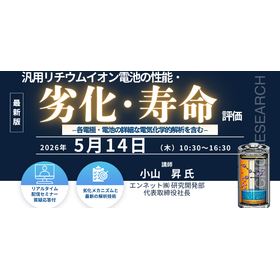
■ Title: "Performance, Degradation, and Lifetime Evaluation of General-purpose Lithium-ion Batteries – Including Detailed Electrochemical Analysis of Each Electrode and Battery –" ―― This practical content is useful for practitioners involved in research, design, quality evaluation, and reuse inspection, covering materials and characteristics of practical batteries, Li deposition evaluation methods, interface control, and safety measures. ■ Date and Time: May 14, 2026 (Thursday) 10:30 AM – 4:30 PM ■ Zoom Distribution (with materials) ■ Required Background Knowledge - Basic knowledge of general chemistry, introduction to electrical and electronic engineering, thermodynamics, and kinetics ■ Knowledge Gained from the Seminar - Fundamental characteristics of battery reactions - Evaluation of charge and discharge characteristics - Various DC evaluation methods - AC impedance measurement methods - Characteristics of current general-purpose batteries - Performance degradation of batteries and its mechanisms - Evaluation methods for degradation level and lifetime prediction - Ensuring battery performance
Added to bookmarks
Bookmarks listBookmark has been removed
Bookmarks listYou can't add any more bookmarks
By registering as a member, you can increase the number of bookmarks you can save and organize them with labels.
Free membership registration
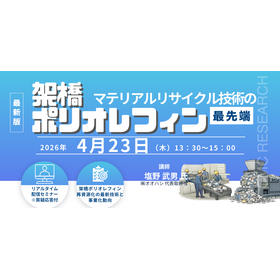
■ Title: "Cutting-Edge Material Recycling Technology for Cross-Linked Polyolefins" ―― Recycling resources from cross-linked polyolefins that were previously disposed of or incinerated! We will provide a detailed introduction to the XPR system, which is attracting attention both domestically and internationally, from practical examples to commercialization. ■ Date and Time: April 23, 2026 (Thursday) 13:30–15:00 ■ Zoom Broadcast (with materials) ■ Target Audience for the Seminar Companies that manufacture cross-linked polyolefin products. Recycling companies that collect and regenerate cross-linked polyolefin products. Others; trading companies, newspapers, and media outlets that may be interested in the SDGs related to plastics. ■ Knowledge Gained from the Seminar We will explain, with specific examples, the technology that can commercialize cross-linked polyolefins (cross-linked polyethylene, cross-linked polypropylene) currently treated as industrial waste or fuel worldwide, focusing on sustainable development goals (SDGs) rather than mere resource circulation. Furthermore, we believe this development is one approach that contributes not only to resource circulation but also to the global efforts towards building a decarbonized society.
Added to bookmarks
Bookmarks listBookmark has been removed
Bookmarks listYou can't add any more bookmarks
By registering as a member, you can increase the number of bookmarks you can save and organize them with labels.
Free membership registration
■ Title: "Fundamentals and Application Examples of Synthesis, Analysis, and Uses of Metal-Organic Frameworks (MOFs) - From Gas Separation and Storage to Polymer Synthesis, Purification, and Bio Applications" ―― Unraveling the potential of next-generation porous materials "MOFs" from the basics. Introducing research examples and application hints that can be utilized immediately, including gas adsorption and separation, conductivity and functionalization, and bio and polymer applications! ■ Date and Time: April 22, 2026 (Wednesday) 13:30 - 16:30 ■ Zoom Streaming + Archive Available (with materials) ■ Target Audience for the Seminar - Engineers/researchers interested in research and development of porous materials - Researchers/developers of nanomaterials and polymer materials - Individuals considering separation and purification of various substances - Engineers/researchers in battery materials, reaction fields/sensors/catalysts, etc. ■ Knowledge Gained from the Seminar - Characteristics of MOFs - Specific methods for the design/synthesis/evaluation of MOFs - Practical examples of how to utilize MOFs - Various utilization examples of MOFs (separation agents, sensors, catalysts, polymer synthesis, etc.) - Understanding new separation technologies utilizing MOFs
Added to bookmarks
Bookmarks listBookmark has been removed
Bookmarks listYou can't add any more bookmarks
By registering as a member, you can increase the number of bookmarks you can save and organize them with labels.
Free membership registration
World AI Data Center Battery - Latest Industry Report ~1500V High Voltage and Material DX Transforming the Next Generation DC Infrastructure~ 【Features of this Book】 - Challenging the physical limits of 1500V high voltage! Insulation and BMS design for next-generation DC architecture! - Exploration of new materials through MI (Material Informatics). Atomic-level interface control! - Response characteristics to the steep dynamic loads unique to AI. Innovations in electrode interfaces controlling capacitive behavior! - Extending lifespan in high-temperature environments from theory to implementation. An overview of thermal stability design that breaks free from reliance on air conditioning! - Disclosure of negative electrode material performance matrix! Analyzing the fragmented technology roadmap from the perspective of materials science! - The conflict between dry process powder design and thick film formation. Process innovations that break through energy density limits! - Crystal structures and operational evaluation data for post-lithium 3 technologies (Na/Ni-Zn/Fe-Air)! - Technical benchmarking of hyperscaler power strategies. R&D guidelines looking towards 2027!
Added to bookmarks
Bookmarks listBookmark has been removed
Bookmarks listYou can't add any more bookmarks
By registering as a member, you can increase the number of bookmarks you can save and organize them with labels.
Free membership registration
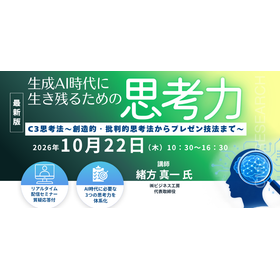
■Title: "Thinking Skills in the Age of Generative AI: C3 Thinking Method" --- What is the "human thinking ability" required in the age of generative AI? This seminar explains the "C3 Thinking Method," which systematizes creative thinking that expands ideas using AI, critical thinking that discerns AI results, and expressive skills that effectively communicate. ■Date and Time: April 21, 2026 (Tuesday) 10:30 AM - 4:30 PM ■Venue: Chiyoda Platform Square (tentative) 3-21 Kanda Nishikicho, Chiyoda-ku, Tokyo 101-0054 ■Target Audience for the Seminar ・Planning, technical, and research professionals who want to utilize generative AI in their work ・Individuals looking to enhance their thinking and presentation skills ・Those who want to appropriately evaluate and utilize AI outputs ■Knowledge Gained from the Seminar ・An overview of the thinking skills necessary in the age of generative AI ・Specific methods and applications of creative thinking ・Verification methods for AI results through critical thinking ・Techniques for structuring and expressing ideas for effective communication ・Practical application skills of the C3 Thinking Method
Added to bookmarks
Bookmarks listBookmark has been removed
Bookmarks listYou can't add any more bookmarks
By registering as a member, you can increase the number of bookmarks you can save and organize them with labels.
Free membership registration
■Title: "Fundamentals and Applications of Neural Network Molecular Dynamics: AI-Driven Material Design" ――Solving issues such as "calculations not going well" and "uncertainty about the scope of application." This seminar will systematically explain the fundamentals, strengths, limitations, and countermeasures of NNMD, as well as specific implementation strategies for material development. ■Date and Time: May 20, 2026 (Wednesday) 10:30 AM – 4:30 PM ■Target Audience for the Seminar - Those who want to introduce NN molecular dynamics - Those who want to understand the differences and advantages compared to traditional MD - Those who want to acquire troubleshooting skills from the basics - Those who want to understand their strengths and weaknesses in applicable areas - Those who want to know the utilization strategies and directions in companies ■Knowledge Gained from the Seminar - Successful case studies of NN molecular dynamics - Comparison with traditional MD (features and advantages) - Fundamentals, methods, and calculation procedures - Countermeasures for calculation issues - Understanding of strengths and weaknesses in applicable areas - Direction and strategy for corporate utilization
Added to bookmarks
Bookmarks listBookmark has been removed
Bookmarks listYou can't add any more bookmarks
By registering as a member, you can increase the number of bookmarks you can save and organize them with labels.
Free membership registration
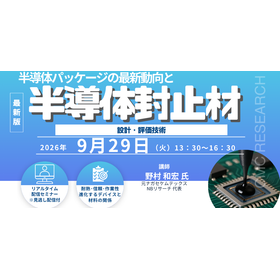
■Title: "Latest Trends in Semiconductor Packaging and Design/Evaluation Techniques for Semiconductor Encapsulation Materials" ――As chipletization and 3D packaging advance in semiconductors, there is a growing demand for more sophisticated material design in encapsulation materials. This seminar will provide a detailed practical perspective on the latest trends in semiconductor packaging, including raw material selection, design techniques, and reliability evaluation of encapsulation materials. ■Date and Time: April 17, 2026 (Friday) 13:30–16:30 ■Target Audience: Designers of semiconductor encapsulation materials, engineers using semiconductor encapsulation materials, designers of epoxy resins and hardeners for semiconductor encapsulation materials ■Knowledge Gained from the Seminar: - Trends in semiconductor packaging - Knowledge about raw materials for semiconductor encapsulation materials - Design techniques for semiconductor encapsulation materials and evaluation techniques for semiconductor encapsulation materials
Added to bookmarks
Bookmarks listBookmark has been removed
Bookmarks listYou can't add any more bookmarks
By registering as a member, you can increase the number of bookmarks you can save and organize them with labels.
Free membership registration
■Title: "Latest Regulatory Trends and Requirements for Organic Fluorinated Compounds (PFAS)" ―― PFAS compliance cannot be overlooked with "I didn't know." Systematically organizing the latest developments such as the POPs Convention, European PFAS restriction proposals, and state regulations in the United States. A detailed explanation of the practical measures companies should take! ■Date and Time: April 16, 2026 (Thursday) 13:30 - 16:30 ■Target Audience for the Seminar Individuals in quality control, production, and development departments of various companies who wish to obtain the current status and latest information on PFAS regulations. ■Knowledge Gained from the Seminar - Basic properties and applications of PFAS - PFAS regulations and the latest developments in the UN, Europe, and the United States - Current status of chemical analysis related to PFAS - Past movements regarding mandatory measures for companies - Initiatives for PFAS management within companies
Added to bookmarks
Bookmarks listBookmark has been removed
Bookmarks listYou can't add any more bookmarks
By registering as a member, you can increase the number of bookmarks you can save and organize them with labels.
Free membership registration
■Title: "Flexible Substrates and FPC Formation Technology for 5G/6G - LCP-FCCL and Its Development" ――A must-see for developers of high-frequency FPCs. This seminar provides knowledge useful for future FPC substrate design, from the key technologies for LCP multilayering to examples of new low-dielectric films. ■Date and Time: April 15, 2026 (Wednesday) 13:30 - 16:30 ■Target Audience for the Seminar Development engineers engaged in the development of high-frequency FPCs and their substrates ■Knowledge Gained from the Seminar ・Basic characteristics required for FPC substrates ・Reasons for using LCP and polyimide films in FPCs ・Key technologies for LCP multilayering ・Points to consider when processing LCP films ・Examples of hybridization methods between LCP and low-dielectric materials
Added to bookmarks
Bookmarks listBookmark has been removed
Bookmarks listYou can't add any more bookmarks
By registering as a member, you can increase the number of bookmarks you can save and organize them with labels.
Free membership registration
■Title: "Fluorine-Free Water and Oil Repellent Treatment Technology Achievable - Guidelines and Examples for Surface Design to Improve Wetting Fundamentals and Liquid Sliding Properties" As PFAS regulations accelerate, surface designs that achieve water and oil repellency without fluorine are gaining attention. This seminar will systematically explain the fundamentals of wetting, dynamic wettability evaluation, design guidelines for improving sliding properties, and the latest examples of fluorine-free surface treatments by leading researchers. ■Date and Time: April 14, 2026 (Tuesday) 13:30 - 16:30 ■Target Audience for the Seminar - Individuals engaged in surface treatment and modification work - Those involved in research and development related to imparting water and oil repellency, stain resistance, and anti-adhesion properties to various substrate surfaces - Individuals engaged in research and development of fluorine (PFAS) alternative technologies and fluorine-free surface treatment and modification technologies ■Knowledge Gained from the Seminar - Fundamental knowledge/theory related to wettability - Correct knowledge of wettability evaluation techniques (static/dynamic contact angle, contact angle hysteresis, sliding/falling angle) - Know-how for creating surfaces/interfaces with excellent water and oil repellency, stain resistance, and anti-adhesion properties without fluorine
Added to bookmarks
Bookmarks listBookmark has been removed
Bookmarks listYou can't add any more bookmarks
By registering as a member, you can increase the number of bookmarks you can save and organize them with labels.
Free membership registration
■Title: Basic Information on Semiconductor Packaging Technology: Comprehensive Explanation ■Date and Time: April 10, 2026 (Friday) 10:30 AM - 4:30 PM ■Target Audience for the Seminar - Individuals involved in semiconductor packaging (sales, technology) - Those interested in semiconductor packaging technology - Those interested in semiconductor resin encapsulation and encapsulation materials ■Knowledge Gained from the Seminar - Development history of semiconductor packaging (PKG) - Development history of semiconductor packaging technology (methods, materials) - Specifications of semiconductor encapsulation materials (raw materials, composition, manufacturing equipment, evaluation methods, etc.)
Added to bookmarks
Bookmarks listBookmark has been removed
Bookmarks listYou can't add any more bookmarks
By registering as a member, you can increase the number of bookmarks you can save and organize them with labels.
Free membership registration
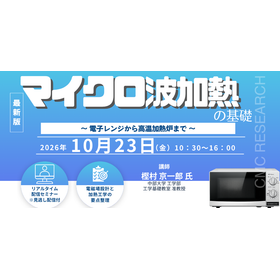
■Title: Fundamentals of Microwave Heating - From Microwave Ovens to High-Temperature Furnaces - ■Date and Time: April 9, 2026 (Thursday) 10:30 AM - 4:00 PM ■Target Audience for the Seminar - Engineers and researchers from companies considering the application of microwave chemistry - Engineers and researchers considering adopting microwave heating technology for their own technologies - Individuals engaged in chemical engineering processes such as heating and drying who wish to overcome current challenges - Those looking to reduce process costs by accelerating firing and chemical reactions ■Knowledge Gained from the Seminar - Basics of microwave heating - Fundamentals of microwave chemistry (basics of chemical reactions using microwave ovens) - Applications of microwave processes - Design of microwave heating furnaces
Added to bookmarks
Bookmarks listBookmark has been removed
Bookmarks listYou can't add any more bookmarks
By registering as a member, you can increase the number of bookmarks you can save and organize them with labels.
Free membership registration
■Title: Heat Dissipation/Cooling Technology for AI Data Centers ■Date and Time: April 8, 2026 (Wednesday) 10:30 AM - 4:30 PM ■Target Audience for the Seminar Electronic equipment designers (assembly design, mechanical design, circuit design, PCB design), heat dissipation device/material developers, quality assurance, and quality control departments ■Knowledge Gained from the Seminar - Basic knowledge of heat transfer - Knowledge of heat dissipation in component and PCB design - Common methods for thermal design of forced air cooling and natural air cooling equipment - Thermal design methods for heat sinks, etc.
Added to bookmarks
Bookmarks listBookmark has been removed
Bookmarks listYou can't add any more bookmarks
By registering as a member, you can increase the number of bookmarks you can save and organize them with labels.
Free membership registration
■Title: Fundamentals of Slurry Preparation and Evaluation - From Ceramic Slurries to Battery Electrode Slurries - ■Date and Time: April 6, 2026 (Monday) 10:30 AM - 4:30 PM ■Target Audience for the Seminar Engineers and researchers handling slurries (ceramics, batteries, food, cosmetics, pharmaceuticals, etc.) ■Knowledge Gained from the Seminar Factors governing particle dispersion and aggregation state in liquids, methods for evaluating particle dispersion and aggregation state in liquids.
Added to bookmarks
Bookmarks listBookmark has been removed
Bookmarks listYou can't add any more bookmarks
By registering as a member, you can increase the number of bookmarks you can save and organize them with labels.
Free membership registration
Design and Scale-Up of Bioreactors for Organ and Tissue Culture in Pharmaceuticals and Healthcare 【Features of this Book】 - Understand the design and scale-up of organ and tissue culture bioreactors through Excel simulations! - Design cell culture processes based on "calculations" rather than "experience." - Learn while simulating batch, fed-batch, and perfusion cultures using Excel templates. - Gain a practical understanding of bioreactor design for pharmaceutical and healthcare bioprocesses through actual calculations! - Systematically explain bioreactor design and scale-up in pharmaceutical and healthcare bioprocesses! 【Structure】 Chapter 1: Organ and Tissue Culture Bioreactors in Pharmaceuticals and Healthcare Chapter 2: Reaction Rate Analysis of Organ and Tissue Culture in Pharmaceuticals and Healthcare Chapter 3: Operation Methods for Organ and Tissue Culture Bioreactors in Pharmaceuticals and Healthcare Chapter 4: Design and Scale-Up of Organ and Tissue Culture Bioreactors in Pharmaceuticals and Healthcare Chapter 5: Bioreactors in the Pharmaceutical and Healthcare Fields Chapter 6: Single-Use Bioreactors Chapter 7: Development of Organ and Tissue Culture Bioreactors in Pharmaceuticals and Healthcare Appendix 1 Appendix 2 Index
Added to bookmarks
Bookmarks listBookmark has been removed
Bookmarks listYou can't add any more bookmarks
By registering as a member, you can increase the number of bookmarks you can save and organize them with labels.
Free membership registration
Revised Edition: Ensuring the Safety of Lithium-Ion Batteries 2026 - Addressing Safety from the Perspective of Battery Usage - [Features of This Book] - The safety of batteries boils down to not deviating from the principles of electrochemistry! - The safety of industrial products depends on the manufacturer's policy; can it be achieved?! - Reducing battery costs = decreased safety; unfortunately, this is true! - Both the safety of the battery itself and the maintenance of safety in application fields are essential! - In the coming year, the confirmation of domestic fire safety regulations will continue; do not take your eyes off it! - There are no new revisions to global safety standards; safety cannot be guaranteed by standards! - Measures against hydrogen sulfide in sulfide-based all-solid-state batteries are somewhat manageable, but... [Structure] * Chapters 1 to 6 will be the same as the 2023 edition (https://cmcre.com/archives/114978/). Chapters 7 to 10 are the new additions. Chapter 7: Status of Revisions to Major Safety Regulations as of the End of 2025 Chapter 8: New Developments in Fire Safety Law Compliance Chapter 9: Safety of All-Solid-State Batteries and Sulfide-Based Electrolytes Chapter 10: Conclusion
Added to bookmarks
Bookmarks listBookmark has been removed
Bookmarks listYou can't add any more bookmarks
By registering as a member, you can increase the number of bookmarks you can save and organize them with labels.
Free membership registration
Title: Latest Industry Report on PFAS Removal, Separation, Decomposition, and Treatment Technologies Worldwide [Features of this Book] - PFAS Crisis! Accelerating regulations and supply chain restructuring, detailed separation, decomposition, and treatment technologies! - An overview of regional schedules and industrial impacts, quantitatively predicting market opportunities and risks up to 2030! - Thorough analysis of PFAS removal technologies such as separation, adsorption, coagulation, and membrane treatment, including principles, application areas, and adopting companies! - Detailed explanation of next-generation decomposition technologies such as electrochemical oxidation, photocatalysis, supercritical hydroxylation, and plasma decomposition! - Investigation of technology seeds from startups, universities, and international research consortia! Comprehensive tracking of EXIT strategies! - Visualization of the technological competition from "separation and concentration" to "complete decomposition"! In-depth analysis of application areas and adopting companies! - Industry analysis of cooling equipment such as chillers, cooling towers, heat exchangers, and CDU, including features of products from various companies! - Compilation of case studies on purification projects for PFAS-contaminated soil, groundwater, and industrial wastewater! Technologies of entering companies. [Table of Contents Structure] Part 1: Separation and Removal Technologies Part 2: Decomposition Technologies Part 3: Analysis of Trends in Countries and Companies
Added to bookmarks
Bookmarks listBookmark has been removed
Bookmarks listYou can't add any more bookmarks
By registering as a member, you can increase the number of bookmarks you can save and organize them with labels.
Free membership registration
【Features of this Book】 - Introduces the actual energy usage and decarbonization potential of the materials manufacturing industry! - Organizes and explains energy conversion technologies and waste heat utilization technologies in the materials manufacturing industry! - Presents examples and realities of waste heat recovery categorized by manufacturing industry! - Explains decarbonization technologies and trends in the materials manufacturing industry by sector! - Discusses CCUS by industrial sector, trends in CO2 separation and recovery, recycling examples from various industries, and trends in e-fuels! 【Table of Contents】 Chapter 1: Actual Energy Usage and Decarbonization in the Materials Manufacturing Industry Chapter 2: Energy Conversion Technologies and Applications for Waste Heat Utilization in the Materials Manufacturing Industry Chapter 3: Examples of Waste Heat Recovery in Various Materials Manufacturing Industries Chapter 4: Decarbonization Technologies in the Materials Manufacturing Industry Chapter 5: CO2 Utilization Technologies in the Materials Manufacturing Industry
Added to bookmarks
Bookmarks listBookmark has been removed
Bookmarks listYou can't add any more bookmarks
By registering as a member, you can increase the number of bookmarks you can save and organize them with labels.
Free membership registration
Title: Additives and Advanced Plastic Recycling 【Features of this Book】 - A comprehensive understanding of "recycling technology" and the recycling knowledge of "additives and composite materials" in plastics! - Plastic recycling is essential for both environmental conservation and securing carbon resources! - A catalyst for comprehensive research on property stabilization, quality improvement, and the utilization of additives! - Includes recycling case studies by material! - Aids in the promotion of material recycling and chemical recycling! - A book aimed at further practical applications of plastic recycling! 【Table of Contents】 Part 1: Fundamental Principles Part 2: Recycling Technologies and Additives for Each Material Part 3: Corporate Trends
Added to bookmarks
Bookmarks listBookmark has been removed
Bookmarks listYou can't add any more bookmarks
By registering as a member, you can increase the number of bookmarks you can save and organize them with labels.
Free membership registration
■Title: Explanation of Remaining Capacity and Degradation Estimation Techniques for Optimal Management of Lithium-Ion Batteries … Focusing on operating principles, modeling, and control methods, with perspectives based on battery type and application for EVs, HEVs, and PHEVs. ■Date: December 9, 2025 (Tuesday) 10:30 AM - 4:30 PM ■Target Audience Beginners, young engineers ■Knowledge Gained from the Seminar Basic characteristics of lithium-ion batteries, modeling methods, basic structure of BMS and points to consider, fundamental methods for effective remaining capacity prediction and degradation prediction. ■Program 1. Introduction 2. Modeling of storage batteries 3. High-precision remaining capacity meter 4. Modeling of degradation and diagnostic techniques 5. Latest technologies related to degradation diagnosis and lifespan prediction.
Added to bookmarks
Bookmarks listBookmark has been removed
Bookmarks listYou can't add any more bookmarks
By registering as a member, you can increase the number of bookmarks you can save and organize them with labels.
Free membership registration
**Features of this Book** - Carefully explains the fundamentals to applications of semiconductor packaging! - Provides detailed insights into the noteworthy 2.5D/3D packaging and chiplet technologies! - Introduces valuable practical knowledge accumulated by the author over many years in the field! - Explains specific examples of defects and evaluation/analysis methods during prototyping and development! - What are the efforts towards RoHS and PFAS in response to environmental regulations? - A book that looks towards the future of semiconductor packaging! **Table of Contents** Part 1: Basics of Backend Processes, Assembly, and Design in Semiconductor Manufacturing 1. Introduction 2. Fundamentals of Semiconductor Packaging - Evolution and Development of Packages 3. Packaging Processes (Representative Examples) 4. Technologies and Key Points of Each Manufacturing Process 5. Testing Processes and Their Key Points 6. An Example of Assembly and Implementation-Related Defects Experienced in the Past 7. Examples of Evaluation and Analysis Methods During Prototyping and Development 8. RoHS and Green Compliance 9. Future of 2.5D/3D Packaging and Chiplet Technologies 10. Conclusion Part 2: Integration of Existing Chips through Chiplet Technology: Advantages, Disadvantages, and Technical Challenges Part 3: PFAS in Semiconductor Backend Processes *For a detailed table of contents, please refer to the related link URL.*
Added to bookmarks
Bookmarks listBookmark has been removed
Bookmarks listYou can't add any more bookmarks
By registering as a member, you can increase the number of bookmarks you can save and organize them with labels.
Free membership registration
**Features of this Book** - EV Bubble... Is the inability to manufacture high-performance batteries the cause? - Even if EVs are powered by thermal power generation, isn't this a "coal car"? - The positive electrode material is decided to be iron phosphate LFP; is there nothing beyond this? - Where did it go? NMCxyz high-capacity high-nickel positive electrode material! - Still unclear, the SiOx/C high-capacity negative electrode material! - Is a lithium-sulfur battery free of transition elements the ultimate "Nihon Maru" battery? - Dry electrodes and bipolar structures are Japan's well-practiced technology! **Table of Contents** Part 1: Positive and Negative Electrode Materials Chapter 1: Overview of Lithium-Ion Batteries, Electrochemistry of Chemical Batteries Chapter 2: Division of Roles Between Positive and Negative Electrode Materials, Collaboration of Main Actors and Supporting Roles Chapter 3: Selection of Positive Electrode Materials (1) Chapter 4: Selection of Positive Electrode Materials (2) Chapter 5: Selection of Negative Electrode Materials (1) Chapter 6: Selection of Negative Electrode Materials (2) Chapter 7: Selection of Negative Electrode Materials (3) Part 2: New Electrode Processes Chapter 8: (Lithium Metal/Sulfur) Batteries, the Ultimate 500Wh/kg+ Chapter 9: Manufacturing Processes for Positive and Negative Electrode Plates, Transition from Wet to Dry Processes Chapter 10: Bipolar Cells and Solid Electrolytes, Reconstruction of Ion & Electron Movement Chapter 11: (Special Contribution) Positioning of Positive and Negative Electrodes from the Disassembly of BEV-Mounted Batteries
Added to bookmarks
Bookmarks listBookmark has been removed
Bookmarks listYou can't add any more bookmarks
By registering as a member, you can increase the number of bookmarks you can save and organize them with labels.
Free membership registration**Features of this Book** - A comprehensive introduction to the promising "protein degradation therapeutics," focusing on foundational and evaluation technologies for practical application! - Thorough coverage from the basics of Targeted Protein Degradation (TPD) technology to the clinical development status of protein degradation therapeutics! - Introduction of various technologies that are useful for the development of protein degradation therapeutics! - Contributions from researchers not only from universities and research institutions but also from pharmaceutical companies! - An essential read for researchers, companies, and investors interested in protein degradation therapeutics! **Table of Contents** Part 1: Protein Degradation Therapeutics Part 2: Protein Degradation Therapeutics Section 1: Molecular Glues Part 3: Protein Degradation Therapeutics Section 2: PROTAC Part 4: Protein Degradation Therapeutics Section 3: Others Part 5: Supporting Technologies to Promote the Practical Application of Protein Degradation Therapeutics Part 6: Initiatives by Pharmaceutical Companies *For a detailed table of contents, please refer to the related link URL.*
Added to bookmarks
Bookmarks listBookmark has been removed
Bookmarks listYou can't add any more bookmarks
By registering as a member, you can increase the number of bookmarks you can save and organize them with labels.
Free membership registration【Features of this Book】 - Explains the latest trends in drug discovery research using cultured cells, which are gaining attention as an efficient and highly accurate alternative to conventional animal experiments! - Provides detailed insights into cutting-edge trends such as the advancing MPS/organoid research, the potential of intercellular communication through exosome research, and the innovations in drug discovery research brought about by iPS cell technology! - Focuses on the new phase of experimental automation technology! - Raises issues regarding the challenges of human resource development that emerge with technological advancements! - Introduces the latest findings and perspectives from leading researchers in the field! 【Table of Contents】 Part 1: Neurons Part 2: Exosomes Part 3: Organoids Part 4: MPS Part 5: MEA Part 6: Automation Part 7: Human Resource Development *For a detailed table of contents, please refer to the related link URL.
Added to bookmarks
Bookmarks listBookmark has been removed
Bookmarks listYou can't add any more bookmarks
By registering as a member, you can increase the number of bookmarks you can save and organize them with labels.
Free membership registration
**Features of This Book** - Comprehensive information on regulations and industry trends related to product quality in the pharmaceutical industry surrounding scale-up, as well as technology transfer in contract manufacturing, all in one volume! - Detailed explanations regarding GMP, ICH, PIC/S, equivalence evaluation, raw data, and more! - In-depth discussion on quality issues, impurity management, genotoxic impurities, continuous production, etc.! **Table of Contents** Chapter 1: Basics of Scale-Up Chapter 2: Issues in Scale-Up Chapter 3: Revised Pharmaceutical Affairs Law and GMP Chapter 4: Efficiency and GMP Measures Appendix at the End of the Chapter: The Cutting Edge of UHPLC Chapter 5: Crystal Polymorphism Chapter 6: Troubleshooting in Scale-Up Chapter 7: GMP for Clinical Trial Drugs and Status of New Drug Development Chapter 8: Points to Consider When Changing Raw Materials and Equivalence Evaluation Points Chapter 9: Handling of Raw Data and Laboratory Notebooks Chapter 10: What is Data Integrity? Chapter 11: Change Management and Deviation Management Chapter 12: Education and Training Chapter 13: Trends in Pharmaceutical Companies and Generic Drugs/Biosimilars Chapter 14: Flow of Active Pharmaceutical Ingredient Import Business Chapter 15: Trends in Pharmaceutical Companies and Contract Manufacturing Companies Chapter 16: Trends in GDP and Countermeasures Afterword *For a detailed table of contents, please refer to the related link URL.*
Added to bookmarks
Bookmarks listBookmark has been removed
Bookmarks listYou can't add any more bookmarks
By registering as a member, you can increase the number of bookmarks you can save and organize them with labels.
Free membership registration
【Features of this Book】 - Investigates the background that makes it difficult for pharmaceutical companies to outsource to CMO/CDMO from various perspectives! What are the advantages for pharmaceutical companies? - What elements, challenges, and targeted delivery technologies are required for the development of mRNA medicines? - What are the advantages and application fields of exosomes? Researching the technological strategies of companies working on modified types! - Explored the business models of companies engaged in contract manufacturing of antibody drugs using CHO cells! - What are the characteristics of companies researching and developing ADCs (antibody-drug conjugates) and the continuous production of antibody pharmaceuticals? - Covered the characteristics of delivery technologies such as liposomes, exosomes, ADCs, and LNPs, as well as industry trends! - The pharmaceutical market in 2030 is projected to be ● billion yen, and the CDMO market is expected to grow to ● billion yen! 【Table of Contents Structure】 Part I: Pharmaceutical Development Part II: CDMO (Contract Development and Manufacturing Organization) Part III: Delivery Technologies *For a detailed table of contents, please refer to the related link URL.
Added to bookmarks
Bookmarks listBookmark has been removed
Bookmarks listYou can't add any more bookmarks
By registering as a member, you can increase the number of bookmarks you can save and organize them with labels.
Free membership registration
【Features of this Book】 - Characteristics required for glass substrates used in semiconductor packaging, and trends in the development of glass interposers! - Advantages and disadvantages of backside power supply technologies from the three major semiconductor manufacturers, their business strategies, and mass production timelines? - Business strategies of foundries, EMS, fabless companies, OSAT, and semiconductor manufacturing equipment-related companies! - Characteristics and applications of 2D and 3D implementations using chiplets for heterogeneous integration! - Material properties required for 2.5D and 3D packages! Re-routing layers, encapsulants, underfills, etc.! - Types of manufacturing processes for FOWLP/PLP, related companies, and requirements for package component mounting! - Intensifying global competition for HBM market share and the business opportunities for Japanese companies that accompany it! - Performance and technology trends required for underfills, market forecasts, and company-specific shares explored! - Design and quality requirement levels to accommodate chipletization in the manufacturing of copper-plated wiring! 【Table of Contents Structure】 Part I: Introduction to Chiplets Part II: Advanced Packaging Technologies Part III: Technologies, Materials, and Equipment for Chiplet Packaging *For a detailed table of contents, please refer to the related link URL.
Added to bookmarks
Bookmarks listBookmark has been removed
Bookmarks listYou can't add any more bookmarks
By registering as a member, you can increase the number of bookmarks you can save and organize them with labels.
Free membership registration