1~12 item / All 12 items
Displayed results
Filter by category

Added to bookmarks
Bookmarks listBookmark has been removed
Bookmarks listYou can't add any more bookmarks
By registering as a member, you can increase the number of bookmarks you can save and organize them with labels.
Free membership registration
Contact this company
Contact Us Online1~12 item / All 12 items
Filter by category

This is a concrete mat that constructs high-density, high-strength hardened bodies. 【Features】 - Labor-saving Based on design drawings, concrete or mortar is injected into mats manufactured in a factory, allowing for construction with fewer people and in a shorter time compared to traditional on-site poured concrete or precast block work. It also proves effective in disaster recovery. - Cost-effectiveness Since underwater construction is possible, switching work and water-stopping work are not necessary, resulting in shortened construction periods and excellent economic benefits.
Added to bookmarks
Bookmarks listBookmark has been removed
Bookmarks listYou can't add any more bookmarks
By registering as a member, you can increase the number of bookmarks you can save and organize them with labels.
Free membership registration
The "Fabric Formwork Method," also known as fabric formwork and concrete mats, was developed in the United States and introduced in Japan in 1970. Since then, efforts have been made to develop and promote the technology, achieving many accomplishments. The "Fabric Formwork Method" is a concrete forming method in which fluid concrete or mortar is pumped into a fabric formwork made of high-strength synthetic fibers processed into a mat shape. Because the fabric formwork is permeable, excess mixing water is squeezed out by the injection pressure, reducing the water-cement ratio (W/C), which accelerates the curing time and results in the formation of a high-density, high-strength cured body. Fabric Formwork is a certified product by the Fabric Formwork Association. 【Features】 ○ Labor-saving ○ Cost-effective For more details, please contact us or download the catalog.
Added to bookmarks
Bookmarks listBookmark has been removed
Bookmarks listYou can't add any more bookmarks
By registering as a member, you can increase the number of bookmarks you can save and organize them with labels.
Free membership registration
The "Fabric Formwork Method" is a concrete forming technique that involves pumping fluid concrete or mortar into a fabric formwork made of high-strength synthetic fibers processed into a mat-like shape. Since the fabric formwork is permeable, excess mixing water is squeezed out by the injection pressure, which reduces the water-cement ratio (W/C), accelerates the curing time, and results in the formation of a high-density, high-strength hardened body. 【Features】 ■ Can be constructed with fewer people and in a shorter time compared to conventional on-site concrete and precast block work. ■ Demonstrates effectiveness in disaster recovery. ■ Allows for underwater construction, eliminating the need for switching work and water-stopping work. ■ Exhibits excellent effects in shortening construction periods and economic efficiency. ■ Adapts well to complex slopes with varying gradients, achieving uniform thickness. ■ Lightweight. ■ Reduces curing time. *For more details, please request materials or view the PDF data available for download.
Added to bookmarks
Bookmarks listBookmark has been removed
Bookmarks listYou can't add any more bookmarks
By registering as a member, you can increase the number of bookmarks you can save and organize them with labels.
Free membership registration
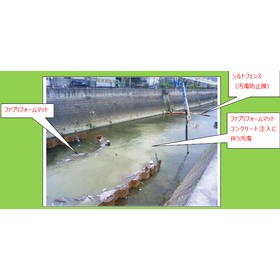
We would like to introduce a case where we proposed the "silt fence (pollution prevention membrane) + fabric formwork for underwater construction." In this project, the erosion of the riverbed caused by the water flow discharged from the rainwater drainage facility was a concern. We proposed the fabric formwork method, which allows for underwater construction, for riverbed protection work, and it was adopted. Additionally, to address the potential impact on the surrounding environment due to pollution generated when injecting concrete into the fabric formwork underwater, we employed the silt fence method as a countermeasure against pollution diffusion. This contributed to preventing pollution from spreading downstream. 【Case Overview】 ■ Adopted Method: Silt Fence (Pollution Prevention Membrane) - Prevents the diffusion of pollution generated during land reclamation, dredging, riverbank, river, and dam construction, protecting nearby marine resources. ■ Adopted Method: Fabric Formwork "FabriForm" *For more details, please download the PDF or feel free to contact us.
Added to bookmarks
Bookmarks listBookmark has been removed
Bookmarks listYou can't add any more bookmarks
By registering as a member, you can increase the number of bookmarks you can save and organize them with labels.
Free membership registration
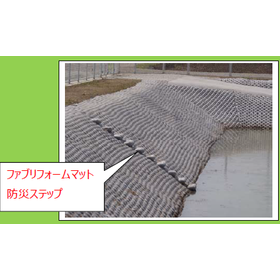
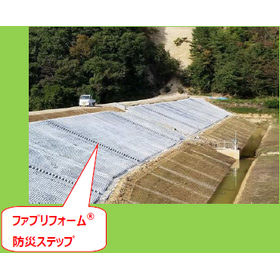
We would like to introduce a case study of the "Fabriform Disaster Prevention Steps" installation. In recent years, drowning accidents have become a problem in agricultural retention ponds and golf course ponds, and disaster prevention measures have been required at this agricultural retention pond as well. By adopting this method, we were able to install steps made of fabric formwork at any desired position on the Fabriform revetment slope, thereby constructing emergency disaster prevention steps. [Case Overview] ■ Issues - The surface of the fabric formwork became slippery due to moss and other growths. ■ Results - We were able to install steps using fabric formwork and construct emergency disaster prevention steps. *For more details, please download the PDF or feel free to contact us.
Added to bookmarks
Bookmarks listBookmark has been removed
Bookmarks listYou can't add any more bookmarks
By registering as a member, you can increase the number of bookmarks you can save and organize them with labels.
Free membership registration
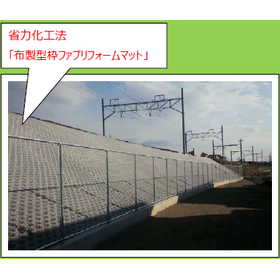
We would like to introduce a case study on the application of the labor-saving method "Fabric Formwork Fabric Reform Mat." In this project, it was necessary to protect the embankment of the railway track, which is an important structural element, during the railway line improvement work. By adopting this method, we were able to shorten the construction period for the originally planned block method embankment protection work to about one-sixth of the initial estimate. 【Case Overview】 ■Challenges - The large area requiring embankment protection resulted in an extended construction period. ■Results - We achieved a reduction in the construction period, which pleased our client. *For more details, please download the PDF or feel free to contact us.
Added to bookmarks
Bookmarks listBookmark has been removed
Bookmarks listYou can't add any more bookmarks
By registering as a member, you can increase the number of bookmarks you can save and organize them with labels.
Free membership registration
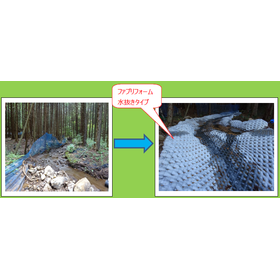
We would like to introduce a case of "fabric formwork for reforming water channels." In this project, due to large-scale land development, the stream channels in the surrounding area were altered, leading to unexpected locations experiencing water infiltration, raising concerns about expansion. Since there are multiple spring water locations in the stream area, we selected a fabric formwork with drainage type. We designed and constructed it to drain backwater into the channel. 【Case Overview】 ■Challenges - The site is a forest, making it difficult for heavy machinery to enter and shape the slopes, resulting in a site with many irregularities. ■Proposal - A concrete body forming method that injects fluid concrete or mortar into high-strength synthetic fiber fabric formwork using a pump. *For more details, please download the PDF or feel free to contact us.
Added to bookmarks
Bookmarks listBookmark has been removed
Bookmarks listYou can't add any more bookmarks
By registering as a member, you can increase the number of bookmarks you can save and organize them with labels.
Free membership registration
We would like to introduce a case study on measures to prevent water surface drop accidents in pond bank protection construction. At this site, after the installation of fabric formwork, there was a problem where the surface of the fabric formwork became slippery due to moss and other growths on the fabric. In response, we proposed the "Fabric Formwork Disaster Prevention Step Method." This allows for the installation of steps made from fabric formwork at any desired location on the bank slope, enabling the construction of emergency disaster prevention steps. 【Case Overview】 ■ Issues - The surface of the fabric formwork became slippery due to moss and other growths on the fabric. ■ Results - Steps made from fabric formwork were installed at any desired location on the bank slope. - Emergency disaster prevention steps were successfully constructed. *For more details, please download the PDF or feel free to contact us.
Added to bookmarks
Bookmarks listBookmark has been removed
Bookmarks listYou can't add any more bookmarks
By registering as a member, you can increase the number of bookmarks you can save and organize them with labels.
Free membership registration
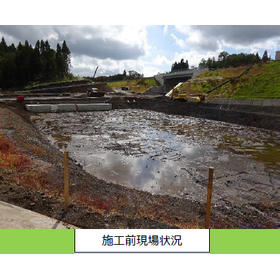
We would like to introduce a case where a fabric formwork "FabriForm" was adopted for the construction of a retention basin aimed at suppressing rainwater drainage associated with roadworks. At this site, an alternative construction method was required due to the need to remove groundwater in order to carry out the originally designed cast-in-place concrete. Therefore, we proposed and implemented this method as a surface protection work that allows construction even with some groundwater present, while also shortening the construction period. 【Features】 - Possible to construct with fewer workers and in a shorter time, leading to reduced construction period and costs - Construction possible underwater - Can be implemented in areas where heavy machinery cannot access - Mats can be produced to fit the site shape *For more details, please download the PDF or feel free to contact us.
Added to bookmarks
Bookmarks listBookmark has been removed
Bookmarks listYou can't add any more bookmarks
By registering as a member, you can increase the number of bookmarks you can save and organize them with labels.
Free membership registration
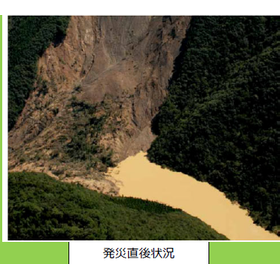
We would like to introduce a construction case of the fabric formwork "FabriForm" used in the emergency measures for temporary drainage works. In this site, a large-scale landslide disaster occurred in a mountainous area due to heavy rain caused by a large typhoon. It was necessary to construct a temporary drainage channel to drain a large amount of water that was accumulating urgently. Therefore, we proposed the use of fabric formwork "FabriForm" as a surface protection work that could shorten the construction period, and it was adopted. 【Features】 ■ Can be constructed with a small number of workers and in a short time, leading to reduced construction period and cost ■ Can be constructed underwater ■ Can be constructed in places where heavy machinery cannot enter ■ Mats can be produced to fit the shape of the site *For more details, please download the PDF or feel free to contact us.
Added to bookmarks
Bookmarks listBookmark has been removed
Bookmarks listYou can't add any more bookmarks
By registering as a member, you can increase the number of bookmarks you can save and organize them with labels.
Free membership registration
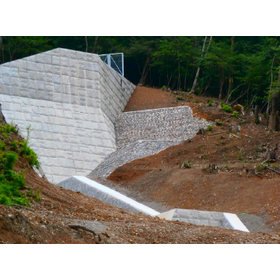
We would like to introduce a case where the fabric formwork method "FabriForm" was adopted for the construction of concrete erosion control dams. In this site, it was difficult to install concrete secondary products and rock fragments generated on-site on the slopes. Therefore, we proposed and implemented this method as a surface protection work that allows construction even with slight slope irregularities and can shorten the construction period. 【Case Overview】 ■Challenges - Difficulty in installing concrete secondary products and rock fragments generated on-site on the slopes. ■Advantages - Construction is possible even with slight slope irregularities, and it can also shorten the construction period. *For more details, please download the PDF or feel free to contact us.
Added to bookmarks
Bookmarks listBookmark has been removed
Bookmarks listYou can't add any more bookmarks
By registering as a member, you can increase the number of bookmarks you can save and organize them with labels.
Free membership registration
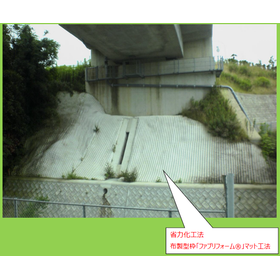
We would like to introduce a case study of the construction of a fabric formwork "FabriForm" on the slope beneath the superstructure. This site is nearing the end of the construction period, and there are almost no construction roads or equipment access routes, making it difficult to transport heavy machinery and materials to the site. Therefore, the site contractors were looking for a slope protection method that would achieve labor-saving efficiency. By adopting this method, we were able to shorten the originally planned construction period for the block slope protection work to about one-sixth. We successfully achieved a reduction in the construction period, which pleased our clients. [Case Overview] ■Challenges - Difficulty in transporting heavy machinery and materials to the site - Desire for the application of a labor-saving slope protection method ■Benefits of Implementation - Shortened the originally planned construction period to about one-sixth *For more details, please download the PDF or feel free to contact us.
Added to bookmarks
Bookmarks listBookmark has been removed
Bookmarks listYou can't add any more bookmarks
By registering as a member, you can increase the number of bookmarks you can save and organize them with labels.
Free membership registration