Construction method Product List and Ranking from 1592 Manufacturers, Suppliers and Companies

Last Updated: Aggregation Period:Dec 17, 2025~Jan 13, 2026
This ranking is based on the number of page views on our site.

Construction method Manufacturer, Suppliers and Company Rankings

Last Updated: Aggregation Period:Dec 17, 2025~Jan 13, 2026
This ranking is based on the number of page views on our site.

  1. Taiyo Kisokogyo Co.,Ltd. Aichi//General contractors and subcontractors
  2. ナカムラ Hyogo//Other construction industries
  3. 中外商工 Osaka//Building materials, supplies and fixtures manufacturers
  4. 4 水研 Shiga//Building materials, supplies and fixtures manufacturers
  5. 5 HOKOKU ENGINEERING CO.,LTD. Osaka//Other construction industries

Construction method Product ranking

Last Updated: Aggregation Period:Dec 17, 2025~Jan 13, 2026
This ranking is based on the number of page views on our site.

  1. Construction method for achieving large wooden structures: "NK Method" ナカムラ
  2. Lining Method for Sewer Facilities "Plascoat E/L" 中外商工
  3. Install the valve without stopping the water! 'EM Continuous Water Valve Method' 水研
  4. 4 Foundation Omega Method HOKOKU ENGINEERING CO.,LTD.
  5. 5 側溝修繕工法『ネプラス工法』<施工前後の写真付き資料進呈> ネプラス工法全国会 本部

Construction method Product List

4021~4035 item / All 4254 items

Displayed results

LPF method for temporary deadlines contributing to schedule management.

Optimize the process through material rationalization. A temporary formwork method for bridge piers that achieves both shortened construction time and reduced workload.

The temporary closure LPF method is a construction technique aimed at shortening construction periods and improving work efficiency through the rationalization of component composition. By reducing custom manufacturing for each pier, it contributes to the leveling of preparation time and on-site work. As a result, it also leads to easier process management and a reduction in the burden on workers. *Please view the comparison materials and process image materials in PDF format. [Features] ■ Temporary closure structure using liner plates ■ Above-water assembly and underwater installation method ■ Compatible with low headroom and narrow areas ■ Construction that minimizes vibrations is possible

  • Renovation and repair methods

Added to bookmarks

Bookmarks list

Bookmark has been removed

Bookmarks list

You can't add any more bookmarks

By registering as a member, you can increase the number of bookmarks you can save and organize them with labels.

Free membership registration

Temporary closure LPF method suitable for reinforcing river bridge piers.

Construction that takes into account the water discharge period and water level fluctuations is possible. A temporary closure method that allows for the reinforcement of bridge piers while considering the river environment.

The temporary cutoff LPF method is a construction technique that allows for work on the reinforcement and repair of bridge piers in rivers, taking into account water level fluctuations and work constraints. After assembling the tubular structure above the water surface, it is installed underwater, enabling construction to proceed while minimizing impact on the river environment. It can accommodate low headroom conditions and narrow river cross-sections, and is used in maintenance and management work for river bridges. *Case studies of construction in river projects are available. 【Features】 ■ Temporary cutoff structure using liner plates ■ Above-water assembly and underwater installation method ■ Accommodates low headroom and narrow areas ■ Construction that minimizes vibrations is possible

  • Renovation and repair methods

Added to bookmarks

Bookmarks list

Bookmark has been removed

Bookmarks list

You can't add any more bookmarks

By registering as a member, you can increase the number of bookmarks you can save and organize them with labels.

Free membership registration

Low-altitude site response temporary deadline LPF method

Construction is possible with a temporary cutoff of about 1.0m for the bridge pier reinforcement work, which has many constraints.

In bridge pier reinforcement work where the workspace is limited, the selection of the temporary cutoff method influences the feasibility of construction. The temporary cutoff LPF method can accommodate manual construction and can be assembled and installed even under low headroom and narrow conditions. It is easy to introduce even in sites where heavy machinery usage is difficult, expanding the options for construction planning. *Construction achievements in low headroom sites are documented. 【Features】 ■Temporary cutoff structure using liner plates ■Above-water assembly and underwater installation method ■Compatible with low headroom and narrow areas ■Construction that suppresses vibrations is possible

  • Renovation and repair methods

Added to bookmarks

Bookmarks list

Bookmark has been removed

Bookmarks list

You can't add any more bookmarks

By registering as a member, you can increase the number of bookmarks you can save and organize them with labels.

Free membership registration

Temporary closure LPF method suitable for short-term construction.

A bridge pier temporary closure method that makes it easy to organize work processes and can be easily implemented even during nighttime or within a limited construction period.

In nighttime construction or bridge pier reinforcement work with limited construction periods, the ease of assembling the process is important. The temporary cutoff LPF method features a simple component structure and allows for shape selection according to site conditions, making it easy to organize the construction steps. It is being considered as an option for sites looking to shorten the construction process. *You can check the process comparison materials in PDF format. 【Features】 ■ Temporary cutoff structure using liner plates ■ Above-water assembly and underwater installation method ■ Suitable for low headroom and narrow areas ■ Construction that minimizes vibrations is possible

  • Renovation and repair methods

Added to bookmarks

Bookmarks list

Bookmark has been removed

Bookmarks list

You can't add any more bookmarks

By registering as a member, you can increase the number of bookmarks you can save and organize them with labels.

Free membership registration

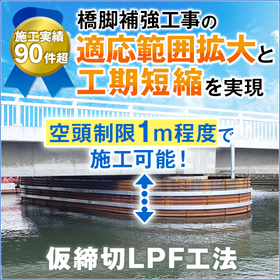
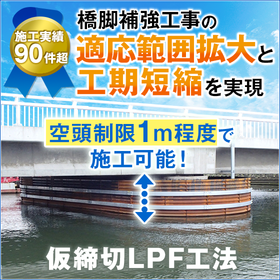
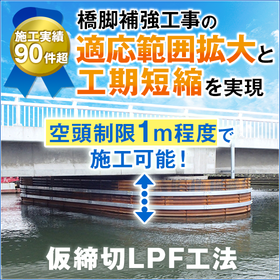
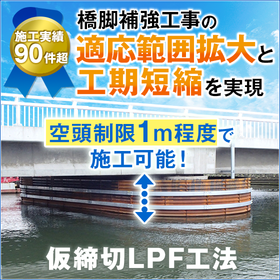
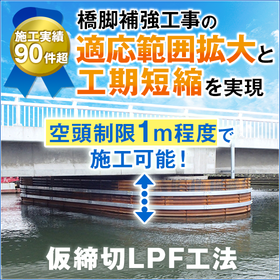
Temporary closure method for bridge pier reinforcement using liner plates.

Over 90 construction achievements and more than 110 target bridge piers. A liner plate temporary closure method that accommodates low headroom and narrow conditions, contributing to shortened construction periods.

The temporary cutoff LPF method is a temporary cutoff construction technique that uses liner plates to build a temporary cutoff structure, aimed at bridge pier reinforcement and repair work. It has over 90 construction records nationwide in underwater environments such as rivers, seas, and dams, and has been applied to more than 110 bridge piers. This method adopts a technique where a tubular liner plate structure is assembled above water and then installed underwater. It allows for the selection of shapes according to site conditions while minimizing excessive custom component manufacturing for each bridge pier, contributing to shortened processes, rationalized construction planning, and securing holidays. 【Features】 ■ Composed of liner plates, H-beams (reinforcement rings), and supports ■ Above-water assembly and underwater installation method ■ Construction possible with low headroom (approximately 1.0m) ■ Manual construction compatible, can be executed under heavy machinery restrictions ■ Vibration-free construction reduces impact on the surrounding environment *Method comparison materials and construction case studies can be viewed in PDF format.

  • Renovation and repair methods

Added to bookmarks

Bookmarks list

Bookmark has been removed

Bookmarks list

You can't add any more bookmarks

By registering as a member, you can increase the number of bookmarks you can save and organize them with labels.

Free membership registration

For fall prevention in high-altitude work! C-ring method

[Construction video available] Achieving easy transportation! This is a construction method developed with a focus on "safety" and "convenience."

The "C Ring Method" utilizes a "C Ring" equipped with a pulley in a notched shape, eliminating the need to replace fall arrest devices (safety belts) for each span, allowing for free movement on scaffolding. By using various shaped parts, it can also be used as a pulley or trolley. Please feel free to contact us when you need assistance. 【Lineup】 ■ Scaffolding Through ■ Trolley Through ■ Hoist Through ■ Parts *For more details, please download the PDF or feel free to contact us.

  • Special Construction Method

Added to bookmarks

Bookmarks list

Bookmark has been removed

Bookmarks list

You can't add any more bookmarks

By registering as a member, you can increase the number of bookmarks you can save and organize them with labels.

Free membership registration

[Must-see for those in the Tohoku area!] Cross-section repair method 'sto dry spray method'

Construction can be completed in a short period! Dry spray method using polymer cement mortar.

The "sto Dry Spray Application Method" is a technique that allows for the repair and reinforcement of concrete structures using a unique silo system, enabling construction to be completed in a short period of time. A device called the spray supply system sprays polymer cement mortar at a high speed of 200 km/h. This method can be applied to various concrete structure repair works, such as cross-section repairs and the thickening of the underside of RC slabs, which were traditionally addressed by plastering methods, filling methods using formwork, and wet spray methods. 【Features】 - Shortened construction period - Reduced running costs - Excellent workability - Improved quality - Registered in the Ministry of Land, Infrastructure, Transport and Tourism's NETIS New Technology Information System *Quick response is available for those in the six prefectures of Tohoku. (Aomori, Iwate, Miyagi, Akita, Yamagata, Fukushima) For more details, please contact us or download the catalog.

Added to bookmarks

Bookmarks list

Bookmark has been removed

Bookmarks list

You can't add any more bookmarks

By registering as a member, you can increase the number of bookmarks you can save and organize them with labels.

Free membership registration

Must-see in the Tohoku region! Cross-section restoration method 'sto dry spray method'

Construction can be completed in a short period! - Reducing construction costs, extending the lifespan of structures, and increasing durability - Dry spraying method using polymer cement mortar.

The "sto Dry Spray Application Method" is a technique that allows for the repair and reinforcement of concrete structures using a unique silo system, enabling construction to be completed in a short period of time. It sprays polymer cement mortar at a high speed of 200 km/h using a spray supply system. This method can be applied to various concrete structure repair projects and the thickening of the underside of RC slabs, which were traditionally addressed using plastering methods, filling methods with formwork, and wet spray methods. - Features Transport distance: Horizontal 300m, Vertical 150m Single layer application thickness: 6mm to 50mm (maximum 100mm) Can be applied under traffic vibrations Finishing with a trowel is possible No mixing work required on-site No issues such as blockage of the pumping hose, allowing for long periods of work interruption Easy to clean No formwork required No primer needed High-quality cross-section formation - Benefits Significant reduction in construction time Cost savings in construction Extension of the lifespan and durability of structures *Quick response is possible for the six prefectures in the Tohoku region. (Aomori, Iwate, Miyagi, Akita, Yamagata, Fukushima) For more details, please contact us or download the catalog.

Added to bookmarks

Bookmarks list

Bookmark has been removed

Bookmarks list

You can't add any more bookmarks

By registering as a member, you can increase the number of bookmarks you can save and organize them with labels.

Free membership registration

Low-pressure resin injection method, Tarpan Type 2 method * Optimal for concrete cracking.

A low-pressure injection method that achieves a high filling rate that could not be achieved with high-pressure injection methods such as grouting pumps!

The actual internal cracks have a complex shape and are not smooth like acrylic sheets. When injected with a grout pump, the pressure is high, which speeds up the injection time, but considering the filling properties, it is not necessarily true that high pressure is always good. Additionally, there are methods that only involve sealing techniques or applying epoxy to the surface, but these only treat the surface, leaving the internal cracks as they are, which could lead to the widening of cracks in the future or act as a trigger for cracks to develop in other areas. 【Features】 ■ Easy handling of injection equipment! ■ A wide variety of bases! ■ Available in flat bases, corner bases, narrow L-shaped joints for use in tight spaces, and holders, making it adaptable to any site! ■ A trusted product featured in the LPIS (Automatic Low-Pressure Resin Injection Method Guidebook)! *For more details, please download the catalog or contact us directly.

  • Renovation and repair methods
  • Architectural design office

Added to bookmarks

Bookmarks list

Bookmark has been removed

Bookmarks list

You can't add any more bookmarks

By registering as a member, you can increase the number of bookmarks you can save and organize them with labels.

Free membership registration

Low-pressure resin injection method Tarpan Type 2 method *Same results regardless of who performs the work!!

An automatic low-pressure injection method that eliminates variability caused by the operator by relying on the restoring force of the spring, ensuring the same results regardless of who performs the work!

The actual interior of the cracks has a complex shape and is not smooth like an acrylic plate. When injected with a grouting pump, the pressure is high, which speeds up the injection time, but considering the filling ability, high pressure is not necessarily always good. Additionally, in conventional methods, workers could not leave the site until the injection was completed, but with the automatic low-pressure injection method, once the capsule is set in the crack, the worker can leave the site as the operation relies on the spring's restoring force. This allows for a small number of workers to cover a wide area, and the significant feature of this product is that anyone can achieve the same results regardless of who performs the work. 【Features】 ■Ease of handling injection equipment! ■A wide variety of bases! ■Includes flat bases, corner bases, L-shaped joints for narrow widths, and holders, making it adaptable to any site! ■A trusted product featured in the LPIS (Automatic Low-Pressure Resin Injection Method Guidebook)! *For more details, please download the catalog or contact us directly.

  • Renovation and repair methods
  • Architectural design office

Added to bookmarks

Bookmarks list

Bookmark has been removed

Bookmarks list

You can't add any more bookmarks

By registering as a member, you can increase the number of bookmarks you can save and organize them with labels.

Free membership registration

Concrete Repair Method 'IPH Method' for Customers in Aichi Prefecture

High-density filling even for fine cracks of 0.01 mm with ultra-low pressure injection while removing air. *Numerous construction achievements within Aichi Prefecture.

At our company, Chūnichi Construction, we are implementing the concrete repair and reinforcement method known as "IPH Method." The conventional concrete repair method, "low-pressure resin injection method," often failed to allow the resin to reach the internal structure of the concrete due to the obstruction of air inside. In contrast, the "IPH Method" allows the injected resin to diffuse radially within the concrete while removing the air present inside the structure, enabling it to fill even the finest cracks at the ends. This detailed filling enhances the adhesion strength between the rebar and concrete, providing anti-corrosion effects as well. We have a significant track record of adoption in tunnels, bridges, and public works projects, and in recent years, there has been a notable increase in inquiries from large private facilities and factories! 【Construction Achievements in Aichi Prefecture (Partial Excerpt)】 ◇ May 2018: Toyoda City, Aichi Prefecture Construction work for seismic reinforcement of the Kanpachi Water Pipe Bridge as part of the Yahagi River Comprehensive Phase II Agricultural Disaster Prevention Project. ◇ March 2019: Okazaki City, Aichi Prefecture Box culvert repair work as part of road disaster prevention construction. ◇ March 2019: Nishikasugai District, Aichi Prefecture Combined construction for the improvement of the internal roads at Nagoya Airport (Phase 5) and civil engineering facilities (Phase 18). *For more details, please refer to the PDF document or feel free to contact us.

Added to bookmarks

Bookmarks list

Bookmark has been removed

Bookmarks list

You can't add any more bookmarks

By registering as a member, you can increase the number of bookmarks you can save and organize them with labels.

Free membership registration

[Helpful Materials Provided] Explanation of the 'Void Injection Filling Method' to Prevent Injuries

Install PVC pipes for injection! There are advantages such as 'low noise and vibration generation'.

In the "Void Injection Filling Method," if there are depressions or voids around the building, cement is injected to fill them. First, a PVC pipe is installed for injection. Then, a cement slurry is prepared and injected into the void areas. There are advantages such as "possible construction in a short period" and "minimal noise and vibration." 【Process Flow】 (1) Install PVC pipes for injecting cement slurry (2) Prepare the cement slurry for injection (3) Inject the cement slurry into the void areas *For more details, please refer to the PDF document or feel free to contact us.

  • Ground foundation construction method

Added to bookmarks

Bookmarks list

Bookmark has been removed

Bookmarks list

You can't add any more bookmarks

By registering as a member, you can increase the number of bookmarks you can save and organize them with labels.

Free membership registration

Self-Supporting Manhole Rehabilitation Method SS Hole System

Acquisition of inspection certification! Types 1 to 4! Manhole depth 10m! Construction method using high acid resistance and high load-bearing reinforced plastic composite pipes. No special construction techniques required!

The "SS Hole System" is a rehabilitation method that simply extends the lifespan of aging manholes. Being self-supporting, it does not require the residual strength from diagnostic surveys of existing manholes and can also accommodate unreinforced manholes, providing a load-bearing capacity equivalent to new installations. This method does not require special construction techniques, allowing for rehabilitation using general construction skills anywhere in Japan. As a factory-produced product, it has consistent quality with no variability and stable load-bearing capacity. The internal cross-section is maximally secured. 【Features】 ■ Constructability: Does not require special construction techniques, allowing for rehabilitation with general construction skills. ■ Acid Resistance: Reinforced plastic composite pipes with over 40 years of proven performance. ■ Load Capacity: Factory-produced, ensuring consistent quality and stable load-bearing capacity. ■ Seismic Resistance: Reinforced plastic composite pipes with high strength and excellent seismic resistance. 《Acquired the Construction Technology Review Certificate (Sewage) from the Japan Sewerage New Technology Organization  March 18, 2021, No. 2021  Scope of expansion: Manholes No. 1 to No. 4, up to a depth of 10m》 *For more details, please refer to the PDF materials or feel free to contact us.

  • Manhole body
  • Dam construction
  • Water Supply Facilities

Added to bookmarks

Bookmarks list

Bookmark has been removed

Bookmarks list

You can't add any more bookmarks

By registering as a member, you can increase the number of bookmarks you can save and organize them with labels.

Free membership registration

Introduction of standard construction procedures for obtaining inspection certification for self-supporting manhole rehabilitation methods!

No special materials or construction techniques are required, and it can be completed in a short period of about 4 to 5 days! Here is an introduction to the construction procedure of the SS Hall system!

The "SS Hole System" is a rehabilitation method that simply extends the lifespan of aging manholes. Depending on the conditions, it can be completed in a short construction period of about 4 to 5 days! The construction steps are as follows: 1. Clean and remove the deteriorated sloped walls of the manhole, the vertical walls of the existing manhole, and the invert. 2. Install the "Reinforced Plastic Composite Pipe Manhole" into the existing manhole, filling the gap between the reinforced plastic and the vertical wall of the existing manhole with backfill material. 3. Install the foundation block and slab block of the SS hole, then backfill after installing the sloped walls, adjustment rings, and iron covers to complete the process. 《Construction Technology Examination Certificate (Sewage) obtained March 18, 2021, No. 2021 Scope of application expanded: Manholes No. 1 to No. 4, up to a depth of 10 meters》 *For more details, please refer to the PDF document or feel free to contact us.

  • Manhole body
  • Dam construction
  • Water Supply Facilities

Added to bookmarks

Bookmarks list

Bookmark has been removed

Bookmarks list

You can't add any more bookmarks

By registering as a member, you can increase the number of bookmarks you can save and organize them with labels.

Free membership registration

Self-Supporting Manhole Rehabilitation Method for Construction Consultants

Supports inspection certificates No. 1 to 4 up to 10m! No special construction techniques required! A method using reinforced plastic piping materials with high acid resistance and high load capacity.

The "SS Hole System" is a self-supporting manhole rehabilitation method that simply extends the lifespan of aging manholes. It is widely adopted by construction consultants, construction managers, and civil engineers. This method does not require any special construction techniques, allowing rehabilitation to be performed in any region of Japan using standard construction practices. As a factory-produced product, it has stable load-bearing capacity without quality variations. Additionally, it uses reinforced plastic composite pipes with over 40 years of proven performance, demonstrating high acid resistance and seismic resistance, while also maintaining a slim profile to maximize the internal cross-section. 【Features】 ■ Workability: Can be rehabilitated using standard construction techniques without the need for special skills ■ Acid Resistance: Reinforced plastic composite pipes with over 40 years of proven performance ■ Load-Bearing Capacity: Factory-produced, ensuring stable load-bearing capacity without quality variations ■ Seismic Resistance: High-strength reinforced plastic composite pipes with excellent seismic resistance 《Construction Technology Review Certificate (Sewage) obtained  March 18, 2021, No. 2021  Scope of application expanded: Manholes No. 1 to No. 4, up to a depth of 10m》

  • Renovation and repair methods
  • Manhole body

Added to bookmarks

Bookmarks list

Bookmark has been removed

Bookmarks list

You can't add any more bookmarks

By registering as a member, you can increase the number of bookmarks you can save and organize them with labels.

Free membership registration