Coating Product List and Ranking from 342 Manufacturers, Suppliers and Companies | IPROS

Last Updated: Aggregation Period:Mar 11, 2026~Apr 07, 2026
This ranking is based on the number of page views on our site.

Coating Manufacturer, Suppliers and Company Rankings

Last Updated: Aggregation Period:Mar 11, 2026~Apr 07, 2026
This ranking is based on the number of page views on our site.

  1. ゆはかのこ Saitama//Service Industry
  2. TOAシブル Chiba//Other construction industries
  3. ONZ Tokyo//Interior construction business
  4. 4 G-POWER Tokyo//Building materials, supplies and fixtures manufacturers
  5. 4 日本ビソー Tokyo//Other construction industries

Coating Product ranking

Last Updated: Aggregation Period:Mar 11, 2026~Apr 07, 2026
This ranking is based on the number of page views on our site.

  1. Powerful anti-rust coating agent "Guard Scepter 101P" TOAシブル
  2. Elevator construction gondola | Covers all concerns during construction 日本ビソー
  3. Glass Coating G-POWER 88 G-POWER
  4. Solvent Recycler イデア
  5. 5 Fire-resistant sheet "SK Taika Sheet" エスケー化研

Coating Product List

541~570 item / All 1074 items

Displayed results

Vacuum reaction vessel Teflon coating

If you need design and manufacturing of mixing tanks, leave it to UIK. We promise low prices, high quality, and short delivery times by leveraging our extensive know-how.

If you need design and manufacturing of mixing tanks, please leave it to us at U.I.K. We provide comprehensive support from design and manufacturing to installation and aftercare. Leveraging our extensive know-how, we promise "low prices," "high quality," and "short delivery times." Thanks to this, we have gained the loyalty of many customers and have numerous achievements with major companies. While we handle a wide range of plant equipment, we are particularly confident in our mixing tanks, which have satisfied many customers. We often receive feedback like, "The equipment we installed a long time ago is still in operation today." At U.I.K., we deliver the best equipment to all our customers as a trusted and proven manufacturing factory. Please feel free to contact us first. "U.I.K. Business Overview" - Design and manufacturing of equipment related to the production of chemicals, food, and pharmaceuticals, mixing tanks with agitators, jacketed tanks, transport tanks, storage tanks, box-type dryers, ribbon blenders - Installation work, removal and relocation work, piping work, trailer transport services, relocation work using cranes and rough terrain forklifts, piping work for SUS, PVC, gas pipes - Maintenance work including mechanical seal replacement, gear reducer and agitator replacement, and repair or replacement of damaged parts.

  • pump
  • Steel
  • Secondary steel products
  • Coating

Added to bookmarks

Bookmarks list

Bookmark has been removed

Bookmarks list

You can't add any more bookmarks

By registering as a member, you can increase the number of bookmarks you can save and organize them with labels.

Free membership registration

Diffusion coating × hydrophilic coating

Maintain the panel surface and light diffusion in their original state for a long time!

We introduce a technology that uses "diffusion coating" and "hydrophilic coating" to maintain the panel surface and light diffusion in their original state for a long time. To prevent dirt and dust from adhering to the panel surface through static electricity prevention and self-cleaning effects from rain, light can diffuse beautifully for an extended period without being scattered by dirt and dust. 【Features】 ■ It is possible to apply a hydrophilic coating over the diffusion coating. ■ Static electricity prevention ■ Self-cleaning effect from rain ■ Light does not scatter due to dirt and dust ■ Maintains a long-lasting and beautiful state of light diffusion *For more details, please refer to the PDF document or feel free to contact us.

  • Synthetic Resin Plywood
  • panel
  • Coating

Added to bookmarks

Bookmarks list

Bookmark has been removed

Bookmarks list

You can't add any more bookmarks

By registering as a member, you can increase the number of bookmarks you can save and organize them with labels.

Free membership registration

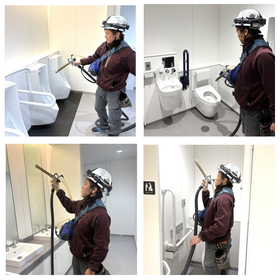
This is a case study of photocatalytic treatment for deodorization and antibacterial measures in public facility restrooms.

The photocatalytic oxidation power suppresses and reduces the substances causing unpleasant odors in the toilet, creating a clean environment.

By coating a titanium dioxide aqueous solution, which serves as the raw material for photocatalysts, on the ceilings and walls of buildings, it exhibits effects such as dirt resistance, deodorization, antibacterial properties, antiviral properties, and mold prevention. When light hits the surface of the indoor photocatalyst, reactive oxygen species are generated, which decompose organic substances that cause dirt and odors into harmless water and carbon dioxide. Additionally, the surface of the outdoor photocatalyst, when exposed to rain, utilizes a hydrophilic effect that allows water to spread thinly beneath the dirt, contributing to self-cleaning as the dirt flows away with the water, thus maintaining the aesthetic of the building and reducing cleaning costs. Since the raw material for the photocatalyst, titanium dioxide, is inorganic, it does not degrade due to ultraviolet rays or other factors, and its effects continue for a long time.

  • Photocatalysts and various wall materials (exterior and interior walls, etc.)
  • Coating

Added to bookmarks

Bookmarks list

Bookmark has been removed

Bookmarks list

You can't add any more bookmarks

By registering as a member, you can increase the number of bookmarks you can save and organize them with labels.

Free membership registration

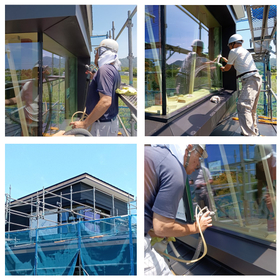
This is a case study of photocatalytic treatment for dirt prevention on glass in detached houses.

The hydrophilic effect of photocatalysts makes it easier for rain to wash away dirt from the glass of detached houses, creating a clean environment.

By coating the titanium dioxide aqueous solution, which is the raw material for photocatalysts, on the ceilings and walls of buildings, it exhibits effects such as dirt resistance, deodorization, antibacterial properties, antiviral properties, and mold prevention. The surface of the outdoor photocatalyst, when exposed to rain, utilizes hydrophilic effects that cause water to spread thinly beneath the dirt, contributing to self-cleaning as the surface dirt flows away, thus maintaining the aesthetic of the building and reducing cleaning costs. When light hits the surface of the indoor photocatalyst, reactive oxygen species are generated, which decompose organic substances that cause dirt and odors into water and carbon dioxide, rendering them harmless. Since the raw material of the photocatalyst, titanium dioxide, is inorganic, it does not degrade due to ultraviolet rays or other factors, and its effectiveness continues for a long time.

  • Photocatalysts and various wall materials (exterior and interior walls, etc.)
  • Coating

Added to bookmarks

Bookmarks list

Bookmark has been removed

Bookmarks list

You can't add any more bookmarks

By registering as a member, you can increase the number of bookmarks you can save and organize them with labels.

Free membership registration

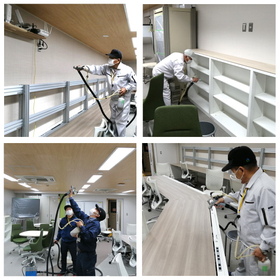
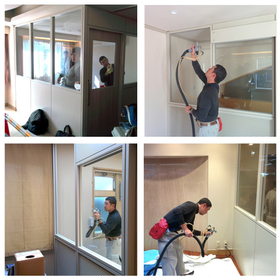
This is a case study of photocatalytic antibacterial and antiviral treatment in the office of a beverage factory.

Using the oxidative decomposition power of photocatalysts, we suppress and reduce the causes of bacteria and viruses in the office, creating a clean environment.

By coating the ceilings and walls of buildings with a titanium dioxide aqueous solution, which is the raw material for photocatalysts, it exhibits effects such as anti-soiling, deodorization, antibacterial properties, antiviral properties, and mold prevention. When light hits the surface of the indoor photocatalyst application, reactive oxygen species are generated on the surface, breaking down organic substances that cause dirt and odors into harmless water and carbon dioxide. Additionally, the surface of the outdoor photocatalyst application has a hydrophilic effect, where rainwater spreads thinly beneath the dirt, contributing to self-cleaning as it washes away the surface dirt, thus maintaining the building's aesthetic and reducing cleaning costs. Since the raw material for the photocatalyst, titanium dioxide, is inorganic, it does not degrade due to ultraviolet rays or other factors, and its effectiveness lasts for a long time.

  • Photocatalysts and various wall materials (exterior and interior walls, etc.)
  • Coating

Added to bookmarks

Bookmarks list

Bookmark has been removed

Bookmarks list

You can't add any more bookmarks

By registering as a member, you can increase the number of bookmarks you can save and organize them with labels.

Free membership registration

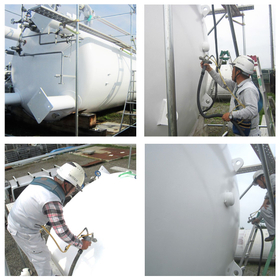
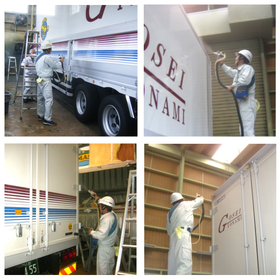
This is a case study of photocatalytic application for anti-fouling measures on industrial gas tanks.

The decomposition of organic dirt using photocatalysts and self-cleaning creates a clean environment by breaking down substances that cause dirt, odors, bacteria, and mold both inside and outside buildings.

By applying a titanium dioxide aqueous solution, which is the raw material for photocatalysts, to the ceilings and walls of buildings, it exhibits effects such as dirt resistance, deodorization, antibacterial properties, antiviral properties, and mold prevention. When light hits the surface of the indoor photocatalyst application, reactive oxygen species are generated on the surface, decomposing organic substances that cause dirt and odors into harmless water and carbon dioxide. Additionally, the surface of the outdoor photocatalyst application has a hydrophilic effect that causes water to spread thinly beneath the dirt when it rains, contributing to self-cleaning as the dirt flows away with the water, thus maintaining the aesthetic of the building and reducing cleaning costs. Since the raw material for the photocatalyst, titanium dioxide, is inorganic, it does not degrade due to ultraviolet rays or other factors, and its effectiveness continues for a long time.

  • Photocatalysts and various wall materials (exterior and interior walls, etc.)
  • Coating

Added to bookmarks

Bookmarks list

Bookmark has been removed

Bookmarks list

You can't add any more bookmarks

By registering as a member, you can increase the number of bookmarks you can save and organize them with labels.

Free membership registration

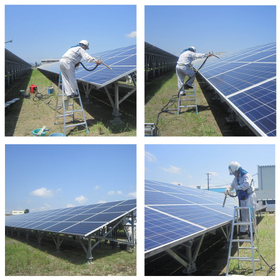
This is a case study of photocatalytic treatment for anti-dirt measures on solar panels.

The hydrophilic effect of photocatalysts (self-cleaning effect) makes it easier for rain to wash away dirt from building exteriors and glass, creating a clean environment.

By applying a titanium dioxide aqueous solution, which serves as the raw material for photocatalysts, to the ceilings and walls of buildings, it exhibits effects such as anti-soiling, deodorization, antibacterial properties, antiviral properties, and mold prevention. When light hits the surface of the indoor photocatalyst, reactive oxygen species are generated, which decompose organic substances that cause dirt and odors into harmless water and carbon dioxide. Additionally, the surface of the outdoor photocatalyst, when exposed to rain, utilizes a hydrophilic effect that allows water to spread thinly beneath the dirt, contributing to self-cleaning as the dirt flows away with the water, thereby maintaining the aesthetic of the building and reducing cleaning costs. Since the raw material for the photocatalyst, titanium dioxide, is inorganic, it does not degrade due to ultraviolet rays or other factors, and its effects continue for a long time.

  • Photocatalysts and various wall materials (exterior and interior walls, etc.)
  • Coating

Added to bookmarks

Bookmarks list

Bookmark has been removed

Bookmarks list

You can't add any more bookmarks

By registering as a member, you can increase the number of bookmarks you can save and organize them with labels.

Free membership registration

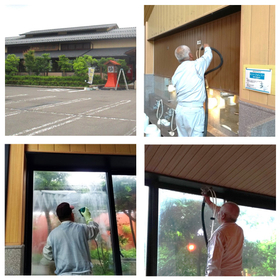
This is an example of photocatalytic treatment for anti-contamination and anti-mold measures in bathing facility premises.

The decomposition of organic contaminants using photocatalysts and self-cleaning creates a clean environment by breaking down substances that cause dirt, odors, bacteria, and mold both inside and outside buildings.

By applying a titanium dioxide aqueous solution, which is the raw material for photocatalysts, to the ceilings and walls of buildings, it exhibits effects such as dirt resistance, deodorization, antibacterial properties, antiviral properties, and mold prevention. When light hits the surface of the indoor photocatalyst, reactive oxygen species are generated, which decompose organic substances that cause dirt and odors into harmless water and carbon dioxide. Additionally, the surface of the outdoor photocatalyst, when exposed to rain, utilizes a hydrophilic effect that spreads water thinly beneath the dirt, allowing for self-cleaning as the dirt flows away with the water, contributing to the maintenance of the building's aesthetics and reducing cleaning costs. Since the raw material for the photocatalyst, titanium dioxide, is inorganic, it does not degrade due to ultraviolet rays or other factors, and its effectiveness continues for a long time.

  • Photocatalysts and various wall materials (exterior and interior walls, etc.)
  • Coating

Added to bookmarks

Bookmarks list

Bookmark has been removed

Bookmarks list

You can't add any more bookmarks

By registering as a member, you can increase the number of bookmarks you can save and organize them with labels.

Free membership registration

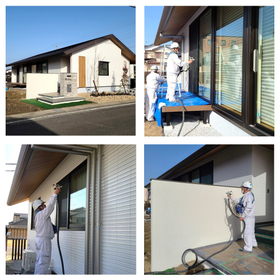
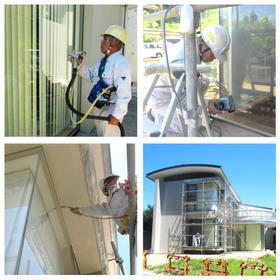
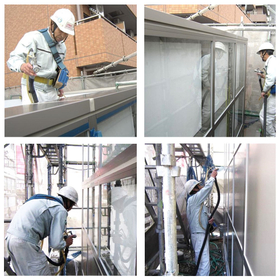
This is a case study of photocatalytic treatment for anti-dirt measures on the exterior walls and glass of detached houses.

The decomposition of organic contaminants using photocatalysts and self-cleaning creates a clean environment by breaking down substances that cause dirt, odors, bacteria, and mold both inside and outside buildings.

By applying a titanium dioxide aqueous solution, which is the raw material for photocatalysts, to the ceilings and walls of buildings, it exhibits effects such as dirt resistance, deodorization, antibacterial properties, antiviral properties, and mold prevention. When light hits the surface of the indoor photocatalyst, reactive oxygen species are generated, which decompose organic substances that cause dirt and odors into harmless water and carbon dioxide. Additionally, the surface of the outdoor photocatalyst, when exposed to rain, utilizes a hydrophilic effect that spreads water thinly beneath the dirt, allowing for self-cleaning as the surface dirt flows away, contributing to the maintenance of the building's aesthetics and reducing cleaning costs. Since the raw material for the photocatalyst, titanium dioxide, is inorganic, it does not degrade due to ultraviolet rays or other factors, and its effectiveness continues for a long time.

  • Photocatalysts and various wall materials (exterior and interior walls, etc.)
  • Coating

Added to bookmarks

Bookmarks list

Bookmark has been removed

Bookmarks list

You can't add any more bookmarks

By registering as a member, you can increase the number of bookmarks you can save and organize them with labels.

Free membership registration

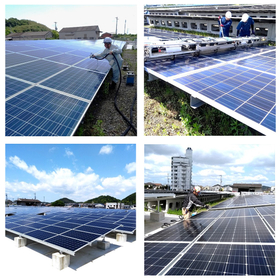
This is a case study of photocatalytic treatment for anti-fouling measures on solar panel glass.

The hydrophilic effect of photocatalysts (self-cleaning effect) makes it easier for rain to wash away dirt from building exteriors and glass, creating a clean environment.

By applying a titanium dioxide aqueous solution, which is the raw material for photocatalysts, to the ceilings and walls of buildings, it exhibits effects such as dirt resistance, deodorization, antibacterial properties, antiviral properties, and mold prevention. When light hits the surface of the indoor photocatalyst application, reactive oxygen species are generated on the surface, decomposing organic substances that cause dirt and odors into harmless water and carbon dioxide. The surface of the outdoor photocatalyst application utilizes a hydrophilic effect, where rainwater spreads thinly beneath the dirt, contributing to self-cleaning as the surface dirt flows away, thereby maintaining the aesthetic of the building and reducing cleaning costs. Since the raw material for the photocatalyst, titanium dioxide, is inorganic, it does not degrade due to ultraviolet rays or other factors, and its effectiveness continues for a long time.

  • Photocatalysts and various wall materials (exterior and interior walls, etc.)
  • Coating

Added to bookmarks

Bookmarks list

Bookmark has been removed

Bookmarks list

You can't add any more bookmarks

By registering as a member, you can increase the number of bookmarks you can save and organize them with labels.

Free membership registration

This is an example of photocatalytic treatment for anti-fouling measures on museum glass.

The hydrophilic effect of photocatalysts (self-cleaning effect) makes it easier for rain to wash away dirt from building exteriors and glass, creating a clean environment.

By coating the titanium dioxide aqueous solution, which is the raw material for photocatalysts, on the ceilings and walls of buildings, it exhibits effects such as anti-soiling, deodorization, antibacterial, antiviral, and mold prevention. When light hits the surface of the indoor photocatalyst, reactive oxygen species are generated on the surface, breaking down organic substances that cause dirt and odors into harmless water and carbon dioxide. The surface of the outdoor photocatalyst, when exposed to rain, utilizes a hydrophilic effect that allows water to spread thinly beneath the dirt, contributing to self-cleaning as the dirt flows away with the water, thus maintaining the aesthetic of the building and reducing cleaning costs. Since the raw material for the photocatalyst, titanium dioxide, is inorganic, it does not degrade due to ultraviolet rays or other factors, and its effects continue for a long time.

  • Photocatalysts and various wall materials (exterior and interior walls, etc.)
  • Coating

Added to bookmarks

Bookmarks list

Bookmark has been removed

Bookmarks list

You can't add any more bookmarks

By registering as a member, you can increase the number of bookmarks you can save and organize them with labels.

Free membership registration

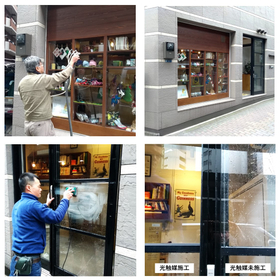
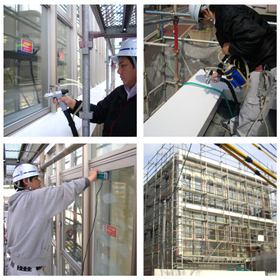
This is a case study of photocatalytic application for anti-dirt measures on store windows.

The hydrophilic effect of photocatalysts (self-cleaning) makes it easier for rain to wash away dirt from glass, creating a clean environment.

By applying a titanium dioxide aqueous solution, which serves as the raw material for photocatalysts, to the ceilings and walls of buildings, it exhibits effects such as dirt resistance, deodorization, antibacterial properties, antiviral properties, and mold prevention. When light hits the surface of the indoor photocatalyst application, reactive oxygen species are generated on the surface, breaking down organic substances that cause dirt and odors into harmless water and carbon dioxide. The surface of the outdoor photocatalyst application utilizes a hydrophilic effect, where rainwater spreads thinly beneath the dirt, contributing to self-cleaning as it washes away the surface dirt, thereby maintaining the aesthetic of the building and reducing cleaning costs. Since the raw material for the photocatalyst, titanium dioxide, is inorganic, it does not degrade due to ultraviolet rays or other factors, and its effects continue for a long time.

  • Photocatalysts and various wall materials (exterior and interior walls, etc.)
  • Coating

Added to bookmarks

Bookmarks list

Bookmark has been removed

Bookmarks list

You can't add any more bookmarks

By registering as a member, you can increase the number of bookmarks you can save and organize them with labels.

Free membership registration

This is an example of photocatalytic treatment in a smoking room of a lodging facility (anti-soiling and deodorization measures).

The photocatalytic oxidation decomposition power (decomposition of dirt) breaks down and suppresses/reduces the harmful substances such as tar stains from smoking, creating a clean environment.

■Raw Material Titanium Dioxide By coating a titanium dioxide aqueous solution, which is the raw material for photocatalysts, on the ceilings and walls of buildings, it exhibits effects such as anti-soiling, deodorization, antibacterial properties, antiviral properties, and mold prevention. ■Indoor Photocatalyst When light hits the surface of the indoor photocatalyst, reactive oxygen species are generated on the surface, decomposing organic substances that cause dirt and odors into water and carbon dioxide, rendering them harmless. ■Outdoor Photocatalyst When rain hits the surface of the outdoor photocatalyst, a hydrophilic effect causes water to spread thinly beneath the dirt, contributing to self-cleaning as the dirt flows away with the water, thus maintaining the aesthetic of the building and reducing cleaning costs. ■Duration of Photocatalyst Effect Since titanium dioxide, the raw material for photocatalysts, is inorganic, it does not degrade due to ultraviolet light or other factors, and the effect continues for a long time as long as the coating substrate's paint surface or wallpaper does not peel off.

  • Photocatalysts and various wall materials (exterior and interior walls, etc.)
  • Coating

Added to bookmarks

Bookmarks list

Bookmark has been removed

Bookmarks list

You can't add any more bookmarks

By registering as a member, you can increase the number of bookmarks you can save and organize them with labels.

Free membership registration

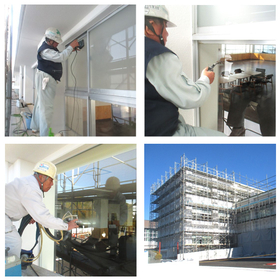
This is a case study of photocatalytic coating (anti-soiling) for glass in detached houses.

The hydrophilic effect of photocatalysts (self-cleaning effect) allows rain to wash away dirt from the glass of detached houses, keeping it clean and reducing the effort required for cleaning.

■Titanium Dioxide Raw Material By coating a titanium dioxide aqueous solution, which serves as the raw material for photocatalysts, on the ceilings and walls of buildings, it exhibits effects such as dirt resistance, deodorization, antibacterial properties, antiviral properties, and mold prevention. ■Indoor Photocatalyst When light hits the surface of the indoor photocatalyst, reactive oxygen species are generated on the surface, which decompose organic substances that cause dirt and odors into water and carbon dioxide, rendering them harmless. ■Outdoor Photocatalyst When rain hits the surface of the outdoor photocatalyst, a hydrophilic effect causes water to spread thinly under the dirt, contributing to self-cleaning as the dirt flows away with the water, thus maintaining the aesthetic of the building and reducing cleaning costs. ■Duration of Photocatalytic Effect Since titanium dioxide, the raw material for photocatalysts, is inorganic, it does not degrade due to ultraviolet rays or other factors, and the effect continues for a long time as long as the coating substrate's paint surface or wallpaper does not peel off.

  • Photocatalysts and various wall materials (exterior and interior walls, etc.)
  • Coating

Added to bookmarks

Bookmarks list

Bookmark has been removed

Bookmarks list

You can't add any more bookmarks

By registering as a member, you can increase the number of bookmarks you can save and organize them with labels.

Free membership registration

M-Tech Exhibition! Non-stick coating technology for non-adhesive surface treatment.

[Sample Presentation] Non-stick treatment that surpasses fluorine and silicone! Compatible with strong adhesive substances!

The "non-stick coating" is a new non-stick surface treatment technology developed to prevent the adhesion of strong adhesive substances that cannot be addressed by fluorine or silicone resins. By coating a substrate with a non-stick material and pre-ceramic (thermosetting silicon-based polymer), we have significantly improved non-stick properties and surface strength. =================================     ◎A sample will be given to everyone who inquires◎ 【Conditions for receiving the gift】 Please fill out the following two points in the "Inquiry Details" section at the bottom of the page and send it. ■Material to be coated *Choose from the options below Stainless steel / Aluminum / Iron ■Required properties *Choose from the options below Non-stick / Heat resistance ================================= *Additionally, we will send a comprehensive catalog for free to those who wish.

  • Heating and cooling equipment and facilities
  • Coating

Added to bookmarks

Bookmarks list

Bookmark has been removed

Bookmarks list

You can't add any more bookmarks

By registering as a member, you can increase the number of bookmarks you can save and organize them with labels.

Free membership registration

[Free samples available!] Byserum

[IPROS Exclusive Project] A new inorganic coating with excellent adhesion applied to various materials that utilize the properties of fine ceramics, such as hardness and high-temperature resistance.

The resistance to NOx, SOx, and H2S gases is excellent, and applications for pollution-related equipment are also being considered. Coating can be applied to metals as well as inorganic products. For metals, it can be applied to iron, aluminum plates, aluminum die-cast, aluminized steel plates, stainless steel, etc., and for inorganic products, it can be applied to ceramics, carbon, refractory bricks, and more. =======≪Campaign Information≫========= ◎Everyone who contacts us will receive a sample!◎ 【Conditions for Receiving the Gift】 Please fill in the following two points in the 'Inquiry Details' section at the bottom of the page when you contact us. ■Material you want to coat ■Required properties *Please select from the options below. We encourage you to take this opportunity to try it out! ========================== 【Coating Target Materials】 ・Stainless Steel ・Aluminum ・Iron ・Rubber 【Required Properties】 ・Corrosion Resistance ・Non-Stick Properties ・Heat Resistance ・Low Friction Properties ・Slidability ・Insulation ・Conductivity ・Ion Leaching Prevention ・Wear Resistance ・Water Repellency ・Antibacterial Properties ・ECO Coating ・Others *We will send a comprehensive catalog free of charge to those who request it.

  • others
  • Coating

Added to bookmarks

Bookmarks list

Bookmark has been removed

Bookmarks list

You can't add any more bookmarks

By registering as a member, you can increase the number of bookmarks you can save and organize them with labels.

Free membership registration

【Free samples available!】 Low-temperature curing fluororesin coating

[IPROS Exclusive Project] Fluororesin Coating for Plastic and Rubber!! FU-1000 Series.

The FU-1000 series of fluororesin coatings features excellent non-stick properties, lubricity, water repellency, and dirt resistance. It is a low-temperature curing fluororesin coating for plastics and rubber. For more details, please contact us or refer to the catalog. =======≪Campaign Information≫========= ◎Everyone who contacts us will receive a sample!◎ 【Conditions for Receiving the Gift】 Please fill in the following two points in the 'Inquiry Details' section at the bottom of the page when contacting us. ■Material to be coated ■Required properties *Please select from the options below. Take this opportunity to try it out! ========================== 【Materials for Coating】 - Stainless steel - Aluminum - Iron - Rubber 【Required Properties】 - Corrosion resistance - Non-stick properties - Heat resistance - Low friction - Sliding properties - Insulation - Conductivity - Ion leaching prevention - Wear resistance - Water repellency - Antibacterial properties - ECO coating - Others *We will send a comprehensive catalog free of charge to those who request it.

  • Heating and cooling equipment and facilities
  • Coating

Added to bookmarks

Bookmarks list

Bookmark has been removed

Bookmarks list

You can't add any more bookmarks

By registering as a member, you can increase the number of bookmarks you can save and organize them with labels.

Free membership registration

【Free samples available!】 Non-stick coating SA-200

[IPROS Exclusive Project] Non-stick properties last longer at a continuous use temperature of 260°C. SA-200.

The non-stick coating SA-200 maintains its non-stick properties at a continuous use temperature of 260°C for a long time. It has excellent solvent resistance and a pencil hardness of 8H. For more details, please contact us or refer to the catalog. =======≪Campaign Information≫========= ◎Everyone who contacts us will receive a sample!◎ 【Conditions for Receiving the Gift】 Please fill in the following two points in the "Inquiry Details" section at the bottom of the page when contacting us. ■Material to be coated ■Required properties *Please select from the options below. Take this opportunity to try it out! ========================== 【Coating Target Materials】 ・Stainless Steel ・Aluminum ・Iron ・Rubber 【Required Properties】 ・Corrosion Resistance ・Non-Stick Properties ・Heat Resistance ・Low Friction ・Slidability ・Insulation ・Conductivity ・Ion Leaching Prevention ・Wear Resistance ・Water Repellency ・Antibacterial Properties ・ECO Coating ・Others *We will send a comprehensive catalog free of charge to those who request it.

  • Heating and cooling equipment and facilities
  • Coating

Added to bookmarks

Bookmarks list

Bookmark has been removed

Bookmarks list

You can't add any more bookmarks

By registering as a member, you can increase the number of bookmarks you can save and organize them with labels.

Free membership registration

[Free Sample Distribution!] Comprehensive Catalog of Functional Coatings

[IPROS Exclusive Project] Comprehensive Catalog of Functional Coatings with Physical Property Comparison Table and Chemical Resistance Characteristics Comparison Table

Nikken Coating Industry Co., Ltd. is a company specializing in functional coatings, performing coatings with engineering plastics such as fluororesin (Teflon), PEEK resin, and PPS resin, as well as ceramic materials. We contribute to our customers by adding various necessary functions to metal materials. For more details, please download our catalog. =======≪Campaign Information≫========= ◎A sample will be given to everyone who inquires!◎ 【Conditions for Receiving the Gift】 Please fill in the following two points in the 'Inquiry Details' section at the bottom of the page and contact us. ■Material to be coated ■Required properties *Please select from the options below. We encourage you to take this opportunity to try it out! ========================== 【Coating Target Materials】 ・Stainless Steel ・Aluminum ・Iron ・Rubber 【Required Properties】 ・Corrosion Resistance ・Non-Stick ・Heat Resistance ・Low Friction ・Sliding Properties ・Insulation ・Conductivity ・Ion Leaching Prevention ・Wear Resistance ・Water Repellency ・Antibacterial ・ECO Coating ・Others *We will send a comprehensive catalog free of charge to those who wish.

  • media
  • Coating

Added to bookmarks

Bookmarks list

Bookmark has been removed

Bookmarks list

You can't add any more bookmarks

By registering as a member, you can increase the number of bookmarks you can save and organize them with labels.

Free membership registration

Fluororesin coating

I recommend this when you want to give various materials a slippery and non-stick quality!

We offer a variety of options to meet requests such as wanting greater corrosion resistance and conductivity, depending on applications in the kitchen and industrial fields.

  • paint
  • Coating

Added to bookmarks

Bookmarks list

Bookmark has been removed

Bookmarks list

You can't add any more bookmarks

By registering as a member, you can increase the number of bookmarks you can save and organize them with labels.

Free membership registration

Fluororesin coating agent Chemilon

Chemiron can be cured at room temperature and medium temperature, allowing it to be applied to plastics, rubber, and large equipment.

Semiconductive grade Friction grade Mold release grade Paint mist removal grade Chemiron can modify various materials. - I want stable semiconductive functionality. - I want to enhance wear resistance and lubrication. - I want to improve the release properties of resin molds. - I want to easily remove paint mist from paint booths, hangers, etc. - I want to improve chemical resistance. - I want heat resistance. - I want to make it easier to remove dirt. We respond to a variety of requests like these.

  • Exterior coating materials
  • Coating

Added to bookmarks

Bookmarks list

Bookmark has been removed

Bookmarks list

You can't add any more bookmarks

By registering as a member, you can increase the number of bookmarks you can save and organize them with labels.

Free membership registration

Art Chemical Chemiron F3088 Clear

It is a clear type, so it does not affect the color of the base. By using a primer, it can be adapted to a wide range of materials.

- It is a two-component coating agent that dries at room temperature, but it takes about 7 days to fully cure (at a temperature of about 25°C). - It can be applied using standard methods (spray, brush, roller). - It is non-stick, has good slip properties, and excellent abrasion resistance. - It has excellent stain resistance and weather resistance. - It has excellent water-repellent and oil-repellent properties.

  • paint
  • Coating

Added to bookmarks

Bookmarks list

Bookmark has been removed

Bookmarks list

You can't add any more bookmarks

By registering as a member, you can increase the number of bookmarks you can save and organize them with labels.

Free membership registration

For automotive parts! Lubricating electrostatic coating EDE-1

You can obtain a PTFE-containing coating with excellent properties such as abrasion resistance, slip resistance, and water repellency!

【Features】 ■ It is a water-based epoxy paint with anionic electrodeposition, offering excellent storage stability. ■ Uniform coating is possible on complex shapes or small parts. ■ Coating efficiency is high, allowing for cost reduction. ■ As it is a water-based paint, it improves the working environment. *For more details, please contact us.

  • paint
  • Coating

Added to bookmarks

Bookmarks list

Bookmark has been removed

Bookmarks list

You can't add any more bookmarks

By registering as a member, you can increase the number of bookmarks you can save and organize them with labels.

Free membership registration

Achieving slip and non-stick properties! "Daikin Industries' fluoropolymer coating"

We can accommodate various requests, such as wanting greater corrosion resistance and conductivity, depending on applications in the kitchen and industrial fields.

【Features】 ■ Non-stick ■ Slippery ■ Resistant to chemicals ■ Heat resistant The base materials that can be processed include metals such as aluminum, iron, and stainless steel. Please choose materials that can withstand a bonding temperature of 180°C to 380°C. *For more details, please contact us.

  • paint
  • Coating

Added to bookmarks

Bookmarks list

Bookmark has been removed

Bookmarks list

You can't add any more bookmarks

By registering as a member, you can increase the number of bookmarks you can save and organize them with labels.

Free membership registration

Non-adhesive surface treatment technology "IMD Coating" *Technical materials available.

The final form of the non-stick coating that achieves excellent release properties without being limited to target substrates such as iron, SUS, and CFRP is the "IMD coating."

The IMD coating, a non-stick surface treatment technology, possesses excellent release properties and non-stick characteristics, with a long-lasting non-stick effect. It can be applied to various substrates, including metals (iron, stainless steel, aluminum) and CFRP, without restrictions. The thermal spraying and coating processes are controlled in temperature, preventing distortion and degradation of the substrate. Additionally, since the coating agent is impregnated into the spraying agent, it allows for polishing treatment, resulting in a smooth surface with excellent release properties (non-stick). 【Features】 ■ IMD coating treatment and recoating are possible for existing products! ■ Various spraying materials can be selected without restrictions on the target equipment! ■ Proposals can be made according to the desired hardness, surface roughness, and release effect of the coating! ★ Web meetings are also available! ★ * For more details, please contact us or download the catalog for more information.

Added to bookmarks

Bookmarks list

Bookmark has been removed

Bookmarks list

You can't add any more bookmarks

By registering as a member, you can increase the number of bookmarks you can save and organize them with labels.

Free membership registration

Improved durability! Room temperature dry ceramic coating 'ERIN'

Excellent wear resistance! Rust resistance! A surface treatment that takes the environment into consideration by not using hexavalent chromium.

The room temperature dry ceramic coating "ERIN" is a new coating technology that does not use "hexavalent chromium," which is a cause of environmental pollution. It has excellent wear resistance with a thin film of 1 to 6 μm and can form a coating on various substrates such as iron, aluminum, and copper. Additionally, it does not produce outgassing in a vacuum atmosphere, and due to the room temperature processing, there is no distortion or dimensional change caused by heat. We will listen to your current concerns and provide proposals and estimates. Please feel free to contact us. 【Features】 ■ Improved wear resistance (1-3 μm) ■ Excellent thin film rust prevention capability (1-6 μm) ■ Heat resistance (−70 to 750°C: coating) ■ No distortion or dimensional change due to heat from room temperature processing ■ Coating hardness (HV 1000-1200) ■ Insulating coating

  • others
  • Coating

Added to bookmarks

Bookmarks list

Bookmark has been removed

Bookmarks list

You can't add any more bookmarks

By registering as a member, you can increase the number of bookmarks you can save and organize them with labels.

Free membership registration

Roof waterproof coating "Flexi Acrylic Water-Based Quick-Drying Type"

No solvents, low odor! Brush application directly from the can! Ideal for roof maintenance and repairs of gutters and downspouts!

Flexi-Acrylic Water-Based Quick-Drying is a high-performance waterproof coating for roofs that is low-odor and quick-drying. It can be applied directly from the can with a brush in just one coat, typically without the need for a primer. It contains synthetic fibers that bridge gaps and form a durable and flexible waterproof membrane. It is particularly suitable for general roof maintenance and emergency waterproof repairs, but can also be used on larger areas. It can also be used for repairing gutters and rainwater drainage. 【Features】 ■ Low odor ■ Quick-drying ■ Contains synthetic fibers ■ Can be applied to damp surfaces *For more details, please contact us or download the catalog.

  • paint
  • Waterproofing work
  • Roof and gutter construction
  • Coating

Added to bookmarks

Bookmarks list

Bookmark has been removed

Bookmarks list

You can't add any more bookmarks

By registering as a member, you can increase the number of bookmarks you can save and organize them with labels.

Free membership registration

Fire-resistant sheet "SK Taika Sheet"

A fire-resistant sheet that does not require thickness management has been born! No protective covering is needed due to the flat dry installation method.

"SK Taikashi Sheet" is a foam-type fireproof coating material that demonstrates excellent fire resistance with a thickness of just 1.5 mm or 3 mm. It expands dozens of times due to heat during a fire, forming an insulating layer that prevents the collapse of steel structures. Additionally, compared to conventional fireproof coatings, it is thin and allows for a finish that does not compromise aesthetics. 【Features】 ■ Significantly reduces construction time ■ Achieves a thin profile ■ Simple construction management ■ Beautiful finish ■ Dry construction method *For more details, please refer to the PDF document or feel free to contact us.

  • Photocatalysts and various wall materials (exterior and interior walls, etc.)
  • Heat-insulating paint for exterior walls (roofs, rooftops, etc.)
  • Coating

Added to bookmarks

Bookmarks list

Bookmark has been removed

Bookmarks list

You can't add any more bookmarks

By registering as a member, you can increase the number of bookmarks you can save and organize them with labels.

Free membership registration

Concrete modification silica coating 'Nano Refresh Coat'

Cutting-edge nanotechnology enhances and modifies concrete, helping to prevent deterioration.

High-purity ultra-fine amorphous silica in nano-order deeply penetrates the interior of concrete, densifying concrete structures from within. Even though it is small, it protects concrete structures with great strength.

  • Interior and exterior tiles
  • Bentonite
  • Exterior coating materials
  • Coating

Added to bookmarks

Bookmarks list

Bookmark has been removed

Bookmarks list

You can't add any more bookmarks

By registering as a member, you can increase the number of bookmarks you can save and organize them with labels.

Free membership registration