
Ground reinforcement work | Geo-column strongly supports structural calculations with clear technical evidence.
Ground reinforcement work

A reliable formula for calculating allowable bearing capacity strongly supports structural design! The trusted Geo-Column method eliminates excessive design and achieves a safe foundation plan.
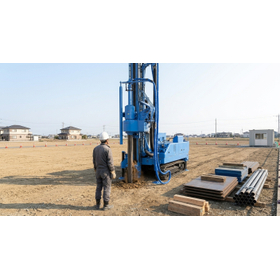
In the foundational planning of architectural design, it is important to clearly calculate the allowable vertical bearing capacity, which serves as the basis for structural calculations, and to select ground reinforcement methods that eliminate unnecessary over-design. The Geo-Column method is a soil-cement column improvement technology that allows for high-precision ground reinforcement design based on established bearing capacity calculation formulas, tailored to site conditions and structural loads. It mechanically mixes and stirs locally generated soil with cement-based solidifying material slurry to form homogeneous columnar improvement bodies underground. It addresses weak layers from GL-2m to GL-8m, ensuring reliable bearing capacity by penetrating the column tips into good ground with a cohesive soil N value exceeding 3 and a sandy soil N value exceeding 4 by more than 50 cm, as per design calculations. With the support of preliminary examination by specialized technicians from Geotech Co., Ltd. and a real-time construction tracking system using management devices, we perfectly meet the requirements of structural designers from application confirmation to on-site quality assurance.
Inquire About This Product
basic information
The design calculation specifications for the geocoral method are based on a standard cross-sectional area of 0.283 m² (column diameter φ600 mm) and a construction depth range from GL-2.0 m to GL-8.0 m. Penetration and fixation into the supporting layer should exceed a calculated N value of 3 for cohesive soil and 4 for granular soil, with a depth of at least 50 cm. The design strength Fc is optimally calculated based on structural calculations within a range of 400 to 1,500 kN/m². The standard amount of solidifying agent is set at 300 kg/m³ or more for cohesive soil and 250 kg/m³ or more for granular soil, and all construction data will be measured and electronically stored and managed using an automatic monitoring device (such as GEO-MONITOR).
Price information
Delivery Time
Applications/Examples of results
It is ideal for the foundation reinforcement of wooden, steel, and reinforced concrete (RC) houses, apartments, and stores that require a logical basis for bearing capacity based on structural calculations (such as those with three stories or fewer, a height of 13 meters or less, and a total floor area of 1,500 m² or less). It rationally distributes axial forces and concentrated loads according to the layout plan of strip foundations or slab foundations. It is widely adopted as a standard column improvement method by architectural design offices, construction companies, and house manufacturers that wish to smoothly prepare documents for submission to confirmation application agencies and structural examination reports.
catalog(4)
Download All Catalogs

Company information

-


