Ground reinforcement work | Ensuring long-term safety of buildings with high-quality CWC method
Ground reinforcement work

The Cross Wing Column Method brings innovation to ground reinforcement work. The patented mixing wings achieve uniform high-quality columns, effectively preventing differential settlement of buildings.
To ensure the long-term safety of buildings and structures, reliable ground reinforcement work is essential. The Cross Wing Column Method (CWC Method) provided by Geotech Co., Ltd. is a deep mixing treatment method that forms uniform and high-quality columnar improved bodies using a patented unique intersecting mixing wing, regardless of soil type. It accommodates various ground conditions such as sandy soil, clayey soil, and loam layers, boasting a high quality stability with a coefficient of variation of 25% or less. This helps to suppress the excessive use of solidifying agents, enabling economical and rational design. Furthermore, it has obtained the GBRC performance certification (No. 12-17 Revision 1) from the General Incorporated Foundation Japan Building Comprehensive Testing Institute, demonstrating reliable bearing capacity verified by a third-party organization. In the case of small-scale buildings, the omission of mixing tests and quality inspections using mold cores are permitted, significantly reducing costs and construction periods. Geotech provides a foundation structure of safety and trust under a strict quality control system. Please feel free to consult us.
Inquire About This Product
basic information
The standard specifications for the Cross Swing Column Method (CWC Method) are applicable to sandy soil, clayey soil, and loam layers. The diameter of the improved column can be set between φ400mm and φ1200mm, with a design strength of 400 to 1500 kN/m². The maximum improvement length is 22m for general buildings (12m for loam layers) and 12m for small-scale buildings. The mixing wings consist of six components excluding the excavation wing, with a required number of blade cuts of 450 cuts/m or more for sandy and clayey soils, and 550 cuts/m or more for loam layers. This is a highly reliable technical specification that has obtained GBRC performance certification (No. 12-17, Revision 1).
Price information
Delivery Time
Applications/Examples of results
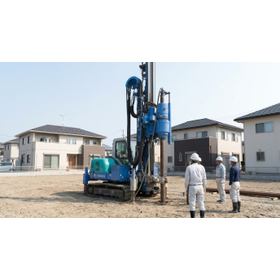
This construction method can be widely applied to small-scale buildings such as single-family homes, mid-rise buildings, retaining walls, structures, and tower foundations. It is particularly suitable for construction sites where there is a desire to avoid the risk of uneven settlement (differential settlement) on weak ground, as well as for ground reinforcement of structures with high foundation bearing pressure. Furthermore, it allows for the selection of construction machinery and plants tailored to site conditions, from construction in narrow spaces to large-scale sites, making it effectively utilized in urban construction projects where space-saving construction and shortened construction periods are required, as well as in various external retaining wall works.
catalog(3)
Download All Catalogs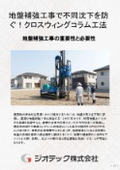
Company information

-