Site Investigation | Deep Soil Bearing Capacity and Dynamic Analysis to Mitigate Earthquake Risks in DC
Ground investigation

To mitigate the earthquake risk of data centers, we clarify the seismic bearing capacity and liquefaction and settlement behavior through deep boring and viscous soil consolidation analysis.
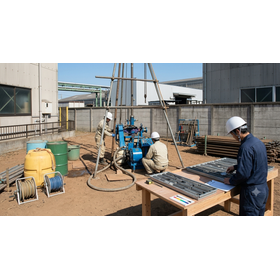
In earthquake-prone Japan, to perfectly establish a business continuity plan (BCP) for data centers, it is essential to accurately assess the dynamic behavior of the ground and the deep bearing capacity against large earthquakes and unexpected tremors. Geotech's dedicated ground investigation services rigorously obtain the depth and thickness of supporting layers present at great depths, as well as continuous N-value data, through deep boring surveys and standard penetration tests, visualizing the foundation bearing capacity that can withstand seismic forces. Furthermore, by conducting indoor staged loading consolidation tests using undisturbed samples of alluvial clay layers, we identify the consolidation yield stress and over-consolidation ratio, allowing us to quantitatively simulate the risks of post-earthquake consolidation settlement and differential settlement that may occur after a major earthquake. In conjunction, we combine in-situ measurements of lateral deformation coefficients through in-situ horizontal loading tests (LLT) and multi-faceted wide-area ground analysis using our proprietary database "GEODAS" to highly elucidate the response characteristics during earthquakes. We demonstrate complete seismic safety from both shaking and settlement perspectives, robustly supporting the operation of data centers as social infrastructure that never stops, 24 hours a day.
Inquire About This Product
basic information
The basic specifications include a boring machine suitable for deep excavation and standard penetration tests (continuous N-value acquisition) in accordance with JIS standards. For cohesive soil layers, undisturbed sample collection (such as triple tubes) will be conducted, and the consolidation yield stress Pc, compression index Cc, and overconsolidation ratio will be calculated using the JIS A 1217 staged loading consolidation test. Additionally, the horizontal loading test (LLT) will measure the lateral deformation coefficient E value of the ground from the pressurized water pressure and borehole wall displacement. All data will be analyzed in conjunction with our in-house ground information system GEODAS and delivered as a technical report specialized for seismic design and BCP evaluation.
Price information
Please contact us.
Delivery Time
※Please contact us.
Applications/Examples of results
It is ideal for the foundation design and BCP evaluation of ultra-high load structures that require high seismic resistance, such as data centers, disaster prevention base facilities, and AI infrastructure. It can be used to verify the vertical and horizontal bearing capacity of pile foundations during major earthquakes, assess the risk of uneven settlement due to post-earthquake consolidation settlement and liquefaction, and analyze ground interaction with seismic-resistant and vibration-damping structures. Additionally, it can be widely utilized for advanced technical documentation submission for structural conformity assessments and building confirmation reviews, as well as for establishing ground safety evidence in large-scale business continuity plans.
catalog(2)
Download All Catalogs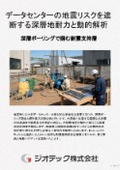

Company information

-