Ground Investigation | Precise Analysis of Liquefaction and Support Layer Inclination in Riverfront Condominium Development
Ground investigation

Thorough investigation of liquefaction and support layer inclination risks for riverside condominium developments! Geotech's ground survey leads to safe pile foundations through soil testing and structural analysis.
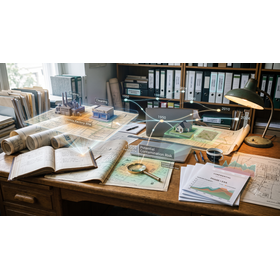
In the planned site for condominium construction near riverbanks and old river channels, there are overlapping complex and diverse ground issues, including liquefaction risks due to loose alluvial sand layers, long-term consolidation settlement of extremely soft alluvial clay layers, and steep inclinations of support layers over short distances. Conducting foundation design based on insufficient ground evaluations can lead to inadequate resistance to ground deformation during earthquakes and excessive piling work due to overly optimistic safety margins. GeoTech conducts precise ground investigations that combine accurate N-value measurements at 1-meter intervals through standard penetration tests and undisturbed sample collection, along with laboratory soil tests such as uniaxial and triaxial compression tests and grain size analysis. We objectively quantify the physical and mechanical constants of the soil, precisely calculating liquefaction assessments using FL and PL values and reducing the ground reaction coefficient (β value). By directly linking support layer inclinations and ground deformation characteristics to structural calculations, we robustly support optimal pile foundation designs that meet structural safety requirements while thoroughly cutting excessive piling costs and reinforcement construction expenses.
Inquire About This Product
basic information
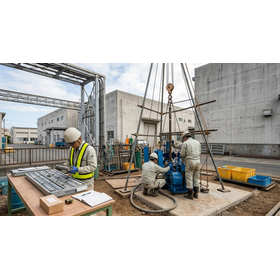
We will conduct standard penetration tests (JIS A 1219) using a boring machine to measure the N value at 1-meter intervals and to collect undisturbed soil samples (undisturbed sampling). For the collected samples, we will perform laboratory physical and mechanical tests in accordance with JIS/JGS standards (moist density, water content ratio, grain size, liquid and plastic limits, unconfined and triaxial compression, consolidation tests) to determine the fine particle content ratio Fc, cohesion c, and internal friction angle φ. We will measure the groundwater level (dry excavation and in-situ permeability tests) and calculate and output the liquefaction judgment indices (FL value and PL value) and the reduction rate of horizontal ground reaction coefficient (β value) based on the design horizontal acceleration for the ground surface.
Price information
Please contact us.
Delivery Time
※Please contact us.
Applications/Examples of results
It is used for the foundation ground evaluation of condominium buildings and large-scale structures made of reinforced concrete (RC) or steel (S) constructed along riverbanks, coastal lowlands, old riverbeds, and alluvial plains. It is utilized for assessing liquefaction effects during earthquakes, examining the horizontal bearing capacity of piles, setting soil parameters necessary for seismic design, performing consolidation settlement analysis in alluvial clay layers, and calculating optimal pile lengths considering the inclination of the supporting layer. Furthermore, it is introduced to attach various soil data to structural calculation documents, create supporting materials for building confirmation applications and submissions to structural calculation conformity assessment organizations (designated assessments), and to optimize construction costs by reducing excessive pile lengths and the number of piles.
catalog(3)
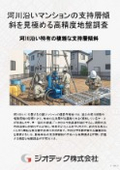
Download All Catalogs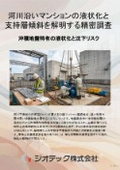

Company information

-


![[Not Public] Soil Contamination | Category B](https://image.www.ipros.com/public/product/image/321794/IPROS4400175568595756491.jpg?w=280&h=280)