Ground Investigation | Plate Load Test and Foundation Assessment to Prevent Ground Variability in Single-Story Logistics Warehouses
Ground investigation

Clarifying the ground unevenness of a large-area single-story logistics warehouse! Evaluating the ground bearing capacity by conducting plate load tests for each area, achieving pinpoint foundation design that eliminates uniform reinforcement.
In the construction plan for a single-story logistics warehouse occupying a vast area, accurately capturing the variability of ground strength (ground inconsistency) within the site is key to cost management. If deep pile construction or comprehensive ground improvement is uniformly applied across the entire site based solely on the weaknesses of specific measurement points, the foundation construction costs will balloon excessively. The plate load test solution proposed by Geotech directly applies loads at multiple points within the large area site and accurately measures the ultimate bearing capacity and deformation coefficients at the foundation bearing surface. By quantitatively evaluating the allowable bearing capacity for each area, it allows for the adoption of "direct foundations (such as mat foundations and strip foundations)" in areas with sufficient strength, while focusing reinforcement only on weak localized sections through "pinpoint foundation design." Furthermore, it scientifically demonstrates the effectiveness of differential settlement prevention through deformation angle analysis, minimizing excessive reinforcement costs while thoroughly maintaining the structural safety of the expansive single-story logistics warehouse.
Inquire About This Product
basic information
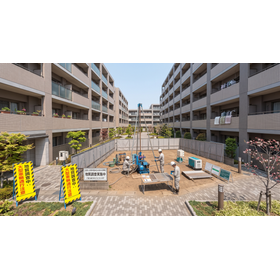
The testing work will be conducted in accordance with the Geotechnical Engineering Society Standards (JGS 1521), and a reaction device such as a hydraulic backhoe that meets the planned load, along with a 30 cm diameter steel loading plate, will be installed. A high-precision compression load cell will be incorporated into the multi-stage loading system using hydraulic jacks, and for displacement measurement, a digital displacement gauge (such as CDP-50) with a resolution of 1/100 mm and a self-recording data logger will be used. Thorough daily inspections of the equipment and leveling checks of the magnetic stand will be conducted before the work, and the ultimate bearing capacity, long-term allowable bearing capacity, and deformation coefficient for each area will be accurately calculated from the measured settlement-load curve.
Price information
Please contact us.
Delivery Time
※Please contact us.
Applications/Examples of results
The newly constructed single-story logistics warehouse, large distribution center, and large factory within an industrial park on a large area of land are ideal for examining foundational structures. If you want to visualize the uneven bearing capacity of the site to avoid uniform reinforcement across the entire area, it provides decision-making materials for applying direct foundations (slab foundations and strip foundations) to sufficiently strong areas, and helps in planning significant construction cost reduction strategies focused on localized reinforcement. Additionally, it is widely used in the planning stages of large-scale developments for attaching structural calculation reports with deformation angle analysis data to prevent differential settlement, and for proposing optimal foundation layouts to general contractors and design offices.
catalog(3)
Download All Catalogs


Company information

-