Site Investigation | Research to Balance Safety and Cost in Landfill Development for Pre-Sold Houses
Ground investigation

Eliminate excessive ground improvement that pressures profit margins in the sale of residential houses on filled land to zero. An optimal foundation design solution that accurately assesses settlement risks.
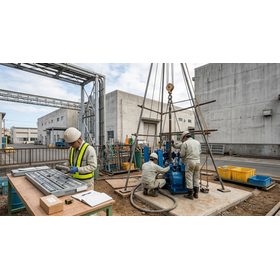
In developed embankment areas on hilly or sloped land in urban suburbs, the unevenness of ground compaction raises concerns about the risk of differential settlement in subdivided built homes. As a result, excessive ground reinforcement work, based on an unnecessarily high safety factor, has become the norm, putting pressure on builders' profits. Geotech provides ground investigation services that accurately assess the unique risks of embankment areas and support "optimal foundation design" to prevent excessive reinforcement. Our analysis goes beyond mere N-value measurements to comprehensively evaluate shrinkage risks based on the years of embankment construction and thickness, as well as the consolidation settlement characteristics of different soil types. Based on data from multiple points, we calculate the maximum settlement within the site and the deformation angle (tilt) of the building, comparing these with the standards set by regulations (such as the presence or absence of self-settlement layers at 2m and 5m below the foundation). By calculating precise allowable stress considering load distribution according to depth, we minimize the scale of reinforcement work without compromising safety, achieving a rational foundation design that directly improves the cost performance of the built home business.
Inquire About This Product
basic information
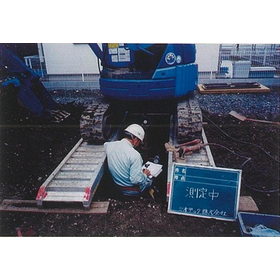
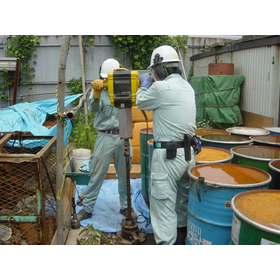
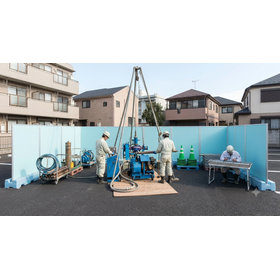
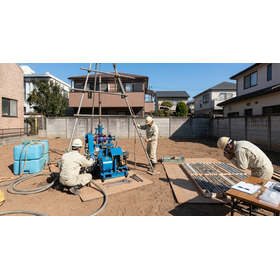
The SWS (Swedish Weight Sounding) test is used as the standard, and data is collected at a total of five points, including the four corners and the center of the target site. The direct influence range up to 2 meters below the foundation and the reduced influence range up to 5 meters are separated to calculate the long-term allowable stress of the ground. In addition to the legal standards such as the Ministry of Land, Infrastructure, Transport and Tourism Notification No. 1113, a unique standard evaluating three items and eight elements related to the ground's "strength, shrinkage, and deformation" is applied. Considering the years since embankment (from less than 1 year to over 15 years) and soil classification (such as loess and alluvial deposits), the potential for differential settlement between measurement points is assessed using a four-level ranking system.
Price range
Delivery Time
Applications/Examples of results
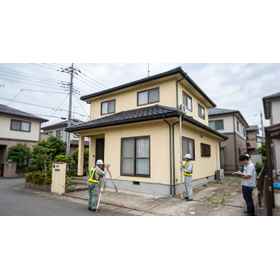
It is ideal for new residential land development created by cutting and filling hilly and sloped areas, as well as for new ground surveys of built houses on sites where valleys and ponds were previously filled. It meets the needs of home builders and construction companies who want to prevent soaring construction costs due to excessive ground improvement work in uneven fill environments, which have a high risk of differential settlement accidents, while ensuring profit margins. Additionally, the high-precision data obtained and the optimized foundation design proposals are widely used as supporting materials for explaining ground safety to clients or as essential documents to pass the review of ground warranty organizations.
catalog(3)
Download All Catalogs

Company information

-


![Fence foundation dual-purpose decorative boundary block [Shikīru]](https://image.www.ipros.com/public/product/image/6d4/2000203792/IPROS6592272567679821523.gif?w=280&h=280)