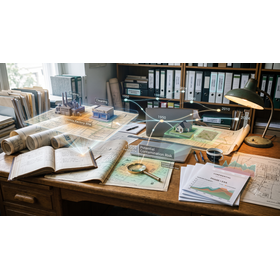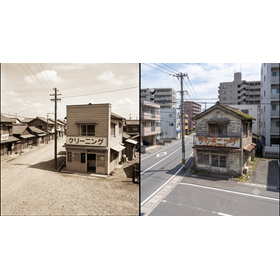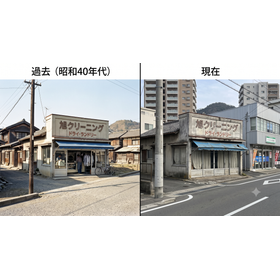
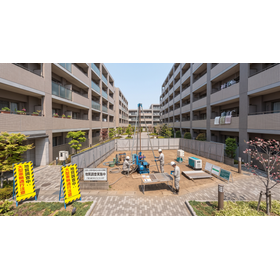
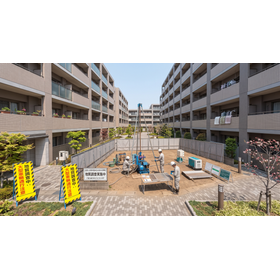
Site investigation | Determining the bearing layer with a ram penetration test in a narrow steel building where large machinery is not allowed.
Ground investigation

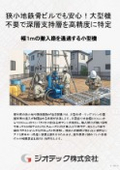
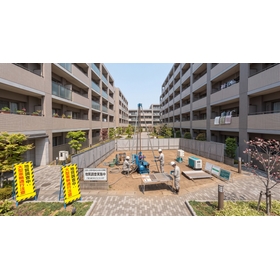
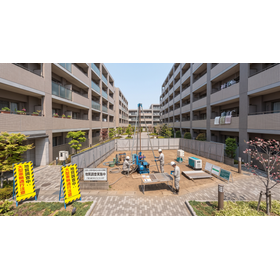
An investigation to accurately identify deep support layers using automatic ram sounding tests in the construction of a steel building on a narrow site where large heavy machinery cannot enter.
In urban areas with limited space or narrow access roads, the construction of steel frame buildings faces serious challenges, such as the difficulty of bringing in large boring machines for standard penetration tests and the inability to accurately determine the depth of the supporting layer. This service utilizes a compact, self-propelled automatic ram sounding test machine, providing an optimal solution for smoothly conducting deep ground investigations even in confined sites or areas with access restrictions. By automatically dropping a 63.5 kg hammer from a height of 500 mm, it continuously measures the number of impacts (N_d values) for every 200 mm of penetration, allowing for precise identification of hard strata equivalent to an N value of 50 and accurate stratigraphic composition up to a maximum depth of 30 m. Automatic correction of surrounding friction effects through torque measurement during impacts is also performed, delivering highly accurate data with a strong correlation to standard penetration tests. This helps prevent excessive pile length design, reduces unnecessary pile reinforcement costs, and achieves a balance between rational structural design and reliable ground quality, ensuring safety and trust.
Inquire About This Product
basic information
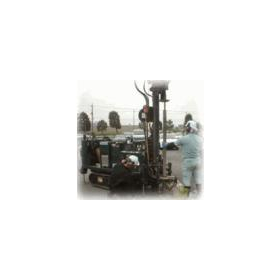
This survey is a dynamic cone penetration test using a self-propelled small machine (such as the YBM CRS12). A hammer weighing 63.5 kg is dropped freely from a height of 500 mm, and the number of impacts (Nd value) for every 200 mm of penetration is automatically recorded. The tip cone has a 90-degree angle and an outer diameter of 45 mm, and if the number of impacts exceeds 5, the rotational torque is measured to correct for the effects of surrounding friction. The maximum measurable depth is about 30 m, and it can accommodate penetration capacities equivalent to an N value of 50. The device dimensions are compact, approximately 830 to 1000 mm in width and 2350 to 2570 mm in height, and it accurately retains all data on a compact flash.
Price information
Please contact us.
Delivery Time
※Please contact us.
Applications/Examples of results
It is ideal for ground surveys for the new construction of mid- to low-rise steel buildings, stores, and welfare facilities in narrow sites where large heavy machinery and 3-ton unic trucks have difficulty accessing, such as flagpole lots and densely populated urban areas. In particular, it is used to confirm the depth of the supporting layer when adopting methods such as steel pipe pile construction or small-diameter steel pipe construction with wing tips (e.g., CPP method), as well as for cost optimization by preventing excessive pile lengths. Additionally, it can be widely utilized in practical applications, such as continuous confirmation of the inclination of the supporting layer at multiple locations as a supplementary survey to standard penetration tests, deep soil bearing capacity evaluation of uneven ground at demolition sites, and obtaining structural calculation data necessary for building confirmation applications.
catalog(3)
Download All Catalogs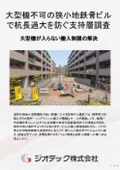

Company information

-
![[Not Public] Soil Contamination | Category B](https://image.www.ipros.com/public/product/image/321794/IPROS4400175568595756491.jpg?w=280&h=280)