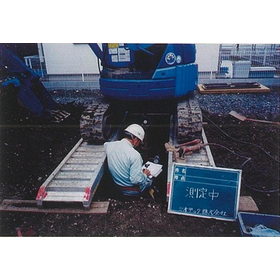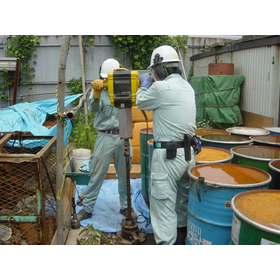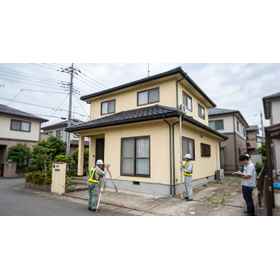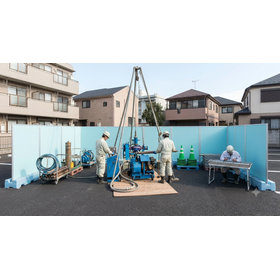
Ground investigation | Ground investigation to identify the supporting layer in a narrow steel building with delivery restrictions.
Boring survey

Prevent excessive pile length design in narrow steel frame buildings! Accurately determine the depth of deep supporting layers with automatic continuous penetration tests using ultra-compact machines.
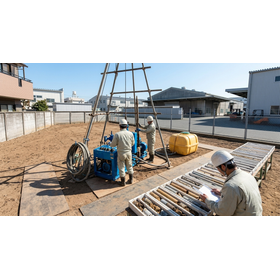
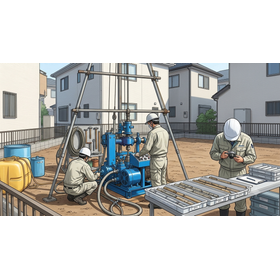
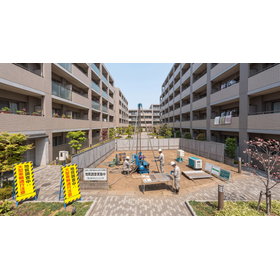
In mid-rise steel buildings planned on small plots, there are often cases where unnecessary long piles are designed due to excessive safety factor estimates and ambiguous ground data, leading to skyrocketing construction costs. GeoTech's "Automatic Ram Sounding Test" utilizes an ultra-compact self-propelled crawler machine with a width of just 830 mm, enabling high-precision deep investigations even under construction conditions where large machinery cannot enter. The automatic striking mechanism allows for the crushing and excavation of hard layers with an N value exceeding 30, which is difficult in SWS tests, and collects continuous ground resistance data up to a depth of 30 meters. Additionally, by electronically measuring the penetration strike count and simultaneously measuring the rotational torque, the influence of side friction resistance is accurately and automatically eliminated, allowing for the precise derivation of only the tip resistance that strongly correlates with the N value of standard penetration tests. The results are instantly visualized as digital data, improving the accuracy of structural calculations and foundation design. By optimizing pile lengths based on clear numerical evidence, significant reductions in pile construction costs and budget optimization are achieved while maintaining safety and robustness.
Inquire About This Product
basic information
This is a dynamic cone penetration test using a fully automatic self-propelled survey machine (YBM model CRS-12). The machine width is 830 mm during normal operation (1,000 mm during work), with a total length of 2,350 mm, a total height of 2,570 mm, and a total mass of approximately 1,630 kg, providing excellent mobility. A hydraulic cylinder drops a 63.5 kg hammer from a height of 500 mm at a rate of 22 times per minute for penetration. The number of impacts (Ndm) and the rotational torque (Mv) are automatically measured simultaneously for every 200 mm of penetration, allowing for the derivation of a reliable equivalent N value that corrects for the effects of surface friction. The maximum measurement depth is approximately 30 m.
Price range
Delivery Time
Applications/Examples of results
It is ideal for foundation ground surveys of newly constructed steel-framed stores, offices, and apartment buildings in urban environments with narrow lots and closely adjacent buildings. When introducing ground reinforcement methods such as small-diameter steel pipe piles, it is used to accurately determine the depth of the bearing layer and optimize the construction length and pile layout. It is also widely used to collect correlation data on strength at different depths as an alternative to standard penetration tests in sites where large boring machines cannot enter, and for precise risk assessment of differential settlement in strata with irregularities.
catalog(3)
Download All Catalogs
Company information

-
![[For Construction Companies] Ground Investigation for Residential Properties on Embankment Land | Geotech](https://image.www.ipros.com/public/product/image/321794/IPROS12421046423598383798.png?w=280&h=280)

![Fence foundation dual-purpose decorative boundary block [Shikīru]](https://image.www.ipros.com/public/product/image/6d4/2000203792/IPROS6592272567679821523.gif?w=280&h=280)