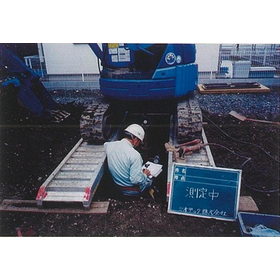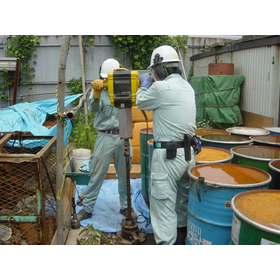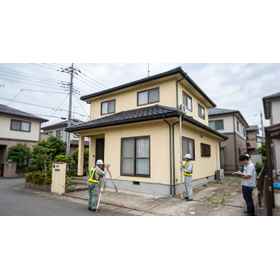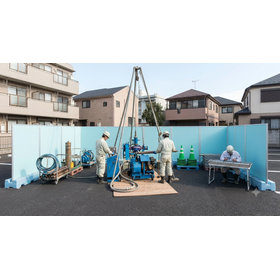
Ground investigation | Ground investigation to identify the support layer in a narrow steel building with delivery restrictions.
Boring survey

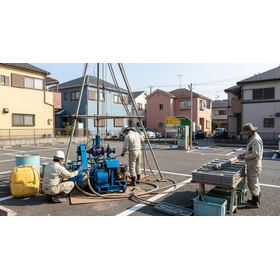
Ideal for constructing steel frame buildings in narrow urban areas where large machinery cannot enter! The ram sounding test automatically measures the depth of the supporting layer with high precision.
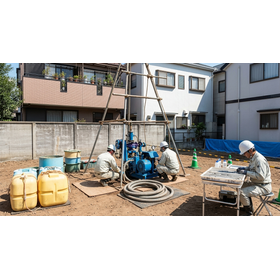
In urban areas with limited space for construction, there is a challenge where large boring machines cannot access the site due to restrictions on the site frontage and the front road. The automatic ram-sounding test provided by Geotech uses an ultra-compact self-propelled machine with a total width of only 830 mm, allowing for smooth delivery and installation even in densely packed site environments. With a fully automated striking mechanism using a 63.5 kg hammer, it can penetrate hard layers with an N value exceeding 30 and gravel layers that are impossible to penetrate with conventional SWS tests, enabling investigations up to a depth of around 30 m. Additionally, by automatically measuring the number of strikes and rotational torque simultaneously for every 200 mm of penetration, it reliably corrects for the effects of surrounding friction resistance, producing reliable ground data that has a high correlation with the N value from standard penetration tests. This minimizes the setup effort and investigation period of the equipment, allowing for low-cost and rapid confirmation of reaching a reliable bearing layer, thus significantly streamlining the design and construction process of safe pile foundations for steel frame buildings in urban areas with limited space.
Inquire About This Product
basic information
The survey machine is a fully automatic self-propelled automatic ram sounding machine (YBM model CRS-12). The dimensions of the machine are a width of 830 mm to 1000 mm, a length of 2350 mm, a height of 2570 mm, and a total weight of approximately 1630 kg, making it transportable by a 2-ton unic truck. It advances by dropping a hammer weighing 63.5 kg from a height of 500 mm at a rate of 22 times per minute in continuous free fall. The number of strikes and the rotational torque for every 200 mm of penetration are digitally recorded automatically, and a corrected N value is derived by eliminating surface friction through torque correction. The maximum measurement depth is approximately 30 m below the surface.
Price range
Delivery Time
Applications/Examples of results
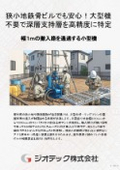
It is utilized for new ground surveys of mid-rise steel buildings and stores/offices in urban areas where large boring machinery cannot enter. It is introduced in pile foundation design methods such as small-diameter steel pipe pile methods to accurately identify the depth of reliable support layers and to prevent excessive pile length design. Additionally, it is optimal for precise evaluation of differential settlement risks through the acquisition of continuous subsurface layer data and for efficient multi-point ground confirmation in limited working spaces.
catalog(3)
Download All Catalogs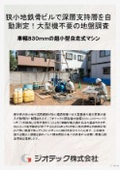
Company information

-

![[For Architectural Design Offices] Optimal Foundation Design and Ground Investigation for Embankment Construction Sites](https://image.www.ipros.com/public/product/image/321794/IPROS4480579958602714144.png?w=280&h=280)
![[Knowledge of Ground] The Relationship Between Topography and Ground.](https://image.www.ipros.com/public/product/image/e42/2000715924/IPROS20577173546744421441.png?w=280&h=280)
![Fence foundation dual-purpose decorative boundary block [Shikīru]](https://image.www.ipros.com/public/product/image/6d4/2000203792/IPROS6592272567679821523.gif?w=280&h=280)