Settlement correction work | Fundamental repair of settlement at retaining walls and uneven ground with steel pipe piles!
Subsidance correction work

Eliminate the settlement of strip foundations occurring at the backfill of retaining walls and the boundaries of cut and fill! A high-durability settlement correction technology that fixes to a hard support layer by driving steel pipe piles under the weight of the building.
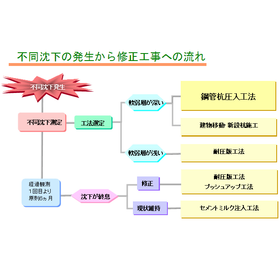
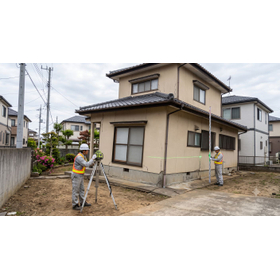
In residential land development, there are many cases where uneven ground, such as backfilling behind retaining walls and the intersection of cut and fill, leads to ground consolidation settlement and differential settlement due to lateral flow. When differential settlement places excessive stress on the foundation, it can cause cracks in the foundation and ground fissures beneath the floor, increasing the risk to the building structure. The settlement correction work provided by Geotech resolves this issue by utilizing the weight of the building as jack reaction force and employing a steel pipe pile driving method that directly presses high-strength steel pipe piles into stable supporting ground. The foundation on the settlement side is carefully lifted with hydraulic jacks and accurately corrected to a horizontal state. Additionally, high-resin repair materials are injected into the cracks of the foundation, and lightweight, self-hardening air milk is filled without gaps into the voids created underground by the settlement. Construction can be carried out while residents are living in the home, eliminating the need for relocation, and foundation reinforcement is achieved in a safe and secure environment with significantly reduced noise and vibration. We provide optimal construction plans tailored to the customer's needs.
Inquire About This Product
basic information
This construction method uses small-diameter high-strength steel pipes (outer diameter 114.3 mm to 165.2 mm, wall thickness of 4.5 mm or more) that conform to the JIS G3444 STK400 standard as standard materials. The foundation of the building is excavated, and a steel pipe pile of approximately 1.0 m is driven into the supporting ground by extending it with the thrust of a hydraulic jack. The determination of the supporting layer is based on N-value data from tests such as the SWS test, ensuring that it is anchored into a deep foundation with reliable bearing capacity. For foundation repair, epoxy resin mortar and U-cut seal methods are employed, and bubble mortar (air milk) is used for ground filling. The total weight of the building and the allowable vertical bearing capacity of each pile are precisely designed and calculated for stability.
Price range
Delivery Time
Applications/Examples of results
It is used for the restoration of differential settlement in wooden houses adjacent to retaining walls, and those located at the boundary of valleys or cut and fill areas. It is effective in restoring foundation cracks and settlement caused by insufficient soil compaction or uneven ground. It is ideal for ground reinforcement in narrow sites where large machinery cannot enter, as well as for settlement correction work that can be carried out while the homeowner continues to live in the property. Additionally, it is widely implemented for reinforcement in complex ground conditions adjacent to underground garages, measures against ground movement due to surrounding environmental construction, and reinforcement work to prevent future settlement recurrence.
catalog(4)
Download All Catalogs



Company information

-
![[Construction Case] Slab Foundation House: Settlement Correction Work (Kyoto Prefecture)](https://image.www.ipros.com/public/product/image/99c/2001214039/IPROS09804030225826509606.png?w=280&h=280)
![[For Ground Investigation] Settlement Repair Work (Investigation of Tilted Houses) | Geotech](https://image.www.ipros.com/public/product/image/321794/IPROS2291186612282469083.jpg?w=280&h=280)