Settlement correction work | Partial correction of cracks in the base foundation and localized settlement using steel pipe pile driving!
Subsidance correction work

Fundamental solution for local subsidence and cracks in the foundation! A partial repair technique that utilizes the building's own weight to drive steel pipe piles into deep support layers, preventing further subsidence.
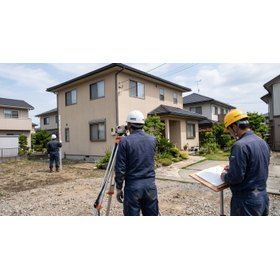
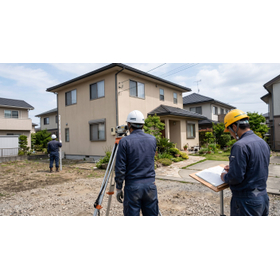
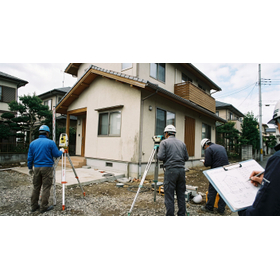
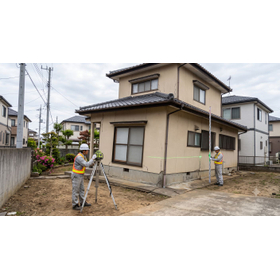
Localized subsidence and cracking occurring in the fabric foundation of a residence are serious structural defects caused by localized weakening of the ground or uneven soil pressure due to neighboring embankments or excavations. If left unaddressed, the building's tilt will progress, leading to significant disruptions in daily life, such as wall cracks and malfunctioning window frames. In GeoTech's subsidence correction work, we employ a steel pipe pile driving method that uses hydraulic jacks to vertically press steel pipe piles into a hard support layer deep below the surface, utilizing the building's own weight as a reaction force. Piles are precisely placed at specific locations where localized subsidence has occurred, and the building is accurately jacked up to restore it to a level state. Additionally, cracks in the foundation are treated with epoxy resin injection or U-cut repairs, and ground fissures or voids beneath the floor are filled with high-density air milk, thoroughly reinforcing the overall stability of the structure and the strength of the foundation. The work can be carried out while residents remain in the building, with low vibration and low noise. This is the optimal method for resolving fabric foundation issues at low cost and in a short construction period, regardless of the building's age.
Inquire About This Product
basic information
This construction method uses general structural carbon steel pipes (with an outer diameter of 114.3 mm or more and a wall thickness of 4.5 mm or more) according to standards such as JIS G 3444 STK 400. The weight of the building is used as a reaction force to press the steel pipes into the supporting ground using hydraulic jacks. The penetration depth is determined based on site survey data, ensuring that it reaches a reliable support layer with a thickness of 2 m or more and a converted N value of 10 or more. High-strength epoxy resin is used for crack repairs, while air-entrained mortar (air milk) is applied to fill voids and cracks under floors and underground. A thorough examination of allowable bearing capacity and structural calculations is conducted, and the pipes are firmly secured to the existing foundation structure through pressure plates and anchorage bases.
Price range
Delivery Time
Applications/Examples of results
It is ideal for correcting local subsidence of strip foundations in detached houses and small buildings, reinforcing corner subsidence, and restoring foundation cracks. It is widely used for repairing dragging subsidence and differential settlement caused by environmental changes such as neighboring embankment loads, retaining wall construction, and drainage work. There are numerous construction achievements in subsidence correction work for residents who find it difficult to move to temporary housing. It is also suitable for sites with narrow access routes where large machinery cannot enter, for renovation work without building demolition, and for structural reinforcement purposes to prevent future subsidence recurrence.
catalog(4)
Download All Catalogs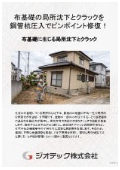



Company information

-