
Designated investigation agency | Ensuring the prevention of hidden soil contamination risks in real estate transactions in advance.
Soil contamination survey

Hidden soil contamination that poses risks in real estate transactions and M&A is reliably visualized through voluntary historical investigations and high-precision sampling conducted by designated research institutions.
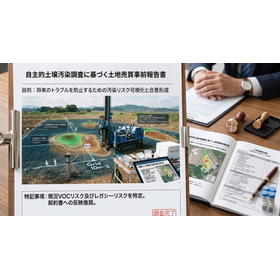
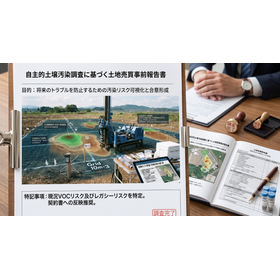
In the context of land transactions and M&A, the discovery of significant "hidden defects" such as soil contamination after the handover can lead to financial and legal disputes. To prevent this risk in advance, it is crucial for the buyer to take the lead and conduct a voluntary risk assessment of soil contamination before the contract is signed. This service provides a comprehensive approach, from detailed voluntary historical land use investigation reports to actual sampling surveys that collect surface soil and soil gas. It does not rely solely on self-reports from the seller; instead, a neutral and rigorous designated investigation agency proves the safety of the ground with objective scientific data. This allows for the identification of often-overlooked potential contamination risks in advance and enables the inclusion of specific clauses in the contract regarding responsibility for measures and cost burdens. We ensure the mitigation of legal risks and environmental liabilities for companies, supporting safe and smooth real estate transactions and the long-term preservation of asset value. This is the ideal package for due diligence when purchasing land.
Inquire About This Product
basic information
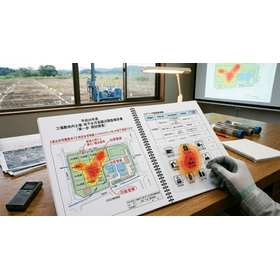
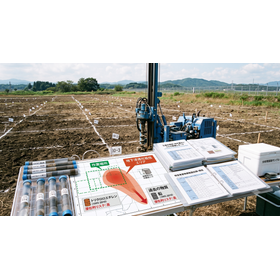
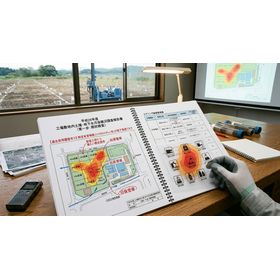
This is a self-investigation method compliant with the standards of designated investigation agencies based on the Soil Contamination Countermeasures Act. In the historical investigation, we evaluate potential contamination risks by reviewing old maps, aerial photographs, land lot maps, and administrative documents from the Meiji and Taisho periods onwards, as well as conducting on-site surveys, and we prepare a report. In the sampling investigation, we target specific harmful substances (26 substances in total, including volatile organic compounds classified as Type 1 specific harmful substances and heavy metals classified as Type 2 specific harmful substances) by collecting surface soil samples (up to a depth of 50 cm) or sampling soil gas using detection tubes. The collected samples are analyzed with high precision at a measurement certification facility based on the official methods specified by the Ministry of the Environment, and we deliver a voluntary soil contamination investigation report containing highly reliable evidence data.
Price information
Price range
P3
Delivery Time
P4
Applications/Examples of results
It is used for pre-environmental risk assessment (due diligence) when companies purchase land or acquire target companies through M&A. In voluntary real estate transactions where there is no legal obligation for investigation, it is used by the buyer to understand hidden defect risks and to avoid disadvantages or significant contamination cleanup costs after acquisition. Additionally, by sharing objective voluntary historical investigation reports and sampling analysis results between the parties before contract signing, it clarifies the responsibility for contamination measures and serves as negotiation materials and decision-making tools to facilitate logical and smooth price negotiations and the establishment of special clauses.
catalog(2)
Download All Catalogs

Company information

-
![[Case Study] Successful "Monetization" of Waste Plastics through Sensor Utilization! Japan Special Ceramics Co., Ltd.](https://image.www.ipros.com/public/product/image/245/2001484916/IPROS11668876257031716160.jpg?w=280&h=280)
![[Case Study] Utilizing Sensors for Material Inspection! Val Corporation](https://image.www.ipros.com/public/product/image/2113824/IPROS2851298067058129490.jpg?w=280&h=280)
![[Case Study] Utilizing Sensors for the Valorization of Waste Plastics! Fuji Kasei Co., Ltd.](https://image.www.ipros.com/public/product/image/2113824/IPROS8141173142511549749.jpg?w=280&h=280)
![[Case Study] Visualizing the Value of Waste Plastics! LIXIL](https://image.www.ipros.com/public/product/image/2113824/IPROS7223626806004004614.jpg?w=280&h=280)
![[Case Study] Utilized for the identification of waste plastics! Mazda](https://image.www.ipros.com/public/product/image/2113824/IPROS11293733218906178171.jpg?w=280&h=280)