

GRP vs FRP
In Europe, it is commonly referred to as GRP (Glassfibre Reinforced Polyester), while in the United States, it is used as FRP (Fiberglass Reinforced Polyester). The two terms mean the same thing. Let me introduce the SMC (sheet molding compound) method. Also known as pre-pregmat, it is used in sheet form as a molding material developed for the mass production of GRP products. It consists of unsaturated polyester resin, additives, fillers, and release agents. Catalysts, pigments, and chopped strands of glass are blended in. The sheet in the photo is GRP, with glass fiber mixed into the polyester. It is soft like clay, and features such as paint, UV protection, and anti-static properties are all included together. GRP material YouTube https://www.youtube.com/watch?v=kC4Jf58wRx8 For inquiries in Japanese, please contact: japan@intertec.info

Inquire About This Product
basic information
【Features of GRP Material】 Glass Fiber Reinforced Polyester ■ Strength (1.7 times that of stainless steel) ■ Lightweight (75% lighter than iron) ■ UV resistant ■ Corrosion resistant, suitable for installation in coastal and humid environments. ■ Excellent durability (20-30 years) ■ Significantly higher heat resistance than iron, providing the ability to protect control equipment from heat generated during disasters. ■ Dustproof and waterproof grade: IP65 or higher, preventing moisture and dust from entering the enclosure, ensuring no issues with equipment over long periods. ■ Wireless communication compatibility ■ Custom sizes available 【Our Products】 - Protective enclosures - Sunshades and canopies - Protective cabinets and shelters - Heaters, thermostats, and temperature controllers (explosion-proof) - Non-explosion-proof heaters - SAFE LINK service: Pre-assembled "hook-up" for site-based plant instrumentation - HOT BOX: Design and construction service for high-temperature heating in hazardous areas - Passive cooling enclosures and shelters: Design and construction service for remote areas
Price information
For inquiries in Japanese, please contact: japan@intertec.info
Delivery Time
※Delivery times may vary depending on the product, so please contact us.
Applications/Examples of results
Products manufactured by GRP are delivered as freeze prevention products for cold regions such as Uzbekistan and Kazakhstan, as well as insulation, heat resistance, and UV resistance products for desert areas. We supply our products to most major companies in the oil, gas, chemical, and petrochemical industries.
Detailed information
-
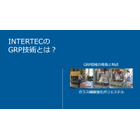
GRP (Glass Reinforced Polyester) is the core material developed and manufactured in-house by INTERTEC. With over half a century of experience designing and manufacturing enclosures and shelters using GRP composites, INTERTEC controls the entire production process — from material forming to finished product — within its own facilities. Key properties include light weight, corrosion resistance, UV resistance, impact resistance, chemical resistance, and maintenance-free operation. The technology is proven across oil & gas, chemical, power generation, and telecommunications industries, with a certified service life exceeding 25 years and field-proven cases beyond 50 years.
-
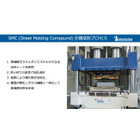
In INTERTEC's SMC compression moulding process, GRP sheets comprising long-fibre glass and polyester resin are placed in a mould and press-formed at approximately 140°C. The heat activates the curing agent, causing the resin to fully bond with the glass fibres and form a high-strength, homogeneous composite material. This manufacturing method enables stable mass production of GRP components with excellent dimensional accuracy and surface quality.
-
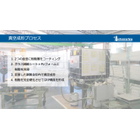
The vacuum moulding process is suited to large or complex GRP components. Both steel mould surfaces are first coated with a resin layer, then glass fibre sheets and PU foam are impregnated with resin. The mould is sealed and vacuum is applied to form the part, after which the resin is fully cured to produce the final GRP structure.
-
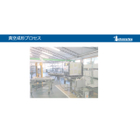
This technique allows sandwich-structure panels — with integrated insulation (PU foam) — to be produced in a single moulding operation, and is widely used for wall panels in large enclosures and shelters.
-
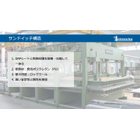
The sandwich construction — in which a layer of insulation material is bonded and compressed between GRP skins to form a single integrated panel — is the fundamental wall structure of INTERTEC enclosures. Expanded polyurethane (PU) foam is used as the insulation for standard applications, while rock wool is employed where fire resistance is required. This construction simultaneously delivers high structural strength and rigidity together with excellent thermal insulation performance, covering a wide range of applications from outdoor instrumentation enclosures in oil, gas, and chemical plants to Arctic-grade and fire-rated shelters.
-
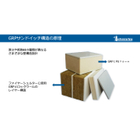
INTERTEC's GRP sandwich panels consist of GRP skins with a 35% glass fibre content bonded and compressed around one or more insulation layers. Standard wall thickness is 20 mm, with three wall configurations available to match application requirements: Basic, Classic, and Arctic. The Classic type adds support posts to the GRP/PU/GRP sandwich, while the Arctic type incorporates an additional PU foam layer for enhanced thermal insulation in cold-climate installations.
-
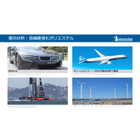
Long-fibre reinforced polyester (GRP) is a high-performance material widely used wherever light weight, high strength, and durability are demanded — including the Boeing 787 Dreamliner (in which composites account for 50% of structural weight), high-performance electric vehicles, America's Cup racing yachts, and wind turbine blades. INTERTEC applies this material to industrial enclosures, achieving products that are 75% lighter than steel while offering approximately 1.7 times the specific strength of stainless steel. The material also delivers high elasticity capable of withstanding loads of 1,300 kg (approximately 2,900 lbs), and structural resistance to storms and blast pressures up to 240 km/h.
-
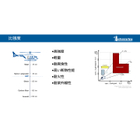
Measured by specific strength (strength divided by density), GRP significantly outperforms steel (equivalent to 25 km) and nylon/polyester (85 km), reaching a level comparable to glass (135 km). Combining high strength, light weight, corrosion resistance, thermal insulation, fire resistance, and UV resistance, GRP is the ideal structural material for protective enclosures housing instrumentation in the demanding outdoor environments of oil, gas, and chemical plants. INTERTEC designs and manufactures all of its products in-house, fully exploiting the properties of this material.
catalog(3)
Download All Catalogs


Company information
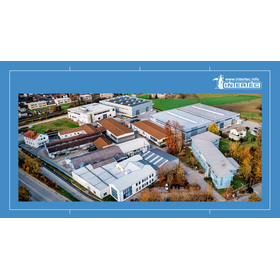
Protecting internal equipment from environments such as cold, heat, corrosion, and chemical areas. Founded in Germany in 1965, our company has a history of 50 years and has achieved an annual growth of 15%. The reason for this growth lies in our unique GRP material. As experts in GRP material, we manufacture enclosures, cabinets, and shelters, while simultaneously providing heating and cooling systems installed inside. We are a German manufacturer that offers diverse solutions to protect delicate field equipment in chemical plants, petrochemical plants, and other industries worldwide. We protect internal measurement, control, and analysis equipment from environments such as freezing, excessive heat, corrosion, and condensation. All of our products are made from GRP (glass-reinforced polyester) material, which has a very low thermal conductivity, allowing us to maximize the efficiency of cooling and heating systems. 【ISO Certification】 ISO 9001 ISO 14001
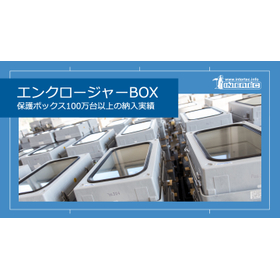

![[Construction Example] Precision Machinery Storage Enclosure](https://image.www.ipros.com/public/product/image/4d1/2000698626/IPROS76548437192049393317.png?w=280&h=280)

![[Rental] ECO-POWER Battery-Powered Vehicle (N-VAN)](https://image.www.ipros.com/public/product/image/2000650219/IPROS4125477253926720990.jpg?w=280&h=280)

![Power-free surveillance camera [Easy, clean, Japanese quality] using i-PRO products.](https://image.www.ipros.com/public/product/image/ca8/2001485567/IPROS16458605253350223962.jpg?w=280&h=280)

![Battery-powered power supply device Eco Power [For legal power outage measures]](https://image.www.ipros.com/public/product/image/97b/2001504001/IPROS7293129062457621567.jpg?w=280&h=280)