Bedrock, weak ground, frozen soil? How should the foundations of solar power adapt to the geology?
 厦門グレースソーラーテクノロジー有限会社
Concrete Foundation: The "Gravity Warrior" of Stability and Reliability
Advantages: The technology is mature, easy to construct, highly durable, and has a wide adaptability to superstructure structures.
Disadvantages: There is a large amount of earthwork involved, the construction period is long, the wet construction method has a certain degree of environmental impact, and restoration to original condition after removal is difficult.
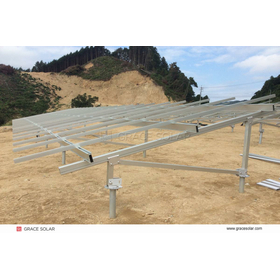
Pile Foundation: The "Decisive Factor" that Penetrates Soft Ground
Advantages: High bearing capacity, fast construction speed, minimal destruction to the original terrain, particularly suitable for projects in complex geology or mountainous areas.
Disadvantages: Requires specialized pile driving equipment, difficult to construct in strata containing many large rocks, relatively high cost.
Ground Anchor: The "Surface Anchor" for Rapid Installation
Advantages: Extremely fast construction speed, no curing period required, minimal excavation volume, and high environmental compatibility.
Disadvantages: Applicable to hard ground, bearing capacity greatly depends on the density and integrity of the in-situ ground, high demands on construction techniques, and relatively high difficulty in quality inspection.
There is no universal solution for diverse ground conditions. However, Grace Solar proposes optimal foundation solutions for different ground conditions through extensive project experience, customizing mounting systems that are safe, efficient, and optimize lifecycle costs.
Inquiry about this news
Contact Us OnlineMore Details & Registration
Details & Registration
Related Links
Related product




Distributors