Site Investigation | Reducing the Disposal Costs of Excavated Soil for Single-Story Logistics Warehouses through Plate Load Testing and Foundation Selection
Ground investigation

Significantly reduce the cost of leftover soil for single-story logistics warehouses! Prove shallow layer bearing capacity through plate loading tests and implement an environmentally friendly eco-foundation design proposal that eliminates pile construction.
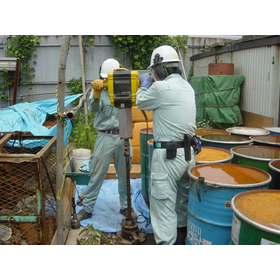
In the construction project of a single-story logistics warehouse, the large amounts of excavation spoil disposal costs and industrial waste treatment costs arising from pile driving work and large-scale ground improvement work significantly pressure the overall profitability of the project. Data from general simple penetration tests often lead to unnecessary deep reinforcement work being selected due to excessive evaluations on the safe side, resulting in the continuous generation of unnecessary spoil. The plate load test service provided by Geotech is a technical method that directly places a loading plate on the ground at the foundation bottom level to accurately measure the actual ultimate bearing capacity and deformation coefficient. By identifying the objective long-term allowable bearing capacity based on actual measurements, it becomes possible to design foundations using "direct foundations" without pile driving or with minimal surface treatment. By thoroughly eliminating unnecessary excavation work, we can minimize spoil disposal costs and transportation costs, contributing to the reduction of CO2 emissions from construction vehicles. Through advanced analysis and a strict ISO management system, we achieve environmentally conscious eco-friendly logistics warehouse development while fully ensuring safety.
Inquire About This Product
basic information
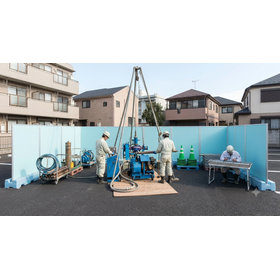
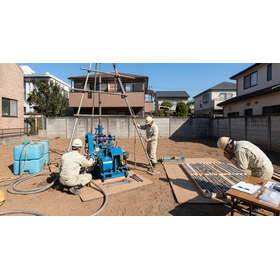
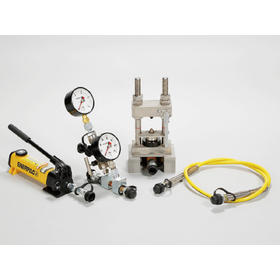
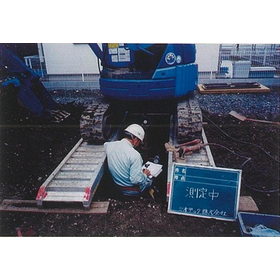
The testing method will be conducted based on the standards of the Japanese Geotechnical Society (JGS 1521), and a reaction device (such as a hydraulic backhoe) and a 30 cm diameter steel loading plate will be set up according to the planned design load. The loading device will use a hydraulic jack and a high-precision compression load cell, and a displacement gauge (such as CDP-50) will be used for displacement measurement, allowing for precise measurements in units of 1/100 mm. Before the test, the operation of the equipment will be confirmed and the measuring instruments will undergo regular calibration, while a dedicated automatic recording device will continuously record the settlement behavior during multi-stage loading and unloading in real-time. From the obtained data, the ultimate bearing capacity, long-term allowable bearing capacity, and deformation coefficient will be accurately calculated.
Price range
Delivery Time
Applications/Examples of results
This is ideal for selecting eco-friendly foundation methods that significantly reduce excavation spoil disposal costs and environmental impact in the construction of single-story logistics warehouses and large distribution terminals. It provides technical support for changing the design to direct foundations (such as strip foundations and slab foundations) to avoid excessive pile work and deep soil improvement methods, helping to cut construction costs by suppressing the generation of spoil on-site. Furthermore, it can be utilized in a wide range of development scenarios, including creating evidence for CO2 emission reductions during construction in line with corporate ESG investments and SDGs (Sustainable Development Goals), providing soil bearing capacity certificates for confirmation applications and submission to review agencies, and offering cost optimization proposals to clients and general contractors.
catalog(3)
Download All Catalogs
Company information

-


![Fence foundation dual-purpose decorative boundary block [Shikīru]](https://image.www.ipros.com/public/product/image/6d4/2000203792/IPROS6592272567679821523.gif?w=280&h=280)