Ground Investigation | Plate Load Test and Foundation Optimization to Prevent Excessive Reinforcement of the Floor in Single-Story Logistics Warehouses
Ground investigation

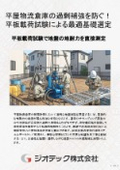
Prevent excessive floor load design in single-story logistics warehouses! Directly quantify the bearing capacity of shallow ground through plate load testing to achieve both structural safety and foundation cost reduction.
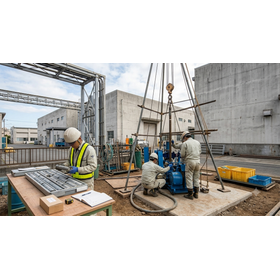
In the design of single-story logistics warehouses subjected to heavy loads, there are many cases where unnecessary piling and large-scale ground improvement are adopted due to an excessive fear of ground subsidence and floor irregularities, leading to a significant increase in costs. The plate load test provided by Geotech is an advanced survey solution that directly applies load on the actual foundation bearing surface, accurately measuring the ultimate bearing capacity and deformation coefficient of the ground. By using high-precision measured data instead of estimated values, it is possible to correctly quantify the original soil bearing capacity in the shallow layer beneath the foundation and select direct foundations or minimal shallow improvement plans that eliminate excessive deep reinforcement. Furthermore, through the analysis of settlement-load behavior with multi-stage loading, we can prevent the risk of settlement during the installation of heavy load racks or forklift operations in advance. Our experienced specialized staff provides consistent support from on-site surveys to data recording and report preparation for the reviewing agency, ensuring both structural safety and unparalleled economic efficiency for single-story logistics warehouses.
Inquire About This Product
basic information
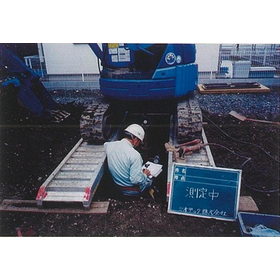
Field load tests are conducted in accordance with the standards of the Japan Geotechnical Society (JGS 1521), selecting and positioning appropriate reaction weight machinery (such as backhoes) based on the required long-term design load. The loading system uses a rigid loading plate, hydraulic jacks, and high-precision compression load cells, with continuous measurements taken using dial gauges or displacement meters (such as CDP-50) with a precision of 1/100 mm. Before the test, preliminary loading is performed to confirm operation and calibrate leveling equipment, and the recorded data is managed with dedicated terminals. The long-term allowable bearing capacity and ultimate bearing capacity are calculated from the obtained P-S curve.
Price range
Delivery Time
Applications/Examples of results
In the construction plans for large logistics warehouses and distribution centers, it is optimal for directly determining the allowable bearing capacity of shallow ground to prevent excessive reinforcement. It is effective for verifying design changes from pile foundations to direct foundations such as slab or mat foundations, providing second opinion evaluations to reduce excessive ground improvement work, and planning measures to prevent settlement and cracking of floor slabs under heavy loads. Additionally, it can be used for creating technical documentation on ground bearing capacity to be attached during application for confirmation and structural conformity assessments, as well as presenting evidence regarding structural safety to clients and general contractors.
catalog(3)
Download All Catalogs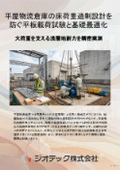
Company information

-
![Fence foundation dual-purpose decorative boundary block [Shikīru]](https://image.www.ipros.com/public/product/image/6d4/2000203792/IPROS6592272567679821523.gif?w=280&h=280)