Site Investigation | Identifying a Strong Support Layer in a Narrow Steel Frame Building with Delivery Restrictions
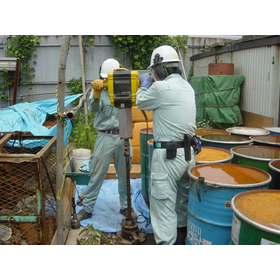
Boring survey

Prevent excessive pile design in narrow steel frame buildings! Accurately identify the depth of the supporting layer with high-precision penetration tests using a compact self-propelled machine.
In newly constructed low to mid-rise steel buildings on small plots of land, the inability to accurately identify the position of the supporting layer in the ground leads to excessive reinforcement designs with unnecessary long piles, which is a factor in cost pressure. The "Automatic Ram Sounding Test" developed by Geotech uses an ultra-compact self-propelled machine to conduct high-precision surveys with great mobility even in narrow sites where large machinery cannot enter. Equipped with a dynamic penetration mechanism using a 63.5 kg hammer, it obtains continuous data up to a depth of 30 meters by penetrating hard layers with an N value exceeding 30, which cannot be excavated in SWS tests. Thanks to the surrounding friction correction function, it can calculate reliable N values equivalent to those obtained from standard penetration tests, allowing for the optimization of the specifications and lengths of foundation piles, dramatically reducing construction costs without compromising safety. The results are digitized and quickly visualized, preventing delays in structural calculations and design practices. This is an ideal ground investigation solution that achieves cost reduction for pile foundations and improved design accuracy in the construction of steel buildings on small urban plots.
Inquire About This Product
basic information
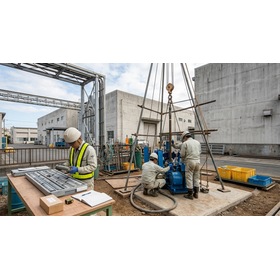
A fully automatic control self-propelled dynamic cone penetration testing machine (YBM model CRS-12) is used. The wheel width can be continuously adjusted from 830 mm in normal mode to 1000 mm during operation, and it has a total mass of approximately 1630 kg with a crawler specification. Using a hydraulic cylinder and an automatic free-fall device, a hammer weighing 63.5 kg is dropped from a height of 500 mm at a constant rate of 22 times per minute for penetration. The number of impacts (Ndm) for every 200 mm of penetration, along with the rotational torque (Mv), is digitally measured to automatically correct the surface friction. The maximum penetration depth is about 30 m, and the measurement data is saved to a CF card.
Price range
Delivery Time
Applications/Examples of results
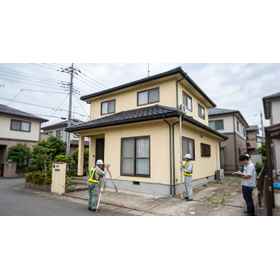
It is used for precise measurement of ground support capacity in newly constructed or renovated steel buildings, stores, and apartment complexes on small plots of land. It is utilized to determine the construction length by accurately identifying the depth of the support layer when adopting ground reinforcement work or small-diameter steel pipe pile methods. Additionally, it is suitable for applications where heavy machinery for boring surveys cannot be brought in, as an alternative or complement to standard penetration tests for continuously collecting N-value data, and for correctly understanding the positional relationship between pile heads and pile bottoms at sites with inclined strata to prevent excessive design.
catalog(3)
Download All Catalogs
Company information

-

![Ground reinforcement construction [Performance certification method] RES-P method](https://image.www.ipros.com/public/product/image/321794/IPROS6263428337976322716.png?w=280&h=280)