
Designated Investigation Agency | Voluntary Soil Contamination Survey to Prevent Defects in Land Sales | Geotech
Soil contamination survey

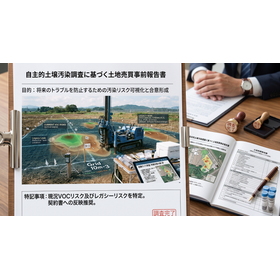
To eliminate liability for contractual nonconformity and defect risks after the sale of the land, a voluntary land history investigation is conducted before the sale to demonstrate safety, ensuring reliable soil contamination measures.
The "contractual non-conformity liability" and "sales defect risk" associated with land sales can lead to significant management troubles after the transfer. In particular, soil contamination is impossible to assess visually, so if harmful substances are detected from land sold unknowingly, there is a risk of being charged substantial purification costs or damages. This technical document explains the importance and specific process of "voluntary soil investigation," which is extremely effective for sellers to avoid these legal sales defect risks. First, by conducting a "voluntary historical investigation" that thoroughly examines past usage history, the risk of underground infiltration of specific harmful substances is visualized. Then, if necessary, accurate sampling and high-precision analysis are performed to establish objective evidence proving the safety of the land. Investigations by Geotech, a designated investigation agency by the Ministry of the Environment, enhance transaction transparency through reliable data and neutral reports, supporting smooth land transactions and complete dispute prevention after the sale. It is an essential measure to protect corporate value and peace of mind.
Inquire About This Product
basic information
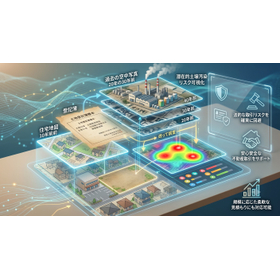
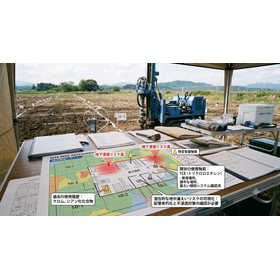
This is the technical specification for voluntary soil surveys conducted by designated investigation agencies of the Ministry of the Environment. The survey process begins with a Phase 1 historical investigation in accordance with the Soil Contamination Countermeasures Act, involving a multifaceted examination of registries, past aerial photographs, residential maps, and public documents. If there are concerns about contamination risks, the process transitions to Phase 2, which involves situational investigations, including surface soil sampling, soil gas surveys, or drilling investigations to assess contamination in depth. The collected samples are analyzed at registered analytical institutions based on the Measurement Law, conducting official analyses of first-class specified harmful substances (volatile organic compounds), second-class (heavy metals, etc.), and third-class (pesticides, PCBs, etc.), accurately measuring elution amounts and contents, and producing reliable reports.
Price information
Price range
P3
Delivery Time
P4
Applications/Examples of results
It is utilized to proactively avoid risks of defects in sales when considering the sale of factory sites, logistics warehouses, commercial facilities, and general business real estate. By conducting this prior to the conclusion of the real estate sales contract, led by the seller, it serves as foundational data to reasonably specify exemptions from liability for contractual nonconformity and special provisions for risk allocation within the contract. Additionally, it is optimal for asset value assessments related to corporate M&A, land price negotiations, and regular environmental risk management and voluntary pollution prevention measures at operational factories. It is also widely used as proof of environmental compliance for loan examinations by financial institutions and for dealings with business partners and local residents.
catalog(2)
Download All Catalogs

Company information

-

![[Latest Edition] A booklet filled with the basics of soil contamination.](https://image.www.ipros.com/public/product/image/a30/2000202626/IPROS986984479586641995.png?w=280&h=280)
![[For the Manufacturing Industry] Designated Investigation Agency | Soil Contamination Survey and Historical Investigation Phase 1](https://image.www.ipros.com/public/product/image/321794/IPROS6628016513153762416.jpg?w=280&h=280)
![[Case Study] Successful "Monetization" of Waste Plastics through Sensor Utilization! Japan Special Ceramics Co., Ltd.](https://image.www.ipros.com/public/product/image/245/2001484916/IPROS11668876257031716160.jpg?w=280&h=280)
![[Case Study] Utilizing Sensors for Material Inspection! Val Corporation](https://image.www.ipros.com/public/product/image/2113824/IPROS2851298067058129490.jpg?w=280&h=280)
![[Case Study] Utilizing Sensors for the Valorization of Waste Plastics! Fuji Kasei Co., Ltd.](https://image.www.ipros.com/public/product/image/2113824/IPROS8141173142511549749.jpg?w=280&h=280)
![[Case Study] Visualizing the Value of Waste Plastics! LIXIL](https://image.www.ipros.com/public/product/image/2113824/IPROS7223626806004004614.jpg?w=280&h=280)
![[Case Study] Utilized for the identification of waste plastics! Mazda](https://image.www.ipros.com/public/product/image/2113824/IPROS11293733218906178171.jpg?w=280&h=280)