[I/O HUB] Remote abnormality detection & gate operation, automatic reporting is also possible!
Lukatel CML-200, Intercom CIT-200

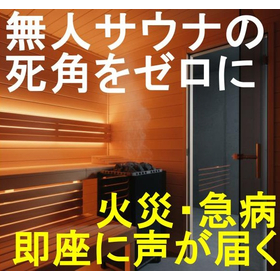
Detect anomalies and automatically report them! Complete unlocking of the local gate and activation of alarms with the push of a button on the phone, eliminating the burden and risks of rushing to the site.
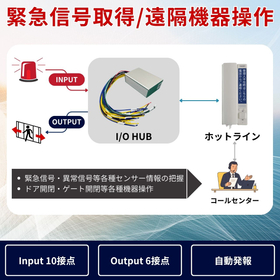
The hotline's I/O (Input/Output) connection is a function that collaborates with external devices to achieve "Input = abnormal detection and automatic reporting" and "Output = remote control." When it receives contact signals from devices such as fire alarms, equipment alarms, payment machines, and security sensors, it automatically dials the designated destination and notifies the situation via voice. The receiving side can perform primary responses such as unlocking gates, opening and closing automatic doors, resetting equipment, and activating sirens and patrol lights using DTMF operations while on the call. Additionally, if added as a backup route for existing reporting equipment, it enhances the reporting success rate even during line failures or nighttime when no personnel are present, contributing to BCP (Business Continuity Planning) enhancement.
Inquire About This Product
basic information
I/O Specifications Input: When the hotline terminal receives a signal from an external device, it automatically dials the configured phone number. When the receiving end is in a call state, a voice guidance message stating "Emergency signal 1/2 detected" will play. Example: Fire alarm, coin parking payment machine, etc. Output: When the hotline terminal and the receiving end are in a call state, pressing the "numeric keypad" at the receiving end will allow the terminal to detect the DTMF tone and send a signal to the connected external device. Example: Opening the gate of a coin parking facility, opening and closing automatic doors, etc. Points to consider during implementation (technical notes) - Isolation design: As stated in the specifications, the use of opto-isolators provides isolation, making it a safe design that minimizes the influence of noise from the control panel (external device) on the hotline terminal. - Contact method: The input supports "voltage-free contacts," allowing operation simply by closing (shorting) the switch, making it compatible with many general-purpose sensors. - Relay capacity: The output circuit is designed to drive the relay on the control panel side, so if you need to directly operate devices that draw large currents (such as large motors), an intermediary like a magnetic switch is required.
Price range
Delivery Time
Applications/Examples of results
Usage scenarios and examples of connected devices for input functions (signal acquisition): - Abnormal monitoring of facilities and equipment - Fire alarms and smoke detectors - Elevator malfunction detection - Leakage and power outage detection in cubicles (power receiving equipment) - Crime prevention and services in stores and public spaces - Emergency call buttons in restrooms - Troubles with payment machines in coin parking - Factories and production lines - Line stoppage and error signals Usage scenarios and examples of connected devices for output functions (operation of external devices): - Remote unlocking of gates and entrances - Gates of coin parking - Automatic doors of unmanned stores and bicycle parking - Resetting and rebooting of equipment - Power reboot of system devices - Activation of alarms and notification devices - Warning sirens and patrol lights
Detailed information
-
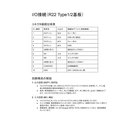
- Connector Connection Specification Table This table shows the connection specifications for all 10 pins, including the signal names for OUT1 and OUT2 (outputs, connected to relays RL1/RL2) and IN1 and IN2 (inputs, connected to switches SW1/SW2), as well as the input/output classification and the connected devices on the control panel side. Pins 5 and 8 are unassigned. - Explanation of Circuit Configuration 1. Output Circuit (OUT1, OUT2): - Electrical isolation between the main board and the control panel side is achieved using phototransistors U8 and U9. - Drives the relays (RL1, RL2) on the control panel side. 2. Input Circuit (IN1, IN2): - Phototransistors U10 and U11 (LED input side) are used. - Pressing the switches (SW1, SW2) on the control panel connects the circuit to GND, transmitting the signal to the main board. - A protection resistor of \$1.2k\Omega\$ (R36, R37) is inserted on the board side to limit the current.
-
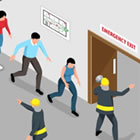
Case B: Unmanned Warehouse/Office at Night 1. [Input] "Magnet switches" installed on windows and doors detect intrusion. 2. [Transmission] Automatic notification to the administrator's smartphone. A voice guidance message states, "Emergency signal 1 detected." 3. [Output] When the administrator presses the "numeric keypad" on the smartphone, all lights at the site turn on and a siren sounds.
-
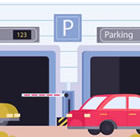
Case A: Troubleshooting in an Unmanned Parking Lot 1. [Input] The user presses the "Call Button" on the payment machine (or the payment machine detects a jam). 2. [Outbound] The hotline terminal automatically dials the call center. 3. [Call] The call center representative checks the situation (e.g., "The parking ticket is jammed and cannot be retrieved"). 4. [Output] When the representative presses the "Numeric Keypad" on the phone, the gate motor activates, and the gate opens.
-

- Use cases for input functionality (signal acquisition) Examples of connected devices: Receives contact signals (switch ON) from external devices and automatically dials and notifies pre-set contacts. - Abnormal monitoring of facilities and equipment - Fire alarms and smoke detectors: Automatically reports to the management center or the owner's mobile phone immediately upon fire occurrence. - Elevator malfunction detection: Notifies the maintenance company with a voice alert "Emergency signal detected" during entrapment or malfunction. - Leakage and power outage detection in cubicles (power receiving equipment): Directly notifies the chief electrical engineer of abnormalities in electrical equipment. - Security and services in stores and public spaces - Emergency call button in restrooms: Notifies the office or security personnel in case of a fall or emergency. - Coin parking payment machine troubles: Detects issues such as out of receipts, paper jams, or unauthorized release of equipment and notifies the call center. - Factories and manufacturing lines - Line stop and error signals: Automatically notifies managers in remote locations during abnormal stops of the production line.
-

- Use cases for output functions (operation of external devices) Examples of connected devices: By pressing "1#" or "2#" from the receiving side (smartphone or landline) during a call, equipment at the site can be operated remotely. - Remote unlocking of gates and entrances - Coin parking gate: In case of user trouble, after confirming the situation at the call center, the gate can be forcibly opened by pressing the "numeric keypad" from the phone. - Automatic doors of unmanned stores and bicycle parking: Identity verification and situation confirmation are conducted over the call, allowing the door to be opened remotely. - Resetting and rebooting equipment - Power reboot of system devices: When network devices at a remote location freeze, a reboot signal can be sent over the phone to restore functionality. - Activation of alarms and notification devices - Warning sirens and patrol lights: When a suspicious person is confirmed, the siren at the site can be sounded or the red light can be activated through phone operation to deter them.
Line up(4)
| Model number | overview |
|---|---|
| Lukatel CML-200 | A hotline terminal that can make calls simply by picking up the receiver. It detects abnormal signals from fire alarms and equipment alarms through I/O connections and automatically reports them. The receiving side can perform initial responses such as unlocking gates or resetting equipment using DTMF operations while on the call. It is ideal for strengthening BCP during unmanned hours. |
| Intercom CIT-200 | On-site intercom-type hotline. In addition to calling and communication, it supports automatic reporting during abnormal detection via I/O connection and remote operation using DTMF during calls. It consolidates "detection → reporting → on-site operation" for unmanned facilities, factory lines, parking lots, etc., enhancing the immediacy of response. |
| Intercom Slim CIT-25S | A slim intercom designed for space-saving installation. It fits easily around narrow column surfaces and equipment panels, allowing for simple operation of calls and conversations on-site. With I/O integration, it enables automatic reporting of abnormal signals and remote responses such as gate unlocking and lighting activation through DTMF operations on the receiving side. |
| Emergency phone CET-903 | An emergency phone with a three-button design specifically for urgent contact. It reduces the chances of pressing the wrong button and is designed for intuitive reporting by anyone, making it suitable for disaster prevention, crime prevention, and emergency response in facilities. It also supports automatic reporting of abnormal detections through I/O integration and remote operation (alarm and equipment control) via DTMF operations on the receiving side. |
catalog(3)
Download All Catalogs


News about this product(1)

Company information
Our company, K-Max Co., Ltd., has been at the forefront of communication technology for 34 years since its founding. What we pursue is not merely information transmission. It is "heartfelt communication" that deeply connects "people" to "people," "people" to "things," and "things" to "things," creating smiles and a better society. We uphold this **"heartfelt communication"** as our philosophy, utilizing the latest communication technologies and innovative solutions to contribute to solving a wide range of societal and customer challenges. Backed by years of experience and proven results, our technological capabilities and the spirit of "heartfelt communication," which always considers others, continue to create value that connects to the future.


![Case Study 5 [Commercial Facility] Operational Improvement (Improvement of Energy Saving Rate through Automated Control)](https://image.www.ipros.com/public/product/image/ce0/2000179925/IPROS1305603999535282668.jpg?w=280&h=280)