
Tohoku Univ. Technology:Lactic acid Adsorbent and method for removing Lactic acid:T19-083_T19-455_T19-456

Reduces adverse effects on cell and microbial growth while increasing the efficiency of lactic acid removal
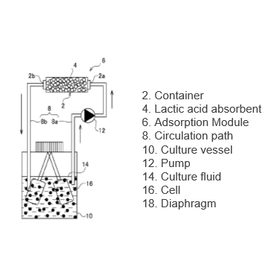
In recent years, there has been a demand for mass culture of cells in fields such as pharmaceutical manufacturing. In order to grow cells stably in culture, lactic acid (a cellular waste product that adversely affects cells) that accumulates in the culture medium must be removed. Until now, lactic acid was removed from the culture medium using the principle of dialysis. However, in order to remove lactic acid sufficiently, the volume of the component preparation liquid tank was set to be more than 10 times the volume of the cell culture tank, so there was a problem that the required volume of liquid was enormous and costly. The present invention has made it possible to provide a new lactic acid removal technology that reduces the negative effects of lactic acid and lactic acid removal treatment on the growth of cells and microorganisms while increasing the lactic acid removal efficiency. An embodiment of the present invention is a lactic acid adsorbent, characterized in that it comprises a layered double hydroxide having anions and water molecules retained between layers of a plurality of metal hydroxide layers. When the present invention comes into contact with a solution containing lactic acid, lactic acid in the solution is adsorbed. Thus, the removal efficiency of lactic acid can be enhanced.
Inquire About This Product
basic information
For details, please contact us or refer to the PDF.
Price range
Delivery Time
Applications/Examples of results
For details, please contact us or refer to the PDF.
catalog(1)
Download All Catalogs
Company information
The revenue generated from technology transfer is reinvested into universities and researchers as new research funding, which is used to create further research outcomes. To ensure the smooth operation of this cycle, known as the "Intellectual Creation Cycle," we will actively promote technology transfer. The types of seeds we handle include patents, know-how, databases, and programs. We have established a collaborative framework by concluding basic technology transfer agreements with the following universities (as of June 1, 2025): - Tohoku University - Hirosaki University - Iwate University - Akita University - Fukushima University - Yamagata University - Tohoku Gakuin University - Iwate Medical University - Fukushima Medical University - Aizu University - Miyagi University - Hokkaido University - Muroran Institute of Technology - Showa Medical University
![High-performance adsorbent for oil and chemicals [Ideal for on-site hygiene management and disaster prevention management!]](https://image.www.ipros.com/public/product/image/e33/2000115420/IPROS9181391022625376752.jpg?w=280&h=280)


![[Proposal] Bird Damage Prevention (Wire Type) Altima Bird Prevention Wire](https://image.www.ipros.com/public/product/image/2032865/IPROS2629637137718331190.jpg?w=280&h=280)
![[Free Download] Increase Results by Collaborating with Outside Sales](https://image.www.ipros.com/public/product/image/2116845/IPROS17620420945394846348.png?w=280&h=280)