Tohoku University Technology: 3D coke deformation recognition system by deep learning: T20-1102

Able to learn and estimate the coke strength after reaction (CSR) and deformation pattern
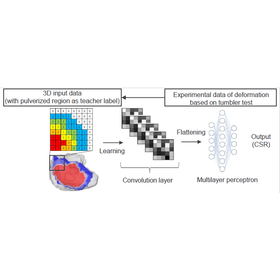
The gas permeability in the blast furnace deteriorates due to excessive coke degradation during the low coke rate operation in order to reduce CO2 emission. The coke strength after reaction (CSR) is a parameter to evaluate coke quality and is used as an indicator of permeability in blast furnace operation. However, CSR is an index that averages the high-temperature deformation behavior of each cokes, and can’t estimate the complex deformation behavior of individual coke particles. Existing method for flow phenomena visualization and clogging prediction using kinetic model is computationally demanding and limited in the ability to analyze stochastic deformation behavior in a scaling manner. This invention applied deep learning using Deep Neural Network (DNN), which is a typical AI method, to the coke 3D deformation process. Machine learning was performed to estimate of the deformation process using DNN. As shown in fig.1, the loss function (deviation from the “estimated value”) decreased with the number of learning sessions, and the recognition accuracy shows over 97%. This indicates that DNN can classify the deformation of every CSR accurately and reduce the computational load for coke deformation prediction remarkably. Therefore, machine learning can easily recognize the coke 3D shape deformation which is difficult to recognize intuitively.
Inquire About This Product
basic information
For details, please contact us or refer to the PDF.
Price range
Delivery Time
Applications/Examples of results
For details, please contact us or refer to the PDF.
catalog(1)
Download All Catalogs
Company information
The revenue generated from technology transfer is reinvested into universities and researchers as new research funding, which is used to create further research outcomes. To ensure the smooth operation of this cycle, known as the "Intellectual Creation Cycle," we will actively promote technology transfer. The types of seeds we handle include patents, know-how, databases, and programs. We have established a collaborative framework by concluding basic technology transfer agreements with the following universities (as of April 1, 2026): - Tohoku University - Hirosaki University - Iwate University - Akita University - Fukushima University - Yamagata University - Tohoku Gakuin University - Iwate Medical University - Fukushima Medical University - Aizu University - Miyagi University - Hokkaido University - Muroran Institute of Technology - Showa Medical University - Asahikawa Medical University


![[Case Study] Atsumi Motors Headquarters Maintenance Factory](https://image.www.ipros.com/public/product/image/bca/2001097774/IPROS12848882049221816125.png?w=280&h=280)