Tohoku Univ. Technology :High brightness fluorescent calcium sensor:T20-1178_T20-1180_T20-1182_T20-1183_T21-303

Useful for elucidating various biological mechanisms involving calcium ions
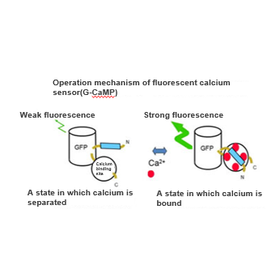
The inventors have previously developed G-CaMP and R-CaMP (CaMP) as proteinaceous fluorescent calcium sensors. By introducing CaMP into a cell, the location of the cell can be identified and changes in calcium ion concentration can be observed as changes in CaMP fluorescence intensity. ・G-CaMP7, G-CaMP7.09: Displays green fluorescence. ・R-CaMP1.07: Displays red fluorescence and can be used in combination with the photo-stimulation probe Channelrhodopsin-2, which is commonly used for cell function manipulation.
Inquire About This Product
basic information
For details, please contact us or refer to the PDF.
Price range
Delivery Time
Applications/Examples of results
For details, please contact us or refer to the PDF.
catalog(1)
Download All Catalogs
Company information

The revenue generated from technology transfer is reinvested into universities and researchers as new research funding, which is used to create further research outcomes. To ensure the smooth operation of this cycle, known as the "Intellectual Creation Cycle," we will actively promote technology transfer. The types of seeds we handle include patents, know-how, databases, and programs. We have established a collaborative framework by concluding basic technology transfer agreements with the following universities (as of April 1, 2026): - Tohoku University - Hirosaki University - Iwate University - Akita University - Fukushima University - Yamagata University - Tohoku Gakuin University - Iwate Medical University - Fukushima Medical University - Aizu University - Miyagi University - Hokkaido University - Muroran Institute of Technology - Showa Medical University - Asahikawa Medical University