Tohoku University Technology: Mg alloy that generates hydrogen inside neutral aqueous solution: T21-060

Alloy that does not stop reaction during the process and continues to produce only hydrogen
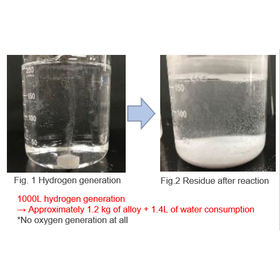
Hydrogen is attracting attention as a sustainable energy source, but all current hydrogen generation methods, such as water electrolysis or steam reforming of fossil fuel, have an important environmental impact. The "hydrolysis" which generates hydrogen by reacting metallic material with water, is attracting attention as a hydrogen generation method with a small environmental impact. The advantage of the hydrolysis is that it does not generate oxygen but only hydrogen, so the oxygen separation process is not necessary and there is no risk of explosion. Hydrogen generating materials consisting of Mg or Mg alloy have been reported as material for hydrolysis, but the phase which does not react with water such as Mg(OH)2 is formed and the reaction stops in the middle of the reaction process. Therefore, most of the previously reported hydrogen generating materials have a small hydrogen generation per unit weight. This invention is about the hydrogen generating alloy that does not stop reaction even inside neutral aqueous solution. This alloy generates a large amount of hydrogen per unit weight because it reacts with water until the end without stopping the reaction in the middle. Moreover, the alloy is composed only of Mg and Ca elements, which are present in large quantity on Earth and are not toxic to the ecosystem. There are very few hydrogen generating materials that do not generate heavy metal ions through hydrolysis, and this alloy has potential to use in any location.
Inquire About This Product
basic information
For details, please contact us or refer to the PDF.
Price range
Delivery Time
Applications/Examples of results
For details, please contact us or refer to the PDF.
catalog(1)
Download All Catalogs
Company information

The revenue generated from technology transfer is reinvested into universities and researchers as new research funding, which is used to create further research outcomes. To ensure the smooth operation of this cycle, known as the "Intellectual Creation Cycle," we will actively promote technology transfer. The types of seeds we handle include patents, know-how, databases, and programs. We have established a collaborative framework by concluding basic technology transfer agreements with the following universities (as of April 1, 2026): - Tohoku University - Hirosaki University - Iwate University - Akita University - Fukushima University - Yamagata University - Tohoku Gakuin University - Iwate Medical University - Fukushima Medical University - Aizu University - Miyagi University - Hokkaido University - Muroran Institute of Technology - Showa Medical University - Asahikawa Medical University