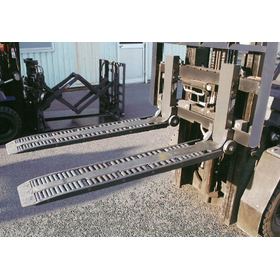
If push-pull doesn't work, there's the roller fork! It can serve two purposes, also capable of handling standard pallets.
The roller fork is an attachment for sheet pallets that features a roller conveyor mechanism arranged in two vertical tiers inside the fork. The roller conveyor mechanism built into the roller fork allows for the loading and unloading of cargo onto and off the fork, facilitated by the forward and backward movement of the forklift. Since the roller fork does not require hydraulic power, it can be attached to many existing forklifts. In contrast, adding a push-pull attachment necessitates additional hydraulic systems, which incurs significant costs and requires a long preparation period. As a result, there is a possibility that the consideration of converting to sheet pallets may be hesitated, but with the introduction of the roller fork, inquiries for consideration have increased. The delivery time typically takes five months, so we also offer rental units as a temporary solution until delivery.
Inquire About This Product
basic information
【Features】 - The fork width is 210 mm, allowing for standard pallet operations. - No hydraulic piping is required for the forklift itself. - Simple structure with no maintenance needed. Exceptional durability. Roller forks require verification that they can pull in cargo placed on the floor onto the tines, so we also offer short-term rentals for testing purposes.
Price information
Please consider a standard length of the 2-ton type at around 1.1 to 1.2 million yen per unit (including shipping, excluding consumption tax).
Price range
P5
Delivery Time
※Due to made-to-order production, the delivery date will be provided at the time of the estimate.
Applications/Examples of results
Example: Export of Industrial Raw Materials When considering the conversion to sheet pallets as a cost-reduction measure for exporting FIBC (Flexible Intermediate Bulk Container) products that were typically exported on standard pallets, roller forks became a candidate due to the significant amortization burden of the push-pull attachment. There were concerns about slippage (pushing the cargo) when pulling in the cargo, but this was resolved by mastering the operating method, leading to the adoption of roller forks along with sheet pallets.
catalog(1)
Download All Catalogs
Company information
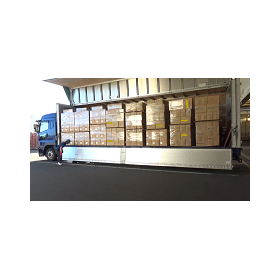
Our company was established by engineers who have been involved in the introduction support of sheet pallets since the 1980s, when they were brought to Japan. The development of sheet pallets aimed to prevent the outflow of pallets and maintain loading efficiency. The Korean War reaffirmed that logistics is the most critical factor in determining victory or defeat. In the logistics 2024 problem, efforts are being made to increase the pallet transportation rate while reducing the variety rate through effective use of joint deliveries and return trips. However, there are many cases where maintaining or recovering loading efficiency is a challenge. By using thin and inexpensive sheet pallets, loading efficiency is maintained. The shipping side can prevent the outflow of their own pallets by stacking cargo on sheet pallets that are high-stacked, while the receiving side can complete the receiving process simply by picking up the cargo on their own pallets, freeing them from managing other companies' pallets. We believe that the low-cost material of sheet pallets can help solve various challenges. <Adoption Case> A shipment was required using pallets specified by the receiving side, but since the specified pallets could not be brought into the management area, the cargo was transferred onto the specified pallets using sheet pallets at the exit of the management area for shipment.