1~2 item / All 2 items
Displayed results

Added to bookmarks
Bookmarks listBookmark has been removed
Bookmarks listYou can't add any more bookmarks
By registering as a member, you can increase the number of bookmarks you can save and organize them with labels.
Free membership registration
Contact this company
Contact Us OnlineBefore making an inquiry
Download PDF1~2 item / All 2 items
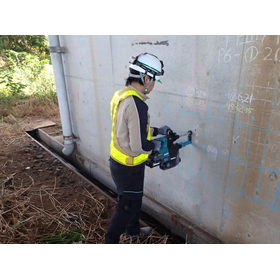
Salt damage investigation is a survey conducted to evaluate whether concrete structures and steel materials are deteriorating due to the effects of salts contained in sea salt and de-icing agents. It is carried out on various structures, primarily focusing on social infrastructure such as bridges, buildings, port structures, and road structures. Our company conducts sample collection using the drill method or core method and quantitatively assesses the penetration of salts by analyzing the amount of chloride ions at different depths. Furthermore, by combining this with rebar detection using electromagnetic radar methods, we can correlate the positions of rebar with the amount of salt, allowing for a more detailed assessment of the progression of salt damage. Additionally, by conducting natural potential measurements and rebar exposure surveys, we can confirm the presence of rebar corrosion and the areas that require repair, providing valuable data for the consideration of maintenance and repair plans.
Added to bookmarks
Bookmarks listBookmark has been removed
Bookmarks listYou can't add any more bookmarks
By registering as a member, you can increase the number of bookmarks you can save and organize them with labels.
Free membership registration
Our company has introduced network-based RTK surveying, which allows for the rapid acquisition of high-precision XYZ coordinates with a single receiver in various public surveying applications. Additionally, point cloud data obtained from laser scanners and autonomously flying drones can be utilized for various purposes, achieving significant labor savings and speed improvements. Please feel free to consult us if you have any requests. 【Collection of Point Cloud Data】 ■ 3D Laser Scanner (GLS-2000) - A device that obtains spatial location information of objects through the reflection of emitted lasers, capable of generating 120,000 points per second. - It can provide high-resolution point cloud data with a minimum pitch of 6.3mm at 10m and 63mm at 100m. ■ Drone (MS06) - Flies along a pre-planned route at a designated speed through autonomous flight. - Creates a single 3D image from hundreds of photos taken, generating point clouds. *For more details, please download the PDF or feel free to contact us.
Added to bookmarks
Bookmarks listBookmark has been removed
Bookmarks listYou can't add any more bookmarks
By registering as a member, you can increase the number of bookmarks you can save and organize them with labels.
Free membership registration