1~7 item / All 7 items
Displayed results
Filter by category

Added to bookmarks
Bookmarks listBookmark has been removed
Bookmarks listYou can't add any more bookmarks
By registering as a member, you can increase the number of bookmarks you can save and organize them with labels.
Free membership registration
Contact this company
Contact Us Online1~7 item / All 7 items
Filter by category

This document explains the risks brought about by the black-box nature of systems and their solutions. It introduces challenges such as the inability to predict the impact range with each modification, as well as methods for visualizing business through data modeling to eliminate dependency on individuals. It also includes information about the "Introduction to Data Model Creation Seminar," which leads to a transition to business operations that do not rely on individuals, so please take a moment to read it. [Contents] ■ No one fully understands the entire system ■ Black boxes can be resolved from the design stage ■ Information on the Introduction to Data Model Creation Seminar to eliminate black boxes *For more details, please download the PDF or feel free to contact us.
Added to bookmarks
Bookmarks listBookmark has been removed
Bookmarks listYou can't add any more bookmarks
By registering as a member, you can increase the number of bookmarks you can save and organize them with labels.
Free membership registration
This document explains the structural issues that cause discrepancies between the field and the system. It includes failure patterns such as creating a system according to requirements that does not fit the field, as well as the visualization of business through data modeling. We also provide information about the "Data Model Creation Introductory Seminar," which aims to eliminate dependency on individuals and enhance flexibility for modifications, so please take a moment to read it. 【Contents】 ■ Why does a "useless system" emerge even when requirements definition is successful? ■ The nature of the structural issues causing discrepancies between the field and the system ■ The key is to accurately identify requirements and reflect them in the system ■ Information about the Data Model Creation Introductory Seminar that leads to successful requirements definition *For more details, please download the PDF or feel free to contact us.
Added to bookmarks
Bookmarks listBookmark has been removed
Bookmarks listYou can't add any more bookmarks
By registering as a member, you can increase the number of bookmarks you can save and organize them with labels.
Free membership registration
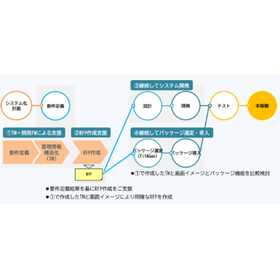
We would like to introduce a case where we consistently supported a food company's core system renewal, utilizing a data model from ERP implementation to data migration. The company required business management that took into account the complex commercial flows unique to the food industry. Since various campaign prices and special pricing significantly impact profits, there was a need for a system that could accurately grasp profit and loss by customer and item, and quickly reflect this in estimates and sales strategies. To address this, we created a data model of the current business operations, visualizing and analyzing the business characteristics and challenges. By designing the improved state as a data model and reflecting it in the RFP, we clarified the requirements and enabled the selection of an appropriate ERP package. Additionally, we improved migration quality and efficiency through data mapping. 【Results and Effects】 - Improved accuracy of vendor proposals and estimate amounts through enhanced RFP precision - Reduced add-on and customization costs with To-Be model and low-code approach - Reduced labor and costs for data migration by utilizing the As-Is model - Enhanced overall project quality and success probability through the visualization of business requirements *For more details, please download the PDF or feel free to contact us.
Added to bookmarks
Bookmarks listBookmark has been removed
Bookmarks listYou can't add any more bookmarks
By registering as a member, you can increase the number of bookmarks you can save and organize them with labels.
Free membership registration
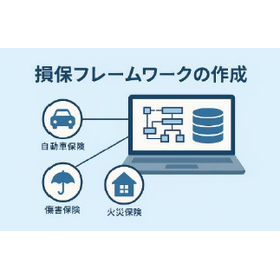
We would like to introduce a case where we rebuilt the insurance contract management system for a property and casualty insurance company and established a framework that allows for the integrated management of multiple products. The company required support for a wide variety of forms and a vast number of management items, as well as the ability to address complex and advanced business requirements. Since individual systems were built for each insurance product, modifications to multiple systems occurred every time there were regulatory or legal changes, resulting in significant development and maintenance costs. To address this, we defined insurance products as a common model and systematized business rules and administrative constraints within a data model. We designed a database that could manage multiple insurance products within a single system and significantly improved development productivity and maintainability by linking model information to low-code tools. [Results and Effects] - Significantly reduced lead time for market introduction of new products - Reduced system maintenance and operational costs - Achieved rapid and efficient responses to regulatory and legal changes - Facilitated easy addition of products and expansion of functions through a common platform *For more details, please download the PDF or feel free to contact us.
Added to bookmarks
Bookmarks listBookmark has been removed
Bookmarks listYou can't add any more bookmarks
By registering as a member, you can increase the number of bookmarks you can save and organize them with labels.
Free membership registration
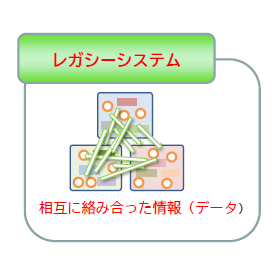
At ITS, by adopting a unique data modeling approach, we solve the challenges inherent in legacy systems while inheriting their benefits and achieving a reconstruction that incorporates new business requirements. Methods for reconstructing legacy systems include rehosting (refreshing only the infrastructure), rewriting (replacing development languages and tools), straight conversion (recompiling in a new language), and rebuilding (reconstructing from scratch). However, we believe these methods are insufficient as means to address the challenges inherent in legacy systems. **Benefits of Model Creation** - Untangles complex information and provides a stable data structure - Inherits strengths from the current system while adapting to new business requirements - Eliminates individual dependency through standardized model creation techniques - The logical model serves as a consistent common blueprint from system construction to maintenance *For more details, please download the PDF or feel free to contact us.*
Added to bookmarks
Bookmarks listBookmark has been removed
Bookmarks listYou can't add any more bookmarks
By registering as a member, you can increase the number of bookmarks you can save and organize them with labels.
Free membership registration
The "Business Analysis Service using Data Model (TM)" ensures comprehensive coverage of the content to be confirmed with users in order to express the relationship between the information managed in the target business and each information repository, thereby reducing rework. Additionally, it leads to centralized management of the same information without multiple management in different locations, enabling efficient utilization of large data within the system. As a result, it contributes to providing users with a high-quality information system. 【Effects】 ■ Accurately express business rules that are difficult to represent in business flows ■ Ensure comprehensive coverage of the content to be confirmed with users to express the relationship between the information managed in the target business and each information repository, reducing rework ■ Centralized management of the same information without managing it in multiple locations ■ Conduct thorough analysis of the As-Is functions without omissions and efficient consideration of the To-Be functions *For more details, please download the PDF or feel free to contact us.
Added to bookmarks
Bookmarks listBookmark has been removed
Bookmarks listYou can't add any more bookmarks
By registering as a member, you can increase the number of bookmarks you can save and organize them with labels.
Free membership registration
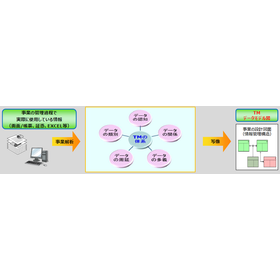
We would like to introduce our "Data Consultation Service." A key point in promoting DX (Digital Transformation) is the establishment of an "information management infrastructure" that enables the utilization of data within the company. At ITS, we use the TM method to conduct data-driven business analysis and visualization, as well as to build the information management infrastructure. This reduces the risk of quality being dependent on individuals while ensuring the consistency of logical data resource management and physical database management within the company, enabling effective data utilization. In supporting our clients' DX initiatives, we contribute to the establishment of the "information management infrastructure" from both logical and physical perspectives. [Features] ■ TM method that enables business analysis, visualization, and the establishment of information management infrastructure - By using the TM method, which has clear rules and procedures as a methodology, we visualize the actual state of the business by mapping it to the TM data model diagram, while expanding the ToBe model to build a stable information management infrastructure that is optimized as a whole. *For more details, please refer to the PDF document or feel free to contact us.
Added to bookmarks
Bookmarks listBookmark has been removed
Bookmarks listYou can't add any more bookmarks
By registering as a member, you can increase the number of bookmarks you can save and organize them with labels.
Free membership registration