1~45 item / All 124 items
Displayed results
Filter by category

Added to bookmarks
Bookmarks listBookmark has been removed
Bookmarks listYou can't add any more bookmarks
By registering as a member, you can increase the number of bookmarks you can save and organize them with labels.
Free membership registration
Contact this company
Contact Us Online1~45 item / All 124 items
Filter by category

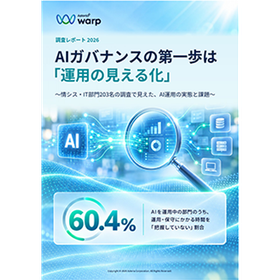
The survey revealed that among 144 respondents currently using AI, 60.4% (87 individuals) are unaware of the monthly operational and maintenance time for their entire department. Additionally, 61.1% (88 individuals) have experienced some issues during AI operations. While the utilization of AI in business is progressing, challenges post-implementation have also come to light, such as costs exceeding expectations, lack of response accuracy, data freshness, and the personalization of operations. This document explains the realities and challenges of AI operations based on survey results from 203 individuals involved in information systems. It highlights the importance of "visualization," which is the first step in AI governance, and introduces improvement approaches utilizing data integration. It also includes a "10-item inspection checklist" to help organizations assess their operational status. *Respondents using AI include those currently in production operations as well as those continuing with PoC and proof-of-concept experiments. Table of Contents 1. Current Status of AI Utilization and Its Foundation 2. The Issues in Operations Are Not Just About AI Accuracy 3. Invisible Operational Burdens 4. Changing Awareness of Challenges in the Operational Phase 5. What Is Required Is "Manageability" 6. Expected Solution Approaches 7. Inspection Checklist for Continuing AI Operations 8. Introduction to ASTERIA Warp
Added to bookmarks
Bookmarks listBookmark has been removed
Bookmarks listYou can't add any more bookmarks
By registering as a member, you can increase the number of bookmarks you can save and organize them with labels.
Free membership registration
With the expansion of delivery services in the food and beverage industry, there is a growing need to centrally manage order data coming from multiple platforms and to smoothly coordinate with cooking and delivery. However, adapting to different API specifications and data formats for each service can become a significant burden in system development and operations. This document explains the basics of Web APIs, typical patterns for inter-SaaS collaboration, and efficient data integration methods using no-code tools, making it useful for companies considering integrated management of order data. 【Use Cases】 - Want to centrally manage order data from multiple delivery services - Want to automatically link order information to the store's POS system or kitchen display - Want to reduce the labor involved in manual order entry and data transcription 【Benefits of Implementation】 - Deepens understanding of system integration specifications, reducing the burden of development and operations - Streamlines the construction of data integration through the use of no-code tools - Enables the establishment of a foundation for data collection with an eye toward AI utilization
Added to bookmarks
Bookmarks listBookmark has been removed
Bookmarks listYou can't add any more bookmarks
By registering as a member, you can increase the number of bookmarks you can save and organize them with labels.
Free membership registration
In the ticket sales operations of the entertainment industry, accurate and rapid data integration between multiple systems, such as sales sites and customer management systems, is required. Particularly in environments where there is a sudden surge in access or a need for real-time understanding of sales conditions, data inconsistencies and delays in integration between systems can lead to lost opportunities. This document explains the basics of Web APIs and outlines integration patterns that efficiently connect SaaS and on-premises systems, introducing methods to reduce the burden of system integration. 【Use Cases】 - Data synchronization between ticket sales sites and customer management systems - Real-time aggregation of sales conditions and data collection for analysis platforms - Expansion of sales channels through API integration with external services 【Benefits of Implementation】 - Reduction of development and operational burdens in data integration between systems - Absorption of differences in API specifications to build a stable data integration foundation - Streamlining data collection for prompt formulation of sales strategies
Added to bookmarks
Bookmarks listBookmark has been removed
Bookmarks listYou can't add any more bookmarks
By registering as a member, you can increase the number of bookmarks you can save and organize them with labels.
Free membership registration
In the energy industry's optimization of power supply and demand, it is essential to quickly and accurately integrate data scattered across various systems and SaaS, including power generation, demand forecasts, and weather data. Particularly in demand adjustment, where real-time capability is emphasized, accommodating different Web API specifications, authentication, and data formats for each service can become a significant burden for system integration. This document explains the basics of Web APIs and the value of data integration, and introduces an efficient approach to data integration using the no-code tool "ASTERIA Warp." 【Use Cases】 - Integration of operational data from power plants and batteries with demand forecasting systems - Improvement of demand forecast accuracy using weather information APIs - Automatic aggregation of power supply and demand data between internal systems and SaaS 【Benefits of Implementation】 - Understanding the mechanism of API integration to streamline data collection between systems - Enabling system construction with reduced development effort through no-code integration - Establishing a data infrastructure and standardizing integration for AI utilization
Added to bookmarks
Bookmarks listBookmark has been removed
Bookmarks listYou can't add any more bookmarks
By registering as a member, you can increase the number of bookmarks you can save and organize them with labels.
Free membership registration
In the tourism industry, there is an increasing trend of utilizing various services such as multiple booking sites and accommodation management systems, and centralizing the management of reservation information is key to improving operational efficiency. However, adapting to the different specifications and data formats of Web APIs for each service can often become a burden for system integration. This document explains the basics of Web APIs, outlines typical data integration patterns between SaaS and on-premises systems, and introduces efficient integration methods using no-code tools. 【Use Cases】 - System integration for centralized management of reservation information from multiple booking sites - Automated data integration between accommodation management systems and external SaaS - Reducing operational burdens through the automation of reservation data collection 【Benefits of Implementation】 - Reduced development and operational burdens in data integration between systems - Achieving accurate and rapid centralized management of reservation information - Optimizing business processes through more efficient data collection
Added to bookmarks
Bookmarks listBookmark has been removed
Bookmarks listYou can't add any more bookmarks
By registering as a member, you can increase the number of bookmarks you can save and organize them with labels.
Free membership registration
In the field of agriculture, the collection of environmental data requires the integration of information obtained from a variety of sources, such as sensors installed in the fields and weather data, into a state that can be utilized for analysis. Particularly when data formats differ between devices from different manufacturers or cloud services, manual aggregation can become a significant burden. This document explains the mechanisms and integration patterns of Web APIs and introduces methods to streamline data integration between systems. 【Use Cases】 - Collection of environmental data such as field sensors and weather data - Data integration between different systems and SaaS - Building an analytical infrastructure using the collected data 【Benefits of Implementation】 - Understanding the mechanisms of data integration reduces the burden of system construction - Improves the efficiency of utilizing collected environmental data - Reduces development effort through integration with no-code tools
Added to bookmarks
Bookmarks listBookmark has been removed
Bookmarks listYou can't add any more bookmarks
By registering as a member, you can increase the number of bookmarks you can save and organize them with labels.
Free membership registration
In the education industry, there is a demand to integrate learning history data scattered across multiple systems, such as Learning Management Systems (LMS) and school administrative systems, to provide education optimized for individual students. However, dealing with different API specifications and data formats for each system often poses a significant burden for data integration. This document explains the basics of Web APIs and the value of data collaboration, and introduces efficient data collection and integration methods using the no-code tool "ASTERIA Warp," as well as collaboration patterns between systems. 【Use Cases】 - Integration of learning data between LMS and school administrative systems - Consolidation of learning history distributed across multiple educational services - Building a data collection infrastructure for learning analytics using AI 【Benefits of Implementation】 - Reduction of integration burdens caused by differences in API specifications for each system - Decrease in development effort through no-code data integration - Promotion of the utilization of educational data through the consolidation of learning history



Added to bookmarks
Bookmarks listBookmark has been removed
Bookmarks listYou can't add any more bookmarks
By registering as a member, you can increase the number of bookmarks you can save and organize them with labels.
Free membership registration
In the real estate industry, the accuracy and immediacy of property information updates across multiple portal sites and internal systems are essential. In particular, accommodating different API specifications and data formats for each service can become a significant burden for system integration. Inappropriate data integration may lead to missed updates or information inconsistencies. This document explains the basics of Web APIs, integration patterns, and efficient data integration methods using the no-code tool "ASTERIA Warp," which can help alleviate the burden of system integration. 【Use Cases】 - Bulk registration and updating of property information on multiple property portal sites - Data synchronization between internal core systems and websites - Data transformation and integration between systems with different API specifications 【Benefits of Implementation】 - Reduction in labor hours required for updating property information - Prevention of input errors and missed updates due to manual work - Standardization of data integration processes between systems
Added to bookmarks
Bookmarks listBookmark has been removed
Bookmarks listYou can't add any more bookmarks
By registering as a member, you can increase the number of bookmarks you can save and organize them with labels.
Free membership registration
In the logistics industry, delivery tracking operations require real-time understanding of delivery status and accurate data sharing with internal systems and external partners. Particularly when data formats differ between multiple delivery hubs or systems, manual data entry and correction can become a burden on operations, posing a risk of delays in tracking information. This document explains the basics of Web APIs and the value of data integration, introducing methods to streamline data collaboration between systems. 【Use Cases】 - API integration between delivery management systems and external delivery service providers - Data integration between internal core systems and web services for delivery tracking - Inter-system collaboration accompanying real-time updates of delivery status 【Benefits of Implementation】 - Automated collection and efficiency of delivery tracking data through API integration - Absorption of differences in data formats between systems, reducing integration burdens - Establishment of a data collection infrastructure in anticipation of AI utilization
Added to bookmarks
Bookmarks listBookmark has been removed
Bookmarks listYou can't add any more bookmarks
By registering as a member, you can increase the number of bookmarks you can save and organize them with labels.
Free membership registration
In the manufacturing industry, smooth data integration between equipment data within factories, core systems, and SaaS is essential to achieve automation and efficiency in production management. In particular, connecting data in a way that is easy to utilize across different systems is crucial for visualizing production status and making quick decisions. However, adapting to different API specifications and data formats for each service often becomes a burden for system integration. This document introduces the basics of Web APIs, solutions to system integration challenges in manufacturing settings, and how to promote data integration using the no-code tool "ASTERIA Warp." 【Use Cases】 - Data integration between production management systems and external SaaS - Data collection between on-premises systems within factories and cloud services - Building a data infrastructure for production forecasting using AI 【Benefits of Implementation】 - Improved efficiency of system integration through understanding the mechanism of Web APIs - Reduced development burden through the use of no-code solutions - Automation of data collection and integration, serving as a foundation for AI utilization
Added to bookmarks
Bookmarks listBookmark has been removed
Bookmarks listYou can't add any more bookmarks
By registering as a member, you can increase the number of bookmarks you can save and organize them with labels.
Free membership registration
In the healthcare industry, smooth data integration between electronic medical record systems and surrounding systems is required to share patient information accurately and quickly. Particularly in environments where systems from different manufacturers and SaaS are mixed, differences in specifications and data formats can become burdensome for integration. This document explains the basics of Web APIs and integration patterns, introducing methods to streamline data collection and integration between systems. 【Use Cases】 - Data integration between electronic medical records and departmental systems - Information sharing between systems within healthcare institutions - Streamlining medical data collection using SaaS 【Benefits of Implementation】 - Understanding the mechanism of Web APIs and challenges during integration - Gaining insights into data integration patterns between systems and guidelines for construction - Reducing operational burdens through the efficiency of data collection and integration
Added to bookmarks
Bookmarks listBookmark has been removed
Bookmarks listYou can't add any more bookmarks
By registering as a member, you can increase the number of bookmarks you can save and organize them with labels.
Free membership registration
In the retail industry, accurate synchronization of inventory information between physical stores and e-commerce sites is essential for improving customer satisfaction and maximizing sales opportunities. However, in an environment with multiple sales channels and systems, adapting to different Web API specifications and data formats for each service becomes a significant burden for system integration. This document explains the basics of Web APIs and outlines integration patterns that efficiently connect SaaS and on-premises systems. It introduces how to automate and streamline data integration between systems using the no-code tool "ASTERIA Warp." 【Use Cases】 - Real-time synchronization of inventory information between physical stores and e-commerce sites - Aggregation and visualization of inventory data scattered across multiple locations - Building a data collection infrastructure for demand forecasting using AI 【Benefits of Implementation】 - Reduction of labor costs and development burden for system integration - Suppression of stockouts and excess inventory through improved accuracy of inventory information - Improvement of operational efficiency through automation of data integration
Added to bookmarks
Bookmarks listBookmark has been removed
Bookmarks listYou can't add any more bookmarks
By registering as a member, you can increase the number of bookmarks you can save and organize them with labels.
Free membership registration
In the financial industry, there is a demand for rapid and secure account integration with external services and internal systems to enhance customer convenience and expand services. However, accommodating different API specifications and authentication methods for each service can become a significant burden in system development and operations. This document explains the basics of Web APIs, data integration patterns between systems, and efficient integration methods using the no-code tool "ASTERIA Warp," supporting the reduction of the burden of system integration and the establishment of a foundation for data utilization. 【Use Cases】 - Account data integration between financial institutions and external services - Integration of customer information between internal systems and SaaS - Automation of data collection that absorbs differences in API specifications 【Benefits of Implementation】 - Improved development efficiency through understanding the mechanisms and challenges of API integration - Reduction of man-hours for system integration through no-code utilization - Establishment of a data collection and integration foundation with an eye toward AI utilization
Added to bookmarks
Bookmarks listBookmark has been removed
Bookmarks listYou can't add any more bookmarks
By registering as a member, you can increase the number of bookmarks you can save and organize them with labels.
Free membership registration
In advancing the business utilization of generative AI, it is important to connect data scattered across internal systems and SaaS in an easily usable form. However, the differing specifications, authentication, and data formats of Web APIs for each service can become a burden for system integration. This document explains the basics of Web APIs and the value of data integration, as well as representative integration patterns between SaaS and on-premises systems, and between SaaS applications. Additionally, it introduces how to utilize API drivers and integration tools, along with the approach to API integration using the no-code data integration tool "ASTERIA Warp." 【Recommended Points】 - Understand the mechanisms of Web APIs and the challenges to consider during integration. - Learn about representative data integration patterns between SaaS and on-premises systems. - Gain insights into streamlining data collection and integration, which serves as the foundation for AI utilization.
Added to bookmarks
Bookmarks listBookmark has been removed
Bookmarks listYou can't add any more bookmarks
By registering as a member, you can increase the number of bookmarks you can save and organize them with labels.
Free membership registration
In administrative agencies, there is a demand for both improving resident services and enhancing operational efficiency, with the automation of application processes being a particularly important issue. However, it is not easy to introduce new digital technologies while maintaining existing legacy systems. When data integration between systems is fragmented, it requires significant effort to input and verify application information, which hinders prompt responses. This document explains the method of "collaborative modernization" with an eye toward utilizing AI while leveraging existing IT assets, and supports the establishment of a foundation for promoting the automation of application processes. 【Usage Scenarios】 - Data integration between internal systems and external application sites - Digitization of application data from paper or PDF and automatic transcription - Aggregation and automation of processing application information across multiple departments 【Benefits of Implementation】 - Building an integration platform without overhauling existing systems, thereby controlling costs - Reducing manual data entry and preventing errors - Accelerating application processing through automated data integration
Added to bookmarks
Bookmarks listBookmark has been removed
Bookmarks listYou can't add any more bookmarks
By registering as a member, you can increase the number of bookmarks you can save and organize them with labels.
Free membership registration
In the tourism industry, there is a demand to enhance customer experience through the analysis of visitor movement patterns. In particular, how to integrate existing reservation systems and facility management systems with new analytical tools and AI is key to accelerating data utilization. When systems are fragmented, it requires significant effort to integrate and analyze data, making it challenging to formulate rapid strategies. This document explains the method of "collaborative modernization," which builds an AI-ready foundation while leveraging existing IT assets, supporting the promotion of tourism digital transformation (DX). 【Usage Scenarios】 - Integration of visitor movement data at tourism facilities with existing customer data - Consideration of congestion alleviation and service improvement using movement analysis data - Establishment of a data integration foundation in an environment where on-premises and SaaS coexist 【Benefits of Implementation】 - Enables the gradual establishment of a data utilization foundation without overhauling existing systems - Improves data integration efficiency between systems through the use of APIs and iPaaS - Connects internal data with generative AI to support the efficiency of analytical tasks
Added to bookmarks
Bookmarks listBookmark has been removed
Bookmarks listYou can't add any more bookmarks
By registering as a member, you can increase the number of bookmarks you can save and organize them with labels.
Free membership registration
In the real estate industry, the integration of a wide range of property data and market information is required to conduct quick and accurate property assessments. Particularly in environments where legacy systems and the latest SaaS coexist, data fragmentation can hinder the speed and accuracy of assessment operations. This document explains the method of "collaborative modernization," which builds an AI-ready foundation while leveraging existing IT assets, and supports the optimization of operations through data integration. 【Use Cases】 - Integration of internal databases necessary for assessments with external market data - Automation of assessment operations using no-code tools - Support for creating property assessment reports utilizing generative AI 【Benefits of Implementation】 - Reducing refresh costs by gradually leveraging existing systems - Decreasing the labor involved in assessment operations through data integration between systems - Improving assessment accuracy by establishing a data foundation with an eye toward AI utilization
Added to bookmarks
Bookmarks listBookmark has been removed
Bookmarks listYou can't add any more bookmarks
By registering as a member, you can increase the number of bookmarks you can save and organize them with labels.
Free membership registration
In the educational field, there is a demand for the provision of "individually optimized" learning tailored to the learners' proficiency levels and characteristics. To achieve this, an environment that can integrate and utilize the data accumulated in the internal systems is essential; however, a complete overhaul of existing systems requires significant costs and time. This document explains the method of "collaborative modernization" to build an AI-ready foundation while leveraging current IT assets. By utilizing APIs and iPaaS, we support the establishment of a foundation for promoting educational DX by optimizing data integration while maintaining the existing environment. 【Usage Scenarios】 - Data integration between internal systems and Learning Management Systems (LMS) - Integration of environments that mix on-premises and cloud services - Establishment of a data foundation for individualized learning support using generative AI 【Benefits of Implementation】 - Reducing refresh costs by gradually utilizing existing systems - Alleviating operational burdens on IT departments through automation of data integration - Acquiring the requirements and practical points for data preparation necessary for AI utilization
Added to bookmarks
Bookmarks listBookmark has been removed
Bookmarks listYou can't add any more bookmarks
By registering as a member, you can increase the number of bookmarks you can save and organize them with labels.
Free membership registration
In the energy industry's supply and demand adjustment operations, rapid and accurate data processing is required to optimize the balance of ever-changing demand and supply. However, many cases are observed where legacy existing systems become bottlenecks, making it difficult to transition to AI utilization and the latest data integration platforms. This document explains the method of "collaborative modernization," which allows for a gradual transition to an AI-ready environment while maintaining existing IT assets, and supports the advancement of supply and demand adjustments. 【Use Cases】 - Supply and demand data integration in environments where on-premises and SaaS coexist - Building an analytical platform that combines existing supply and demand management systems with generative AI - Data integration between systems using APIs and iPaaS 【Benefits of Implementation】 - Risk reduction through gradual renewal leveraging existing systems - Increased efficiency in supply and demand adjustment operations through the establishment of a data integration platform - Optimization of system infrastructure with an eye toward AI utilization
Added to bookmarks
Bookmarks listBookmark has been removed
Bookmarks listYou can't add any more bookmarks
By registering as a member, you can increase the number of bookmarks you can save and organize them with labels.
Free membership registration
In the field of agriculture, precision cultivation requires the integration of multifaceted data such as sensor data, weather information, and growth conditions to achieve efficient cultivation management. In particular, how to link existing management systems with the latest AI technologies is key to improving productivity and optimizing costs. However, a complete overhaul of the system requires significant costs and time, so it is important to adopt an approach that gradually builds an AI-ready foundation while effectively utilizing existing IT assets. This document explains the method of "collaborative modernization" that leverages existing systems and supports the establishment of a data integration infrastructure. 【Use Cases】 - Integration of sensor data with existing cultivation management systems - Linking on-premises data with AI analysis tools in the cloud - Aggregation of farming data distributed across multiple locations and different systems 【Benefits of Implementation】 - Enables the gradual construction of an AI utilization foundation while maintaining existing systems - Improves data integration efficiency between systems through the use of APIs and iPaaS - Visualization of information necessary for precision cultivation through the establishment of a data integration infrastructure
Added to bookmarks
Bookmarks listBookmark has been removed
Bookmarks listYou can't add any more bookmarks
By registering as a member, you can increase the number of bookmarks you can save and organize them with labels.
Free membership registration
In the construction industry's automated design, it is crucial to efficiently connect the vast amount of information accumulated within the company, such as design data and past construction achievements, to AI utilization. However, in an environment where existing on-premises systems and the latest SaaS coexist, data fragmentation often becomes a barrier to AI utilization. This document explains the method of "collaborative modernization," which builds an AI-ready infrastructure while leveraging existing IT assets. By optimizing data integration while minimizing the burden of system renewal, it supports improvements in the accuracy of automated design and operational efficiency. 【Usage Scenarios】 - Situations where you want to integrate existing design management systems with AI tools. - Situations where you want to utilize past drawing data managed on-premises for automated design. - Situations where you want to reduce the burden of data migration associated with system renewal. 【Benefits of Implementation】 - Building a phased AI utilization infrastructure that leverages existing systems. - Improving the efficiency of design operations through automated data integration. - Utilizing specific success stories in system renewal and migration.
Added to bookmarks
Bookmarks listBookmark has been removed
Bookmarks listYou can't add any more bookmarks
By registering as a member, you can increase the number of bookmarks you can save and organize them with labels.
Free membership registration
In the healthcare industry, with the spread of remote diagnosis, there is a demand for the safe and efficient integration of existing in-hospital systems with external networks. In particular, to accurately handle patient medical data and imaging information, it is essential to maintain legacy systems while developing a flexible data infrastructure that anticipates the use of AI. The "Collaborative Modernization" introduced in this document will help mitigate the risks associated with system renewal and gradually transition to an AI-ready environment. 【Usage Scenarios】 - Data integration between existing in-hospital systems and remote diagnosis platforms - Connection between on-premises environments and cloud-based AI diagnostic tools - Integration and utilization of fragmented medical data across departments 【Benefits of Implementation】 - Enables gradual system renewal leveraging existing IT assets - Improves data integration efficiency between systems through API and iPaaS utilization - Acquires key points for defining requirements and developing a data infrastructure with an eye toward AI utilization
Added to bookmarks
Bookmarks listBookmark has been removed
Bookmarks listYou can't add any more bookmarks
By registering as a member, you can increase the number of bookmarks you can save and organize them with labels.
Free membership registration
In the logistics industry, rapid decision-making based on data is required for optimizing delivery routes and improving loading efficiency. However, many existing systems that have been in operation for years have become complex, making it difficult to integrate new AI technologies and external tools. "Collaborative modernization," which connects necessary data to AI and optimization engines without completely overhauling existing systems, is an important approach for promoting logistics digital transformation (DX). 【Use Cases】 - Data integration between delivery management systems and AI optimization engines - Integration of on-premises delivery data with cloud SaaS - Automation of delivery instructions using no-code tools 【Benefits of Implementation】 - Enables gradual system modernization leveraging existing IT assets - Smooth transition to AI utilization through the establishment of a data integration platform - Eliminates fragmentation between systems and supports the efficiency of delivery operations
Added to bookmarks
Bookmarks listBookmark has been removed
Bookmarks listYou can't add any more bookmarks
By registering as a member, you can increase the number of bookmarks you can save and organize them with labels.
Free membership registration
In the retail industry, accurate demand forecasting that captures market changes and consumer trends is crucial for inventory optimization and reducing opportunity loss. However, in complex system environments where on-premises and SaaS coexist, it is often challenging to integrate and utilize the data necessary for AI applications. This document explains the method of "collaborative modernization," which allows for the gradual construction of an AI utilization foundation without completely overhauling existing systems. By utilizing data integration tools to connect internal data with AI, we support the improvement of demand forecasting accuracy. 【Usage Scenarios】 - Demand forecasting that integrates sales data from stores and e-commerce sites with external factor data - Automation of inventory management by linking existing core systems with AI tools - Building an AI analysis foundation using historical sales data from on-premises environments 【Benefits of Implementation】 - Development of a gradual AI utilization foundation that leverages existing systems - Improved demand forecasting accuracy and inventory optimization through data integration - Modernization of IT infrastructure while minimizing risks and costs associated with system overhauls
Added to bookmarks
Bookmarks listBookmark has been removed
Bookmarks listYou can't add any more bookmarks
By registering as a member, you can increase the number of bookmarks you can save and organize them with labels.
Free membership registration
In the financial industry, there is a demand for real-time data analysis and the use of AI to quickly detect increasingly sophisticated fraudulent transactions. However, in environments with complex legacy systems, a complete overhaul is not easy. "Collaborative modernization," which allows for a gradual transition to an AI-ready infrastructure while maintaining existing IT assets, becomes crucial in building a rapid fraud detection system. This document explains a specific approach to connecting internal data and generative AI using the data integration tool "ASTERIA Warp." 【Use Cases】 - Data integration in environments with a mix of on-premises and SaaS - Establishing a data integration platform for fraud detection using AI - Gradual system modernization leveraging existing systems 【Benefits of Implementation】 - Learning how to advance gradual modernization while utilizing existing systems - Understanding key points of system migration through specific corporate case studies - Defining and establishing the requirements for a data integration platform necessary for AI utilization
Added to bookmarks
Bookmarks listBookmark has been removed
Bookmarks listYou can't add any more bookmarks
By registering as a member, you can increase the number of bookmarks you can save and organize them with labels.
Free membership registration
In the manufacturing industry, there is a demand for data-driven predictive maintenance to ensure stable operation of equipment and reduce downtime. In particular, how to integrate existing systems that have been in operation for many years with the latest AI technologies is key to building an efficient maintenance system. "Collaborative modernization," which builds an AI-ready foundation while leveraging existing IT assets without completely overhauling the system, is an effective approach to promoting digital transformation (DX) in manufacturing sites. 【Use Cases】 - Integration of existing equipment data within the factory and AI analysis platforms - Utilization of maintenance data from on-premises environments with AI in the cloud - Data integration between systems using APIs and iPaaS 【Benefits of Implementation】 - Building a phased AI utilization foundation that leverages existing systems - Utilizing concrete success stories in system renewal and migration - Improving the accuracy of predictive maintenance through the establishment of a data integration foundation
Added to bookmarks
Bookmarks listBookmark has been removed
Bookmarks listYou can't add any more bookmarks
By registering as a member, you can increase the number of bookmarks you can save and organize them with labels.
Free membership registration
Although generative AI has been introduced, it does not lead to overall efficiency in operations. The reason for this may be the lack of a system that connects AI outputs to actual business processes. This document explains a method that combines the low-code development tool "WebPerformer" and the no-code data integration tool "ASTERIA Warp" to consider the construction of business systems, data integration between systems, and the utilization of generative AI as a cohesive approach. In addition to processing visualization, maintainability, and support for on-premises and cloud environments, specific use cases such as maintenance support and approval workflow are also introduced. [Recommended Points] - Understand the concept of expanding the use of generative AI from individual work efficiency to organizational business reform. - Recognize the benefits of combining business system development with data integration. - Gain a concrete understanding of the use cases for maintenance tasks and approval processes utilizing generative AI.
Added to bookmarks
Bookmarks listBookmark has been removed
Bookmarks listYou can't add any more bookmarks
By registering as a member, you can increase the number of bookmarks you can save and organize them with labels.
Free membership registration
We want to promote the use of AI, but a complete overhaul of existing systems is difficult. For such companies, we will explain "collaborative modernization," which builds an AI-ready foundation while leveraging current IT assets. We will address challenges in environments where on-premises and SaaS coexist, share modernization case studies from JFE Steel, JAL, and Sakura Color Products, discuss system integration using APIs and iPaaS, and introduce five practical points that IT departments should focus on. Additionally, we will explain an approach that connects internal data with generative AI using the no-code data integration tool "ASTERIA Warp." [Recommended Points] - Understand how to advance gradual modernization while utilizing existing systems. - Learn key points for system renewal and migration from specific corporate case studies. - Understand the requirements and key points for establishing a data integration foundation necessary for AI utilization.
Added to bookmarks
Bookmarks listBookmark has been removed
Bookmarks listYou can't add any more bookmarks
By registering as a member, you can increase the number of bookmarks you can save and organize them with labels.
Free membership registration
In this document, we introduce use cases that enable business efficiency by combining the Bugyo Cloud series and ASTERIA Warp. Examples include registering payroll journal data from the HR payroll system into the Accounting Bugyo, and cases where information acquisition and data linkage for general affairs and HR were conducted using Bugyo Cloud and ASTERIA Warp. Additionally, we also introduce the lineup of ASTERIA Warp products, as well as free trial versions and experience seminars. Please give it a try. [Contents] ■ Registration of journal vouchers in <Accounting Bugyo> ■ Linking employee information and organization in <General Affairs and HR Bugyo> ■ Linking email addresses in <General Affairs and HR Bugyo> ■ Registration of journal vouchers in <Accounting Bugyo> ■ Registration of order slips in <Commerce Bugyo> *For more details, please download the PDF or feel free to contact us.
Added to bookmarks
Bookmarks listBookmark has been removed
Bookmarks listYou can't add any more bookmarks
By registering as a member, you can increase the number of bookmarks you can save and organize them with labels.
Free membership registration
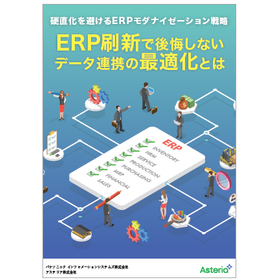
This document is a white paper that thoroughly addresses the pitfalls that are easy to fall into when newly establishing an ERP system, while also getting to the key points of ERP reconstruction that will prevent regrets. It introduces trends related to ERP, the background necessitating composable ERP, and the suitability of "ASTERIA Warp" as a foundation for data integration. Additionally, information on how to apply for a free trial version of "ASTERIA Warp" is also included. Feel free to give it a try. 【Contents】 ■ Trends related to ERP ■ Background necessitating composable ERP ■ Loose coupling through data integration necessary for modernizing core systems ■ Key points for data integration to avoid regrets in ERP renewal ■ Reasons why ASTERIA Warp is suitable as a foundation for data integration ■ Panasonic IS supporting the introduction and utilization of ASTERIA Warp *For more details, please download the PDF or feel free to contact us.
Added to bookmarks
Bookmarks listBookmark has been removed
Bookmarks listYou can't add any more bookmarks
By registering as a member, you can increase the number of bookmarks you can save and organize them with labels.
Free membership registration
This document is a report on the "Actual Condition Survey on Modernization" conducted by Nikkei Cross Tech Active in February 2025, sponsored by our company. It summarizes the legacy systems currently in use and their challenges, the approaches being considered for transitioning to new systems, the challenges faced during the transition, and the cloud ERP systems planned for implementation or already implemented, organized by category. Additionally, it includes an introduction to "ASTERIA Warp," which allows for easy data integration with over 100 types of systems through no-code development. [Contents] ■ Overview of the Implementation ■ Respondent Attributes ■ Actual Condition Survey on Modernization ■ Attribute Information × Actual Condition Survey on Modernization <Cross Tabulation> ■ Summary *For more details, please download the PDF or feel free to contact us.
Added to bookmarks
Bookmarks listBookmark has been removed
Bookmarks listYou can't add any more bookmarks
By registering as a member, you can increase the number of bookmarks you can save and organize them with labels.
Free membership registration
This document is a white paper that considers what is necessary for creating an environment aimed at realizing the concept of hyperautomation. We introduce "ASTERIA Warp" as a no-code tool that allows flexible integration between systems required for hyperautomation. Various integration case studies are also included. As you work towards creating an environment for achieving hyperautomation, why not consider "ASTERIA Warp"? 【Contents】 ■ Challenges in automation and efficiency within companies ■ What hyperautomation as a solution entails ■ Misguided approaches to achieving hyperautomation ■ The presence of no-code tools as a strong option ■ ASTERIA Warp's contribution to automating a wide range of business processes ■ Achievements in hyperautomation with ASTERIA Warp *For more details, please download the PDF or feel free to contact us.
Added to bookmarks
Bookmarks listBookmark has been removed
Bookmarks listYou can't add any more bookmarks
By registering as a member, you can increase the number of bookmarks you can save and organize them with labels.
Free membership registration
This document is a white paper that thoroughly explains the mechanisms, benefits, effective usage, and selection points of the data integration tool "iPaaS." It begins with an explanation of EAI/ETL, which are representative data integration tools, and introduces "ASTERIA Warp Cloud," the iPaaS of ASTERIA Warp. It is suitable for companies that want to use it flexibly, as it allows for the construction and operation of on-premises data integration and infrastructure. [Contents] ■ The necessity of data integration is increasing in multi-cloud environments ■ Conducting data integration in-house poses significant burdens and risks ■ EAI/ETL tools that enable data integration and consolidation ■ Features and benefits of iPaaS ■ Selection points for iPaaS ■ ASTERIA Warp's iPaaS "ASTERIA Warp Cloud" *For more details, please download the PDF or feel free to contact us.
Added to bookmarks
Bookmarks listBookmark has been removed
Bookmarks listYou can't add any more bookmarks
By registering as a member, you can increase the number of bookmarks you can save and organize them with labels.
Free membership registration
This document is a white paper that outlines the essential points needed for on-site digital transformation (DX) and the suitable mobile applications to achieve it. It introduces reasons why DX is not progressing, specific methods for realizing on-site DX, an overview of the no-code tool "Platio," and case studies of its implementation. By swiftly realizing on-site DX, the overall DX of the organization will also be promoted. We hope you will read this and utilize it for improving your company's operations and digitalization. 【Contents】 ■ What is on-site DX ■ Tools suitable for on-site DX ■ Original on-site applications created with no-code ■ Reasons why on-site DX succeeds with no-code ■ Examples of on-site DX made possible by no-code ■ Summary: Three essential points for on-site DX *For more details, please download the PDF or feel free to contact us.
Added to bookmarks
Bookmarks listBookmark has been removed
Bookmarks listYou can't add any more bookmarks
By registering as a member, you can increase the number of bookmarks you can save and organize them with labels.
Free membership registration
This document is a white paper that explains the company-wide business foundation realized by "ASTRIA Warp × ServiceNow." It provides an overview of the core platform "ServiceNow," which is responsible for standardizing IT operations and integrating business processes, as well as the role of "ASTERIA Warp," which is the key to making business "integration" a reality. It also introduces the free trial experience of "ASTERIA Warp." 【Contents (partial)】 ■ Executive Summary & Background ■ Structural challenges hindering DX promotion and three perspectives from the field ■ Essential perspectives and conditions for a fundamental business reform ■ What is ServiceNow ■ The implementation capabilities of business transformation brought by ServiceNow *For more details, please download the PDF or feel free to contact us.
Added to bookmarks
Bookmarks listBookmark has been removed
Bookmarks listYou can't add any more bookmarks
By registering as a member, you can increase the number of bookmarks you can save and organize them with labels.
Free membership registration
This document is a white paper that explains the data integration necessary for building a foundation with "Salesforce Data Cloud." In addition to an overview of CDP and the features of "Salesforce Data Cloud," it includes how to utilize "ASTERIA Warp" as an approach for integrating with external data sources. You can also check the implementation support menu provided by SI&C. 【Contents (partial)】 ■ From building a foundation with Salesforce to the phase of utilizing accumulated data ■ What is CDP? ■ Data utilization approach "Salesforce Data Cloud" ■ About Salesforce Data Cloud ■ Approaches for peripheral systems that are not integrated *For more details, please download the PDF or feel free to contact us.
Added to bookmarks
Bookmarks listBookmark has been removed
Bookmarks listYou can't add any more bookmarks
By registering as a member, you can increase the number of bookmarks you can save and organize them with labels.
Free membership registration
This document is a collection of case studies featuring numerous examples of the mobile app creation tool "Platio." It introduces specific use cases across a wide range of industries, including manufacturing, services, construction, transportation and logistics, accommodation and dining, retail and wholesale, information and communication, public sector and others, as well as healthcare. The document is filled with useful information for solving on-site challenges such as traceability, inventory management, delivery management, and hygiene management. 【Featured Case Studies (Partial)】 ■ Traceability (Kakuichi) ■ Inventory Management (Kyocera) ■ Inbound and Outbound Management (J-Mate Copper Products) ■ Work Reports/Shipping Management (Nabtesco) ■ DX/Business Improvement (LIMNO) ■ Business Requests/Reports (Air Serve) *For more details, please download the PDF or feel free to contact us.
Added to bookmarks
Bookmarks listBookmark has been removed
Bookmarks listYou can't add any more bookmarks
By registering as a member, you can increase the number of bookmarks you can save and organize them with labels.
Free membership registration
"Platio" is a cloud service that allows anyone to easily create and utilize mobile applications tailored to their business needs. It promotes the digitization of business operations and streamlines processes that previously relied on manual labor. The created applications can be used on-site immediately after distribution. Data inputted by on-site personnel through the app is stored in the cloud and shared in real-time, enabling timely understanding of the on-site situation. 【Features】 ■ Diverse data input formats ■ Mobile-first ■ Offline support ■ Security ■ Low cost *For more details, please download the PDF or feel free to contact us.
Added to bookmarks
Bookmarks listBookmark has been removed
Bookmarks listYou can't add any more bookmarks
By registering as a member, you can increase the number of bookmarks you can save and organize them with labels.
Free membership registration
This document explains the appeal of the mobile app creation tool "Platio" through a manga format. It clearly introduces points such as the ability to easily create a mobile app tailored to your business without coding, starting with zero initial investment, and recommendations for administrators. It also includes information about free trials and mobile app creation experience seminars. Please download and take a look. [Contents] ■ Introduction manga for "Platio" ■ Experience it for free right now ■ Mobile app creation experience seminar *For more details, please download the PDF or feel free to contact us.
Added to bookmarks
Bookmarks listBookmark has been removed
Bookmarks listYou can't add any more bookmarks
By registering as a member, you can increase the number of bookmarks you can save and organize them with labels.
Free membership registration
This document is a manga explaining the DX tool "Platio Connect," which connects the IT department and the field. It clearly introduces features that allow anyone to easily create apps and data integration functions that link apps with internal systems. There are also many examples of mobile app and data integration usage, such as inventory apps linked with core systems/ERP and business report apps linked with Excel. [Contents] ■ Introduction manga for "Platio Connect" ■ What you can do with "Platio Connect" ■ Examples of mobile apps × data integration *For more details, please download the PDF or feel free to contact us.
Added to bookmarks
Bookmarks listBookmark has been removed
Bookmarks listYou can't add any more bookmarks
By registering as a member, you can increase the number of bookmarks you can save and organize them with labels.
Free membership registration
This document introduces usage patterns that combine "kintone" and "ASTERIA Warp." Based on direct interviews with users, it presents seven usage patterns with high combinatory effects, along with specific examples. You can also find information about the product lineup, free trial versions, and free experience seminars. 【Contents (partial)】 ■ kintone × Integration with core systems and cloud services ■ Utilizing kintone as a front-end UI and integrating with other systems ■ Inter-app integration within kintone ■ kintone × Excel integration ■ kintone × Mobile app integration ■ Report output from kintone apps *For more details, please download the PDF or feel free to contact us.
Added to bookmarks
Bookmarks listBookmark has been removed
Bookmarks listYou can't add any more bookmarks
By registering as a member, you can increase the number of bookmarks you can save and organize them with labels.
Free membership registration
This document introduces examples of automating routine Excel tasks using "ASTERIA Warp Core." It includes specific use cases in four categories: file collection and processing, report creation, information sharing, and order processing. You can also find information about the ASTERIA Warp product lineup, as well as free trial versions and free trial seminars. [Contents] ■ File collection and processing ■ Report creation ■ Information sharing ■ Order processing ■ ASTERIA Warp product lineup *For more details, please download the PDF or feel free to contact us.
Added to bookmarks
Bookmarks listBookmark has been removed
Bookmarks listYou can't add any more bookmarks
By registering as a member, you can increase the number of bookmarks you can save and organize them with labels.
Free membership registration
This document is a white paper introducing "in-house production," which is the key to realizing DX (Digital Transformation). It covers the barriers to promoting DX, the advantages and disadvantages of outsourcing, the importance of no-code tools, and the necessity of backend tools. Additionally, it introduces the data integration tool "ASTERIA Warp" and presents case studies of companies that have achieved in-house production through no-code development. 【Contents (partial)】 ■ In-house production in DX ■ Barriers to promoting DX ■ Advantages and disadvantages of outsourcing ■ The recommendation of in-house production × no-code ■ The importance of no-code ■ Introduction of case studies that achieved in-house production *For more details, please download the PDF or feel free to contact us.
Added to bookmarks
Bookmarks listBookmark has been removed
Bookmarks listYou can't add any more bookmarks
By registering as a member, you can increase the number of bookmarks you can save and organize them with labels.
Free membership registration
This document is a white paper that explains the requirements for data integration necessary for promoting DX (digital transformation) and the methods of integration. It includes six key points for organizing the requirements to successfully achieve data integration, as well as practical examples based on actual corporate cases. The paper also discusses suitable approaches after organizing the advantages and disadvantages of three main methods: scratch development, RPA, and EAI tools. 【Contents (partial)】 ■ The importance of data integration ■ Organizing requirements for successful data integration ■ Practice: Advancing requirement organization ■ Three main methods of data integration ■ EAI tools that enable easy inter-system integration ■ Selection of data integration tools *For more details, please download the PDF or feel free to contact us.
Added to bookmarks
Bookmarks listBookmark has been removed
Bookmarks listYou can't add any more bookmarks
By registering as a member, you can increase the number of bookmarks you can save and organize them with labels.
Free membership registration
This document is a white paper introducing ways to utilize "ASTERIA Warp" in combination with Box. It includes specific use cases such as automatic management of delivery notes and invoices, compliance with electronic bookkeeping laws, and automation of folder creation and account provisioning. Additionally, you can also check the features of the Box adapter, options for obtaining shared links, and the product lineup of ASTERIA Warp. 【Contents (partial)】 ■ Expanding Box utilization through data integration ■ Use Case 1: Automatically manage documents such as delivery notes and invoices in Box ■ Use Case 2: Automate business processes from electronic storage to metadata assignment ■ Use Case 3: Automate folder creation and account provisioning ■ Use Case 4: Prevent information leaks caused by operational errors or malicious actions ■ Use Case 5: Automate the migration from local file servers to Box *For more details, please download the PDF or feel free to contact us.
Added to bookmarks
Bookmarks listBookmark has been removed
Bookmarks listYou can't add any more bookmarks
By registering as a member, you can increase the number of bookmarks you can save and organize them with labels.
Free membership registration